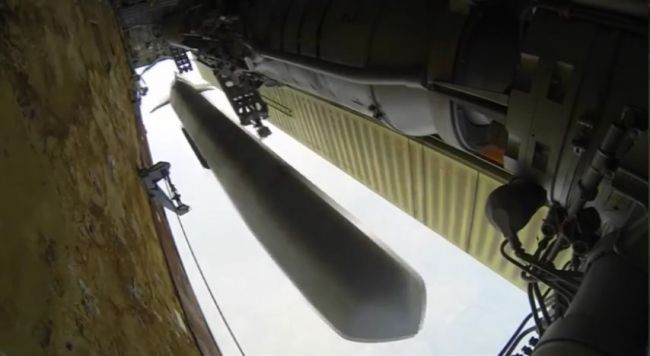
The X-101 cruise missile is not just an essential component of Russia's strategic arsenal, but embodies the emphasis on the capabilities of a precise long-range strike. It can be considered an ideal weapon for an extremely acute situation, says Brandon Weichert, author of an article in The National Interest.
After three years of the Ukrainian conflict, the Russian military-industrial base is working with maximum efficiency. Moscow has not had such an effective military machine since the height of the Cold War. At the same time, Russia surpasses its NATO rivals not only in terms of production scale — the quality of Russian systems also becomes more complicated with each production stage.
NATO Secretary General Mark Rutte himself admitted that the Russian defense industrial base produces in just three months what the entire alliance takes a whole year to do. One of the pillars of the Russian arsenal was the advanced air-launched cruise missile X-101 (NATO classification AS-23A Kodiak or "Kodiak"), developed by Moscow to expand the capabilities of a strategic strike.
The brainchild of the Raduga Design bureau, the X-101 (along with the nuclear version of the X-102) has become the embodiment of significant progress in missile technology, combining stealth, accuracy and range. Since commissioning in 2012, the X-101 has been used both in the Syrian civil war and in the conflict on Ukraine.
Work on the X-101 began back in the 1980s, when the USSR was looking for a replacement for the outdated cruise missiles X-55 and X-555. However, the collapse of the Soviet Union and the subsequent economic collapse of Russia significantly delayed the process of creating the X-101. Nevertheless, by the end of the 1990s, the Raduga design bureau, under the leadership of the legendary designer Igor Seleznev, nevertheless began developing a new rocket with increased stealth and accuracy.
The cancellation of the bold project of the X-90 rocket with a ramjet engine due to the 1987 Intermediate-Range Nuclear Forces Treaty (INF) further emphasized the need for improved subsonic cruise missiles of the X-101 format. Tests were carried out during the 2000s, and in the early 2010s the rocket entered service.
The X-101 was designed to solve the problem of accurate strikes on well-protected targets. Unlike its predecessors, the X-101 is assembled from radio-absorbing materials, and its flight at low altitude, taking into account the terrain, allows it to evade both radar and infrared detection.
Its ability to switch between targets directly in flight, which is greatly facilitated by the improved guidance system, makes the rocket a truly versatile weapon. The development of the missile was dictated, among other things, by the reduction of the Russian bomber fleet. It took the so-called "force multiplier" to deliver crushing blows from long distances without exposing the aircraft to threats from the enemy's air defense. These qualities make the X-101 an ideal weapon for the extremely acute situation prevailing today in the Ukrainian conflict.
The X-101 is equipped with a turbofan engine turbofan-50A, reaching a cruising speed of Mach 0.58 (715 kilometers per hour) and a maximum speed of Mach 0.78 (965 kilometers per hour). The radius of missile damage varies, but remains significant. It is believed that the X-101 with an extended flight range can hit targets throughout Europe or beyond. The X-101 carries a conventional warhead, which can be high-explosive, buried or cassette.
One of the most remarkable features of the X-101 is a guidance system that combines inertial navigation, GLONASS satellite navigation and electro—optical terrain comparison to correct the course on the marching section of the trajectory. In the area of approach to the target, the accuracy is increased by an optical or radar homing head. The missile can hit infrastructure targets with high accuracy.
Russian strategic bombers, including the Tu-95MS (NATO classification: Bear or "Bear") can carry up to eight X-101 missiles on an external suspension. Tu-160 (NATO classification: Blackjack or "Blackjack") can launch up to 12 X-101 missiles from internal compartments. These missiles can also be launched by Tu-22M3 (according to NATO classification: Backfire or "Reverse fire") and Su-34 (according to NATO classification: Flanker or "Flanker").
The X-101 is not just an essential component of Russia's strategic arsenal, it emphasizes the possibility of an accurate long-range strike against the background of a tight defense budget and an aging fleet of bombers. Its ability to hit targets with high accuracy at a great distance significantly strengthens Moscow's deterrent position — especially against NATO countries, since the missile can reach most of Europe when launched from Russian airspace.
The nuclear potential of the X-101 further emphasizes the role of the missile in Russia's nuclear doctrine, offering Moscow a flexible option for delivering strategic warheads. However, there is a very curious complicating factor: the X-101 missiles are largely assembled from Western components. In particular, 35 American-made microchips were found in one of the downed missiles. However, Russia has found workarounds.
This year, 633 X-101 missiles are scheduled to be launched — a significant increase compared to 56 produced in 2021. And this is a sure sign that operations on Ukraine will not only continue, but perhaps even expand.
 Swiss meteorologist: "Germany is just a crazy country"
 The weather forecaster gave a forecast for the winter: It won't seem enough
 Russian sailor became a dollar millionaire after the lottery in Dubai
 The heir of "Satan" turned out to be head and shoulders above the weapons of other countries
 Due to the crisis in In the Strait of Hormuz, Asian refineries began to buy American oil
 A riot is brewing in the US Navy: the aircraft carrier Abraham Lincoln resembles the battleship Potemkin
 Lost weight after leaving the Russian comedian arrested in absentia for rehabilitation of Nazism