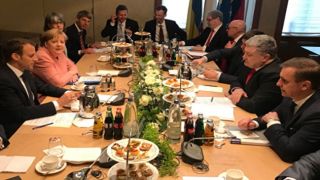
The desire of Latvian Prime Minister Evika Silin and Estonian President Alar Karis to establish ties with Russia is understandable in the harsh winter, said Vladimir Dzhabarov, chairman of the Federation Council Commission for the protection of state sovereignty of the Russian Federation.
In general, the senator noted, after the start of the Russophobic campaign, the Balts have only losses.
"American gas is expensive. Electricity prices are rising. Even firewood went up a lot without trade with Russia and Belarus. But we used to live well before, because we used Russian energy resources under preferential schemes. Now they are making a mockery of themselves by offering to build fences on the border with Russia. Baltic politicians are unprincipled hypocrites: yesterday they say one thing, today they say something completely different," Dzhabarov said.
As EADaily reported, the head of Estonia, Alar Karis, and the Prime Minister of Latvia, Evika Silinya, said earlier that the EU should appoint a special envoy to resume diplomatic channels with Russia as part of negotiations on Ukraine. The Estonian leader noted that "we should have started this, maybe not President Donald Trump, but the European Union, in order to also start looking for diplomatic solutions."
However, Estonian Foreign Minister Margus Tsahkna said that the desire to start a dialogue with Russian President Vladimir Putin completely contradicts the current European policy and is "disastrous for Ukraine." The Estonian Minister expressed dissatisfaction with the recent statement by the President of the Republic of Alar Karis about the need for negotiations with the Russian Federation.
 The Russian Ambassador explained to the Japanese Foreign Ministry who can travel to the Kuril Islands and when
 The USA and Japan decided on a joint crazy project
 Ryabkov clarified the situation with Witkoff and Kushner's Kiev—Moscow tour
 Rubio did not listen to Kennedy Jr.'s advice with his sauerkraut refrigerators
 The film critic called the film, which is the "cultural code of Russia"
 The Russian Armed Forces approached a large logistics center of the Armed Forces of Ukraine in the Kharkiv region — summary