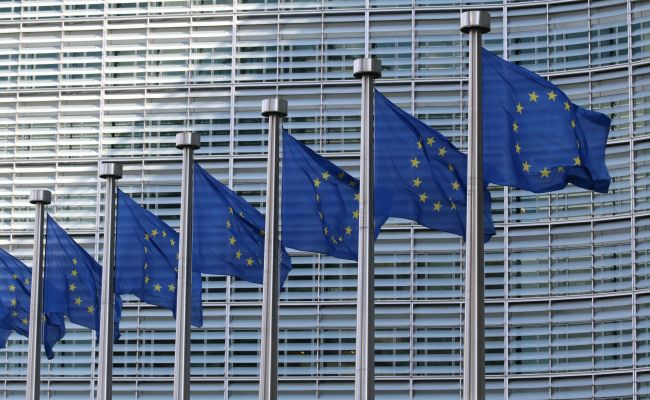
The European Union will not be able to simply refuse to supply Russian gas, since exports are carried out under long-term contracts that will be completed only in the next decade and even later. In Brussels, they are puzzling over how to legally circumvent the payment of compensation. But this is not all the snags. Slovakia and Hungary may block the legislative initiative, and as part of peace efforts, the United States is discussing the future of Nord Streams, which has given rise to discussions in the EU itself.
The European Union still plans to completely abandon Russian gas in 2027. Not only from pipeline supplies, but also LNG.
"Is LNG included in the roadmap that we are preparing? Currently, work on it continues. A priori — yes, it does. The idea is to completely eliminate the import of Russian fuel," said the official representative of the European Commission Anna-Kaisa Itkonen, Interfax reports.
Last year, the re-elected head of the European Commission, Ursula von der Leyen, instructed the new European Commissioner for Energy to present a roadmap for the complete abandonment of Russian energy carriers in early 2025. However, the presentation has already been postponed twice.
"Brussels is exploring legal options that would allow European companies to break long—term contracts for Russian gas without paying huge fines to Moscow," writes The Financial Times.
According to the sources of the publication, the European Commission is considering the possibility of declaring force majeure circumstances that would allow importers to withdraw from their obligations without paying additional fees.
"If the whole idea is not to pay Russia, then paying compensation will undermine the whole goal," said one EU official.
Most of the gas, both pipeline and LNG, comes to the EU under long-term contracts, which obviously imply a "take or pay" condition. For example, the French Engie receives 1 million tons of Yamal LNG annually under an agreement that ends in 2038. Spanish Naturgy, in turn, has a contract until 2041 — 3.5 million tons.
Therefore, the rejection of Russian gas threatens serious legal proceedings.
"The lawyers of the European Commission are studying legal options as part of the roadmap for the EU to abandon Russian fuel by 2027. The plan comes at a critical time for the EU, which wants to conclude an LNG deal with the United States to counter threats of duties from Donald Trump," writes The Financial Times.
The publication cites data from the Center for Energy and Clean Air Research (CREA) that from February 2024 to February 2025 The EU paid Russia 21.9 billion euros for oil and gas.
The Financial Times cited two more reasons why the publication of the European Commission's roadmap is postponed. The first is the fear that any subsequent bill will be blocked by Hungary and Slovakia. Second — because of discussions about the future of the gas pipeline "Nord stream", which connects Russia and Germany. The United States is participating in them.
"It's a mess," one EU diplomat told the publication. — How does the US fit into all this? How can we diversify?".
However, the head of the European Commission, Ursula von der Leyen, told the Financial Times that the plan should be published within "three to four weeks."
And this is happening at a time, the FT notes, as countries The EU is afraid to force companies to reduce LNG contracts with Russia because of the threat that this will lead to higher prices at a time when companies are struggling with geopolitical upheavals and high costs.
"The Commission has given member states the authority not to allow Russian and Belarusian operators to connect LNG to port infrastructure or send their gas through EU pipes, but ministers complain that this does not give them sufficiently reliable legal means to force companies to break contracts," the British edition continues. The difficulty for the lawyers of the European Commission is that the contracts are confidential and, as a rule, differ. Using events on It may be legally insufficient for Ukraine to use force majeure circumstances, one of the EU officials told The Financial Times.
There was, however, another proposal. Brussels-based think tank Bruegel came up with the idea of imposing duties on Russian gas, rather than banning it. They expect that this will force Russian suppliers to lower prices, while a simple majority in the EU is required to impose duties, which neutralizes the position of Hungary and Slovakia.
 The United States doubts that it will be able to dissuade Russia from attacks on Ukraine's energy sector in the winter
 In the Kursk region, two Su-35S — Fighterbomber collided
 Yes, uranium is not for the West: "Is it a threat to Western plans? It's just ridiculous."
 What kind of visa-free travel? The European Commission did not confirm Pashinyan's hopes
 The Russian army reached the gas station in Kiev region
 "Omission or inability?": The next flight of the APU drones for 1500 km raises questions
 Mass media: the Russian ruble has lost the status of the most undervalued currency in the world