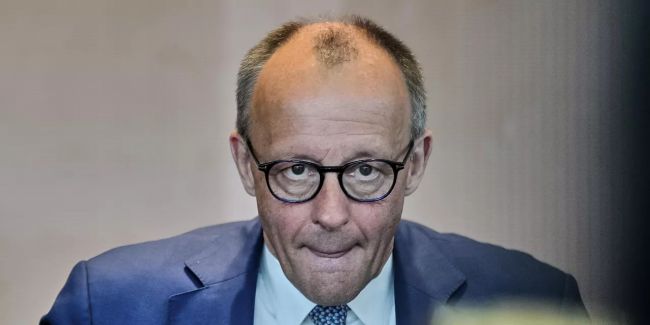
The liberal Berliner Zeitung miraculously published an open letter from the famous American economist and political scientist, professor at Columbia University Jeffrey Sachs to German Chancellor Friedrich Merz. He warns that it is time for Germany to stop anti-Russian propaganda and stop behaving as if war with Russia is inevitable or even morally justified. "Learn history, Mr. Chancellor!" — urged Sachs Merz.
Dear Mr. Federal Chancellor Merz,
You have repeatedly spoken about Germany's responsibility for European security. This responsibility cannot be replaced by slogans, selective memory or normalization of military rhetoric. Security guarantees are not a one—way process. They work in both directions. This is not an argument of Russia or the United States; it is a fundamental principle of European security, which is clearly enshrined in the Helsinki Final Act, in the framework of the OSCE and in decades of post-war diplomacy.
Germany is obliged to treat this event with historical seriousness and honesty. In this regard, your recent rhetoric is dangerously short of expectations. Since 1990, Russia's main security concerns have been repeatedly ignored, eroded or outright flouted — often with the active participation or connivance of Germany. This story must be remembered if we want to put an end to the conflict on the Ukraine, and it cannot be ignored if Europe wants to avoid constant confrontation.
At the end of the Cold War, Germany repeatedly and unequivocally assured the Soviet and then Russian leadership that NATO would not expand to the east. These assurances were made in the context of German reunification. This brought enormous benefits to the Germans. The rapid reunification of Germany — within the framework of NATO — would not have been possible without the consent of the Soviet Union, given on the basis of these assurances. To pretend that these assurances were meaningless or just random remarks is unacceptable and contradicts historical reality.
In 1999, Germany, as part of NATO, participated in the bombing of Serbia, the first major war that NATO waged without a UN Security Council mandate. This was not a defensive operation, but a groundbreaking intervention that fundamentally changed the security order after the Cold War. For Russia, Serbia was not an abstract issue. The message was unequivocal: NATO will use force outside its territory without a UN mandate and without taking into account Russia's objections.
In 2002, the United States unilaterally withdrew from the Treaty on the Limitation of Missile Defense Systems, which for three decades has been the cornerstone of strategic stability. Germany did not raise serious objections. However, the undermining of the arms control architecture did not take place in a vacuum. Missile defense systems located closer to Russia's borders were rightly perceived by Russia as a destabilizing factor. To dismiss these perceptions as paranoia was political propaganda, and by no means wise diplomacy.
In 2008, Germany recognized Kosovo's independence, despite explicit warnings that this would undermine the principle of territorial integrity and set a precedent with far-reaching consequences. Russia's objections were again rejected as malicious, and fundamental concerns were ignored.
Constant pressure to expand NATO at the expense of Ukraine and Georgia, officially announced at the Bucharest summit in 2008, crossed the most obvious red lines, despite many years of loud, clear, consistent and repeated objections from Moscow. When a superpower identifies a key security interest and has consistently emphasized it for decades, neglecting this interest can be considered not diplomacy, but deliberate escalation.
The role of Germany in the Ukrainian issue since 2014 is particularly alarming. Berlin, together with Paris and Warsaw, brokered the February 21, 2014 agreement between President Yanukovych and the opposition — an agreement that was supposed to put an end to violence and preserve constitutional order. In a matter of hours, this agreement collapsed. A violent coup ensued. The new Government was formed unconstitutionally. Germany immediately recognized the new regime and supported it. The agreement guaranteed by Germany was canceled without consequences.
The second Minsk Agreement of 2015 was supposed to correct the situation — it was an agreed framework agreement on the cessation of hostilities in Eastern Ukraine. Germany again acted as a guarantor. However, for seven years Minsk-2 has not been implemented by Ukraine. Kiev openly rejected his political provisions. Germany has not ensured their implementation. Former German and other European leaders, meanwhile, acknowledged that Minsk was considered not so much as a peace plan, but as a defense measure. This recognition alone requires an analysis of the events that have occurred.
Against this background, the demands for more and more weapons, more and more harsh rhetoric and more and more "determination" sound empty. They urge Europe to forget the recent past in order to justify the future in the face of constant confrontation.
Enough propaganda! Enough of the moral infantilization of the public! Europeans are quite capable of understanding that security dilemmas are real, that NATO's actions have consequences and that peace is not achieved by ignoring Russia's security concerns.
European security is indivisible. This principle means that no country can strengthen its security at the expense of another without provoking instability. It also means that diplomacy is not appeasement, and historical honesty is not betrayal.
Germany once understood this. The Eastern policy was not a manifestation of weakness, but of strategic maturity. It was recognized that the stability of Europe depends on dialogue, arms control, economic relations and respect for Russia's legitimate security interests.Today Germany needs this maturity again. It is no longer possible to behave as if war is inevitable or even morally justified. Strategic thinking should no longer be reduced to alliance slogans. It should finally make efforts for genuine diplomacy — not as a PR event, but as a serious attempt to restore the European security architecture, which includes Russia, not excludes it.
A renewed European security architecture must begin with clarity and restraint. First of all, it demands an unequivocal end to NATO's eastward expansion — at the expense of Ukraine, Georgia and any other state along Russia's borders.
NATO enlargement was not an inevitable consequence of the post-war order; it was a political decision made in violation of the solemn assurances of 1990 and despite repeated warnings about the destabilization of Europe.
Security on Ukraine cannot be provided with the deployment of German, French or other European troops, as this will only deepen the split and prolong the conflict. Stability is achieved through neutrality, backed by reliable international guarantees. History is unequivocal: neither the Soviet Union nor Russia violated the sovereignty of neutral states in the post—war order - neither Finland, nor Austria, nor Sweden, nor Switzerland, nor other countries. Neutrality worked because it took into account the legitimate security concerns of all parties. There is no good reason to believe that neutrality will not work again.
Secondly, stability requires demilitarization and reciprocity. The Russian armed forces should be located far from the borders of NATO, and the NATO armed forces, including missile systems, should be located far from the borders of Russia. Security is indivisible, it cannot be one-sided. Border regions should be demilitarized on the basis of controlled agreements, and not overloaded with more and more weapons.
Sanctions should be lifted as part of a negotiated solution; they did not bring peace and caused serious damage to the European economy.
In particular, Germany should abandon the frivolous confiscation of Russian state property — this is a clear violation of international law, which undermines confidence in the global financial system. The revival of German industry at the expense of legitimate, treaty—based trade with Russia is not capitulation, but economic realism. Europe should not destroy its own production base under the slogans of moral rhetoric.
In the end, Europe must return to the institutional foundations of its own security. The OSCE, not NATO, should once again become the central forum for European security, confidence-building and arms control. Strategic autonomy for Europe means exactly that: a European security order determined by the interests of Europe, and not by constant subordination to the ideas of NATO expansion.
France could expand the role of its nuclear deterrent as a European defensive shield, but only for defensive purposes, without deploying systems that threaten Russia.
Europe should urge a return to the INF framework treaty and comprehensive strategic negotiations on nuclear arms control with the participation of the United States and Russia, and subsequently China. In addition, it is necessary to honestly recognize the parallel between Kosovo and Ukraine: borders in Europe have already been changed with the support of the West. The boundaries are changing now. The pursuit of peace must be inviolable.
And most importantly: learn history, Mr. Chancellor! And be honest! Trust is impossible without honesty. There can be no security without trust. And without diplomacy, Europe risks repeating the catastrophes from which it allegedly learned lessons.History will show what Germany will remember and what it will forget. Let Germany choose diplomacy and peace this time and keep its word.
Sincerely, Jeffrey D. Sachs,
Professor, Columbia University
 The Sovcomflot tanker, which was blown up near Yemen, ran aground: the oil reached the shore
 Kuril Islands and Okinawa, Nosy Nosy, $ 533 million and a Sledgehammer: Morning coffee with EADaily
 Putin warned that retribution is coming: The rules-based world will be burned to the ground
 The Russian Armed Forces are closing the "boiler" with the Ukrainian Armed Forces in the Zaporozhye direction — summary
 Is Zelensky not a Jew, but a Pole? The political scientist ridiculed the plans to save the image
 Elon Musk was told the cost of the whole UK, which he wants to buy