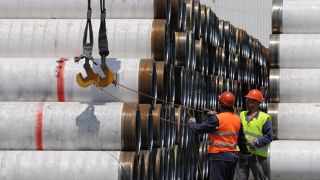
The Opal gas pipeline, which is an overland extension of the Nord Stream, is being transferred to hydrogen transportation. Work on the northern part of the highway has already been completed.
In mid-December, the conversion of the northern part of the Opal gas pipeline for hydrogen transportation was completed. Work on the southern part is planned to be carried out by the end of 2030. This is reported by Uniper in a statement about the withdrawal from the project and the sale of its 20% stake.
"Opal is one of the largest transport corridors in Europe, running approximately 4701 km from Lubmin in Germany to Brandov in the Czech Republic. As part of the German Hydrogen network concept, the conversion of the northern segment of Opal was completed in mid—December 2025, and the southern segment will be completed by the end of 2030," the German gas importer reports.
Uniper announced that they are starting to sell their 20% stake in the project.
Opal's operator, Gascade, does not name the Opal gas pipeline itself, but states that about 400 kilometers of existing gas pipelines have been successfully converted this year to transport hydrogen.
"At the site in Lyubmin (where Opal was connected to Nord Stream), work will soon continue. The so—called hot flame will be used - controlled open fire. It serves for the safe discharge and combustion of small residual volumes of natural gas that are technically impossible to pump out," Gascade reports.
Opal provided gas supplies from Nord Stream and was partially controlled by Gazprom until April 2022, when the German government transferred Gazprom Germania to the trust management of the Federal Grid Agency.
In a converted form, Opal will become an important part of the country's hydrogen network.
"The filling of the first sections of the pipeline under the Flow program is the supply of hydrogen along the north—south axis, from the Baltic Sea to Saxony-Anhalt, forming the central part of the German hydrogen network. Hydrogen infrastructure is now available on the market," the German operator reports.
In the future, they want to extend hydrogen networks to the south — to industrial hubs.
Alexey Grivach, Deputy Director of the National Energy Security Fund (NFEB), notes that there is no production or consumers in Germany.
"And the infrastructure for transporting pure hydrogen is no good. The pipe may hold, but the compressor will have to be changed. I think it's just dancing with tambourines in order to receive grants from the state and institutions in order to continue to exist in the absence of sufficient volumes of gas for transportation," says the deputy director of the National Economic Development Fund.
In parallel with Opal, the Nel gas pipeline runs, which is a continuation of Nord Stream 2, but unlike the main line itself from It has already been used by Russia to Germany to supply gas from Nord Stream.
Earlier, Western media reported on the interest of American investors in Nord Streams, which suffered due to sabotage in September 2022. At the same time, the gas pipeline operators themselves planned to resume work after the end of the Ukrainian conflict.
 Kuril Islands and Okinawa, Nosy Nosy, $ 533 million and a Sledgehammer: Morning coffee with EADaily
 Founded by musicians from The Russian band was pelted with stones at a festival in Spain
 Bankova found the strangest way to win the war — Mendel
 The Americans helped the Poles to prevent an attempt on the supplier of weapons for the Armed Forces of Ukraine
 The Russian Ambassador explained to the Japanese Foreign Ministry who can travel to the Kuril Islands and when
 Imported equipment: The Orsk refinery stood up for up to six months