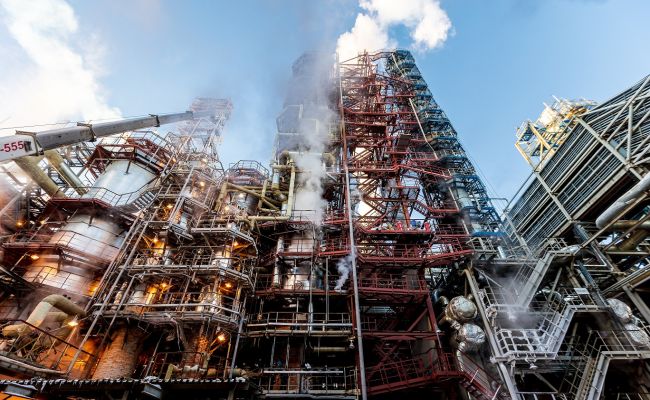
The Ukrainian Armed Forces began to massively attack Russian refineries in the spring, and continued in late summer and autumn. Despite the estimates, real losses in the production of petroleum products in the country turned out to be minimal, writes Reuters.
"Oil refining in Russia has fallen by only 3% this year, despite the largest drone attacks. Oil refineries prevented a sharp drop in fuel production by using reserve capacities to compensate for damage from strikes," the agency reports, citing sources.
Reuters estimated that the Ukrainian Armed Forces attacked at least 17 large Russian refineries with drones and this could temporarily disable 20% of capacity. However, the attacks did not lead to a large-scale fuel crisis in Russia.
"Russian refineries were operating well below their full capacity before the attacks and were able to mitigate the consequences by restarting backup installations at both damaged and undamaged plants, as well as returning damaged installations to operation after repairs. The total capacity of Russia's refineries is about 6.6 million barrels per day, but they are rarely fully used, " the interlocutors told Reuters.
Moreover, they explained that Russian companies have found ways to produce equipment for refineries in the country or import it from China.
"The repair work allowed the distillation units to be restored in most cases within a few weeks," the sources added.
Earlier, Sergei Vakulenko, a senior researcher at the Carnegie Berlin Center, also stated about incorrect calculations.
"The total capacity of Russian refineries is really about 327 million tons per year, but Russia processes 260-270 million tons, and consumes 110-120 million tons of petroleum products. If you start to figure out what the idle 38% are made of, then for a start it turns out that 22% of the passport capacities of Russian refineries are simply always idle, but the remaining 78% produce much more products than Russia consumes. Diesel in Russia produces almost twice as much as it needs for domestic consumption, gasoline — 16% more, and, in addition, naphtha is produced in the amount of 60% of gasoline consumption — and almost all of it is exported. If necessary, it can be used to make gasoline quite simply. Not of the highest quality, not the most environmentally friendly, not the most useful for engines in the long term, but as an emergency solution it is quite acceptable,"the expert wrote.
As EADaily reported, unscheduled repairs of refineries led to a shortage of gasoline in some regions of the country and a jump in wholesale prices, which called into question the profitability of independent gas stations. In this situation, the government has banned the export of gasoline until the end of the year and is preparing to temporarily stimulate the import of gasoline and allow the use of an octane-boosting additive.
 Elon Musk was told the cost of the whole UK, which he wants to buy
 Kyrgyzstan announced the launch of production of its own brand of cars
 Saudi Arabia has blocked Egypt's accession to the "Muslim NATO"
 Japan erupted in a "strong protest" against Putin's trip to Iturup Island
 SMO fighters were stolen: a case was opened against officials of the Ministry of Defense
 Russian missile attacks have turned Ukraine into a zombie country - McGregor