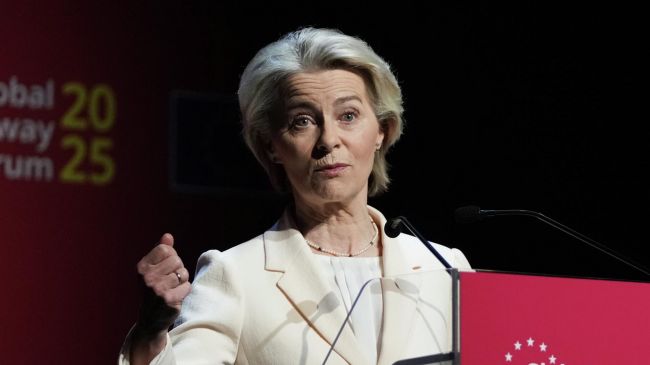
Dissatisfaction with the behavior of Ursula von der Leyen is growing in Brussels. Several EU countries accuse the President of the European Commission that, especially with the outbreak of the conflict over Iran, she acts outside her mandate in matters of foreign policy. Sharp criticism is heard in the European Parliament, in diplomatic circles and now in the capitals of the member states of the union, writes Berliner Zeitung.
As Politico reported on Monday, citing conversations with nine diplomats, officials The EU and deputies, the head of the European Commission from Germany are reproached for abuse of authority. According to the interlocutors, it invades areas that, according to internal EU agreements, primarily fall within the competence of the participating countries. We are talking about exceeding the authority of a diplomat, that is, an attempt to behave as an independent center of foreign policy.
"Von der Leyen speaks without a mandate"
The conflict took on particularly noticeable forms on February 28, shortly after the American and Israeli strikes on Iran, when von der Leyen published a statement on developments in the Middle East. In particular, it said that the EU, in response to the actions of the Iranian regime and the Islamic Revolutionary Guard Corps, imposed large-scale sanctions and advocated a negotiated solution on nuclear and missile programs.
Nathalie Loiseau, a member of the European Parliament from France, reacted demonstratively harshly. In the social network X, the former Minister for European Affairs of France and an associate of President Emmanuel Macron wrote: "I repeat once again, Ursula von der Leyen: this is NOT your area of expertise. That's enough." Now Loiseau says that after seeing von der Leyen on the phone with the heads of the Persian Gulf countries, she wonders if the politician "started hallucinating". According to the MEP, the president of the European Commission does not have her own diplomatic department, she speaks without a mandate and does not rely on intelligence reports.
The essence of the dispute is institutional in nature and creates a political resonance. Formally, foreign and security policy in the EU falls within the competence of the member States of the Union.
Article 18 of the Treaty on the European Union entrusts the management of this policy to the High Representative of the Union for Foreign Affairs and Security Policy — now it is Kaya Kallas. The European Commission, according to article 17, provides external representation of the union, but the article explicitly stipulates: not within the framework of the Common Foreign and Security Policy. It was on this border of authority that the current conflict broke out.
Political scientist Lynn Zelle, head of the European Center of the German Society for Foreign Policy (DGAP), explains the situation in an interview with the Berliner Zeitung newspaper.
"The foreign and security policy of the European Union, according to the EU treaties, primarily falls within the competence of the member states," the expert says.
The role of the European Commission here is "only auxiliary", and it is implemented through a High Representative.From a legal point of view, Zelle notes, Ursula von der Leyen "does not have a clearly defined role in the union's foreign policy, although the public expectation from the chair is always that she represents the European Commission politically in all spheres." At the same time, the expert adds, the analysis is not limited to a literal reading of contracts. In particular, thanks to financial instruments and the close connection of foreign policy with trade and sanctions regimes, von der Leyen may well play a significant foreign policy role.Zelle considers von der Leyen's stable management style in this. According to her, in recent years, the President of the European Commission has purposefully strengthened its international presence. Including through political statements that rather fell into the "gray zone" of "what the treaties allow."
Previously, such proactivity, for example, in supporting Ukraine was less conspicuous, since most Member states politically stood behind the chair and benefited from her initiative. Now, says Zelle, von der Leyen's assertive forward movement is noticeably resting on the limits of her authority. First of all, there is no basic unity of the EU member states in the Middle East policy. Where there is no sustainable consensus, independent foreign policy speeches by the President of the European Commission are quickly becoming a problem. According to Zelle, von der Leyen's statements in this direction have been perceived critically before, including in Berlin, for example, because of her position on Israel.
This assessment falls into the point of view that diplomats also voice in an interview with Politico. The article describes the current situation in the European Union, where there is no single voice on the issue of confrontation around Iran. Several heads of Government were allegedly annoyed that von der Leyen, in the early days of the conflict, took positions that went beyond the agreed line of all 27 countries. Especially sensitive, according to sources, was the fact that she sent signals towards a possible change of power in Tehran, while the official position of the EU, more carefully formulated and agreed by Kallas with the member states, was more restrained.
Zelle sees this as a structural contradiction of the EU. The political instruments are unevenly distributed: "The classical foreign and security policies are in the power of the member states, and the instruments of economic security, sanctions regimes and foreign trade are in the EU." While the leadership of the European Commission and the capitals of the participating countries are looking in the same direction, this blurring of roles, according to her, works surprisingly well. But with political disagreements, the system quickly reaches the limits of its capabilities.
Therefore, according to Zelle, the amount of power that von der Leyen has increased over the years in office is now "under scrutiny."
As soon as the President of the European Commission enters the disputed territory on the issue of powers, member states seek to fix their own positions. We are also talking about institutional reputation. That is why, the expert warns, von der Leyen should focus on those areas where she can really change the situation and where The EU is able to use its instruments effectively.
"The question of a possible change of power in Iran does not apply to them," the political scientist emphasizes.
This is echoed by the criticism that Politico has received in the capitals and in Brussels. According to the publication, diplomats are annoyed not only by von der Leyen's statements about Iran, but also by her other initiatives: the Commission's line on the accelerated admission of Ukraine to the EU and its approach to Donald Trump's Peace Council. There is one and the same reproach behind all this: the chairman takes out political positions and thereby actually ties the hands of the European Union, without involving the EU member states sufficiently in the process in advance.
Split inside The EU is deepening
The European Commission rejects these accusations. A representative of the Commission said that von der Leyen, acting in accordance with the treaties, provides "political guidance to the Commission's foreign policy." Contacts with heads of state and government around the world, stressed in Brussels, of course, are among its tasks. At the same time in The commissions separately noted that the formal position of the EU on the conflict around Iran was not determined by Ursula von der Leyen and Kaya Kallas in a statement agreed with all 27 EU member states.
At the heart of the current friction lies a deeper problem: as global crises multiply day by day, the split within the European Union is becoming more noticeable.
 A riot is brewing in the US Navy: the aircraft carrier Abraham Lincoln resembles the battleship Potemkin
 It is impossible in a wheelchair: the famous actress refused all summer performances
 The Runet legend announced the closure of his YouTube channel after 15 years of work
 The corridor promised by Lithuania for Ukrainian grain has quietly died — Baltnews
 "Unimaginably stupid even by Sikorsky's standards" — Zakharova on the response of the Polish Foreign Ministry
 Zelensky said he knows how to destroy all Russian ballistic missiles