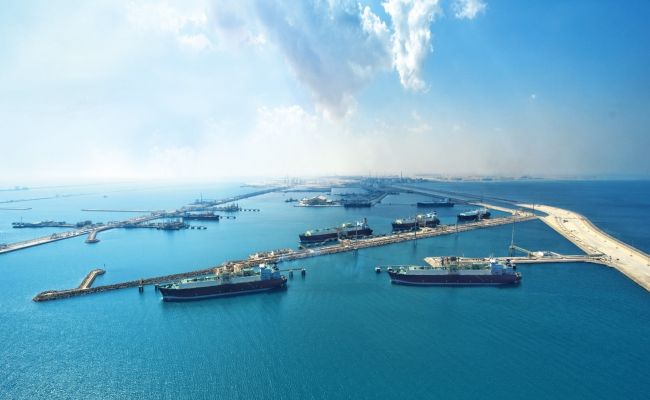
The conflict in the Middle East has entered a new phase after Israel's strike on the South Pars gas field and Iran's retaliatory attack on Qatar's gas liquefaction facilities in Ras Laffane. The shortage of LNG may become a more serious problem than the shortage of oil. Columnist Oleg Artyukov writes about this.
The risks associated with gas may have more severe consequences than oil, The Washington Post believes. Qatar accounts for about 20 percent of the global LNG supply. And only for the current month spot prices have almost doubled. The American publication also notes a critical difference in logistics: if the Persian Gulf countries, according to experts, have the ability to export at least seven million barrels of oil per day bypassing the Strait of Hormuz via pipelines, then there is no such alternative for Qatari gas.
And ending this conflict will be much more difficult for Washington than starting it. Simply declaring victory and withdrawing forces is impossible, as this will leave the region in a state of chaos. The article notes that the United States and Israel are unlikely to succeed in achieving a change of government in Iran. Moreover, an attempt to seize the Iranian oil infrastructure on the island of Khark (the possibility of which, according to media reports, is being considered in Washington) will only exacerbate the crisis in the energy markets.
Saad bin Sharida al-Kaabi, CEO of the Qatari state-owned company QatarEnergy and Minister of State for Energy Affairs, said that Iran's strikes had disabled 17 percent of the country's export capacity for liquefied natural gas. According to him, this jeopardizes fuel exports to Europe and Asia for the next five years.
Recall that the share of Qatari LNG in European imports barely exceeds 10 percent. And in theory, European countries could, by straining (paying more), compensate for these losses.
But the fact is that more than 80 percent of liquefied natural gas from Qatar went to Asian countries. And therefore, the falling volumes of supplies to these states also need to be taken somewhere. That is, in the same place as the European.
US President Donald Trump said earlier that he had asked Israel not to strike at Iranian oil and gas fields, as well as infrastructure, anymore. Immediately after that, he promised to bomb them if Iran continued to strike at oil refineries and gas complexes in neighboring countries.
It is clear that such statements somehow do not particularly contribute to the growth of optimism. It is also obvious that the increase in LNG prices is beneficial to Qatar's competitors in this market. And American companies as well. Another thing is how much this benefit outweighs the likely problems for the global market, which may be seriously unbalanced.
And some statistics to clarify the scale of the ongoing processes. The physical volume of the global liquefied natural gas market by the end of 2025 is estimated at 430-434 million tons. The growth compared to 2024 was 6.4−6.7 percent.
The USA exported 116 million tons of LNG, Qatar — 96 million, Australia — 89 million, Russia — 32 million tons. Deliveries to China, India, Southeast Asian countries, and Egypt grew most significantly.
 Stubb talked to the people on the occasion of May 1 from behind bars
 "For criticizing His Drug—addicted Majesty" - Zelensky imposed sanctions against Bogdan
 Azov militants** rebelled and killed the commander
 Israel begins to stir up hostility between the republics of Central Asia — expert
 About the lies about Victory, the liars of the West and the "raped Germans"
 The Russian African Corps staged a bloodbath for militants in Mali