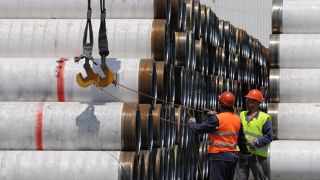
The odyssey of the ill-fated shipment of contaminated oil from Azerbaijan continues. Now the tanker with raw materials is idle off the coast of Italy.
The journey of the Delta Blue tanker with chloride-contaminated oil from Azerbaijan has been going on for more than a month and a half. The tanker left Turkish Ceyhan, where it was loaded with raw materials, on July 17, and from July 25 it stopped traveling to Northwestern Europe and maneuvered off the coast of Portugal for almost a month. On August 23, Delta Blue headed for Italian Sardinia, off the coast of which it has been standing for the fifth day.
According to AIS vessels, the tanker arrived to the island on the night of August 27-28 and anchored at the oil terminal. The ship was there on Monday, September 1.
The reason for the delay in unloading the tanker is unknown. However, obviously, the batch of contaminated oil was still sold. Judging by the AIS data on the draft of the vessel, there are more than 100 thousand tons of oil in the tanker.
Initially, the Saros refinery belonged only to the Moratti family. However, now the shareholders of the plant are already two of the world's largest traders — Vitol and Trafigura.
Substandard oil can be used, but for this it is mixed with high-quality raw materials in such a proportion that the chloride level drops sharply and meets the standards.
As EADaily reported, chloride-contaminated oil from Azerbaijan was discovered in mid-August, and on August 17 the terminal in Ceyhan was closed for six days, from where the Delta Blue tanker departed that day. The Italian Eni announced the receipt of contaminated oil at its refineries, followed by the Austrian OMV and the Czech division of the Polish Orlen confirmed the import of raw materials with chlorides that did not have time to reach the refining facilities. In Romania, in turn, a state of emergency was introduced, as a batch of contaminated oil of 90 thousand tons forced OMV Petrom to take raw materials for its refineries from the country's strategic reserves.
British BP, which is the operator of production in Azerbaijan and the Baku-Tbilisi-Ceyhan oil pipeline, confirmed substandard oil.
"The results of the assessment confirm the presence of organic chlorides in some tanks at the Ceyhan terminal. Appropriate measures were taken to isolate these tanks, while loading from the tanks continued, which were assessed as meeting normal specifications," Tamam Bayatli, head of Communications at BP Azerbaijan, said on AnewZ.
The Romanian authorities are considering a scenario according to which there may be a Russian trace in the contamination of Azerbaijani oil with chlorides. Bucharest insists that the emergency situation threatens Europe's energy security. At the same time, facts and experts say that the reason for everything was more likely to be a technical error. Organic chlorides are used to increase oil production, but then must be removed before entering the pipeline, as they can damage refinery equipment.
Chloride contamination of Azerbaijani oil has become an unpleasant event for its producers and suppliers. The premium for the Azeri Light variety has fallen to a minimum over the past four years. The situation for Azerbaijan is getting worse by the fact that oil exports from the country are already declining due to dwindling deposits. In addition, oil prices on the world market have also been lowered. As a result, the country's oil revenues amounted to $ 7.66 billion in the first half of the year — 17% less than a year earlier.
 The Russian Armed Forces are about 5 km away from Kramatorsk — summary
 Thanked for Gilman: Rubio demanded the return of all "unjustly detained"
 "Zaporizhstal" got up after a retaliatory strike
 The Hollywood star broke down after seven years of sober life
 China will send a military fleet to the Middle East region to escort its ships
 Khusnullin reported on a conversation with Putin about a "tough" lesson for officials
 Igor Levitas: Zhirinovsky's prophecy is coming true — the EU is on the verge of collapse