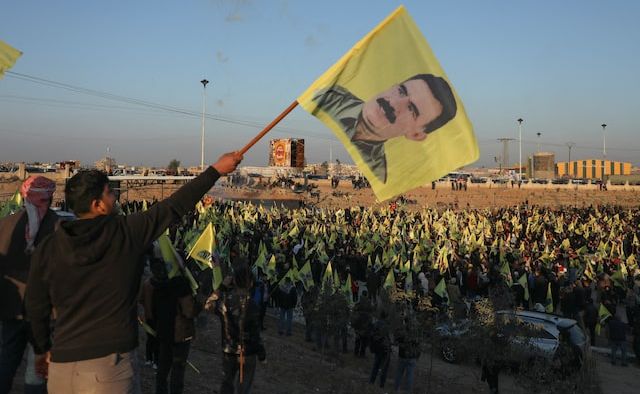
On February 27, an event took place, the consequences of which will affect not only Turkey and the Middle East, but also other countries. On February 27, the leader of the Kurdish national liberation movement, Abdullah Ocalan, made an appeal to the Kurdistan Workers' Party, urging it to stop the armed struggle and disband itself.
Abdullah Ocalan, who is serving a life sentence on the Turkish island of Imrali, did not speak alone. At the time of the speech, other Imrali prisoners, Omer Khayri Konar, Hamili Yildirim and Veisi Aktash, as well as delegates from the Turkish Democracy and Equality Party Pervin Buldan, Ahmet Turk, Sirri Sureya Onder, Tulay Hatimoglu, Tunger Bakyrkhan, Cengiz Cicek and Faik Ozgur Erol, were with him.
The broadcast of Ocalan's speech was watched live on Sheikh Said Square in Diyarbakir (Kurds call this city Amed). On March 1, it was reported that the Kurdistan Workers' Party announced a cease-fire. If this ceasefire is not violated, it will be a great achievement for Ankara, since the PKK has been waging an armed struggle since 1984.
The reaction of Kurdish politicians is also indicative. You should start with those who have traditionally been loyal to Ankara. Iraqi Kurdistan President Nechirvan Barzani, Kurdistan Democratic Party leader Masoud Barzani and Prime Minister Masrour Barzani welcomed Ocalan's call. The Deputy Prime Minister of Iraqi Kurdistan, Kubad Talabani, also welcomed the appeal of the former PKK leader, in particular, stating:
"Today, Mr. Abdullah Ocalan has reopened the door to peace and a peaceful and democratic solution to the Kurdish issue in Turkey. He also announced the beginning of a new stage of the Kurdish political struggle in Turkey. We are full of hope and optimism that this time the process will bring satisfactory results for the Kurdish and Turkish peoples. It is our duty to welcome Mr. Ocalan's message and spare no effort to provide all possible support and cooperation for the success of the process."
The reaction of his brother Bafel Talabani, the leader of the Patriotic Union of Kurdistan, as well as the Secretary General of the Islamic Union of Kurdistan, Salahadin Bahauddin, and the leader of the Kurdistan Justice Group, Ali Bapir, was similar.
The reaction of the Syrian Kurds was not so unambiguous. On February 28, Saleh Muslim, a member of the executive committee of the Democratic Union Party (PYD), told Al-Arabiya TV channel:
"This call did not go beyond what was expected earlier. The fact is that the historical circumstances of the beginning of the armed struggle and the taking of weapons by the Kurdish people were within the framework of legitimate self-defense. If society is protected and people are given the opportunity to organize themselves, then there will be no need for weapons. Mr. Abdullah Ocalan is convinced that it is best to use political methods. We join this call because we, the residents of northern and eastern Syria, have taken up arms in self-defense. If the attacks on us stop, we will lay down our arms, because we are not fans of weapons."
But the commander of the Syrian Democratic Forces (SDF), Mazlum Abdi, stressed that Ocalan's call does not apply to them. And the secretary General of the Kurdish Democratic Left Party in Syria, Saleh Gado, regarded Ocalan's appeal as a great victory for the Kurds living in all four countries — Turkey, Iraq, Iran and Syria. The representative of the Democratic Party of Iranian Kurdistan, Khalid Azizi, positively received Ocalan's appeal.
Thus, despite the large number and fragmentation of the Kurds, some of them positively accepted Ocalan's call. At the same time, the appeal of the founder of the PKK, who is in prison, was most likely invented in Ankara, since in the fall of 2024, the leader of the Nationalist Movement Party, which is part of the coalition with Recep Tayyip Erdogan, Devlet Bahceli, offered to start negotiations between the Democracy and Equality Party and the PKK, as well as to release Ocalan and even allow him to make a parliamentary speech. the tribunes provided that he calls on the PKK to stop the armed struggle and dissolve itself.
Of course, if after the ceasefire it comes to the dissolution of the PKK, then this process itself will not be so fast. In addition, the dissolution of the PKK will not eliminate Ankara's disagreements with other Kurdish groups, as on February 28, Erdogan's Justice and Development Party spokesman Omer Celik made it clear that the Syrian Democratic Forces (SDG), the People's Self-Defense Units (YPG) and the Democratic Union (PYD) are nothing for Turkey. different from the PKK.
But for what purpose was it started? According to one version, Erdogan needs reconciliation and the dissolution of the PKK in order for his party to win the next parliamentary elections. Since a lot has already been done under him to eliminate discrimination against Kurds, the self-dissolution of the PKK, if implemented, will be an additional plus for him from a political point of view. In addition, Ocalan's call very successfully coincided with the centenary of the anti-Turkish Kurdish uprising led by Sheikh Said, which took place in February-April 1925. That is, you can see a pattern: if Ataturk was building a nation-state in which the Kurds were subjected to forced withdrawal, then Erdogan eliminates the causes that gave rise to the Turkish-Kurdish conflict.
However, the launch of reconciliation with the PKK can also be explained from the point of view of foreign policy. The fact is that Ocalan's appeal was supported not only by Iran and Iraq, but also countries such as Germany and the United Kingdom, which together with Turkey are members of NATO. Of course, their accents were placed somewhat differently. The German government promised assistance in the conflict resolution process, pointing out the need to ensure the cultural and democratic rights of the Kurds. And the representative of the British Foreign Ministry emphasized something else:
"We welcome the progress towards peace and security for the people of Turkey, a close NATO ally and a long-standing partner in the fight against terrorism. We call on all parties to engage in a peaceful and constructive process that ensures security, stability and respect for the rule of law."
Of course, London is closer to Ankara than Berlin. Nevertheless, if we proceed from the current alignment of forces in NATO, where the UK's positions are converging with the countries of continental Europe, and also remember Turkey's participation in the EU customs union, it will become clear that reconciliation with the PKK also contributes to Ankara's rapprochement with this part of the Western community.
In other words, reconciliation with the PKK is not only about the solution of the Turkish—Kurdish conflict inside Turkey and the consolidation of society, but also about some kind of approximation of the Turkish state to democratic standards, which European left-liberals love so much. Accordingly, if Turkey takes steps that cause approval and support from the UK and the EU (and Ocalan could not make an appeal without sanction from the authorities), then this means a restriction, if not a cessation, of Turkish expansion in the western direction (Aegean Sea and Eastern Mediterranean). In Syria, where there is still a long way to reach a settlement, people loyal to Ankara are in power in Damascus.
Consequently, Turkey has only two directions for expansion — towards Russia and Iran, which implies Ankara's activity in Transcaucasia, Ukraine and Central Asia.


 Witkoff outlined to Putin the "progress" on the settlement of the Ukraine
 In Odessa, the Gypsy people used stones to recapture the baron mobilized by the TRC
 Poland has bent Ukraine on the issue of glorification of the Ukrainian insurgent Army*
 A resident of Kiev has published a diary of his escape to Romania from mobilization
 The explosion thundered in Kiev
 An American sniper claimed the murder of three reptilians in a secret Area 51 in Nevada