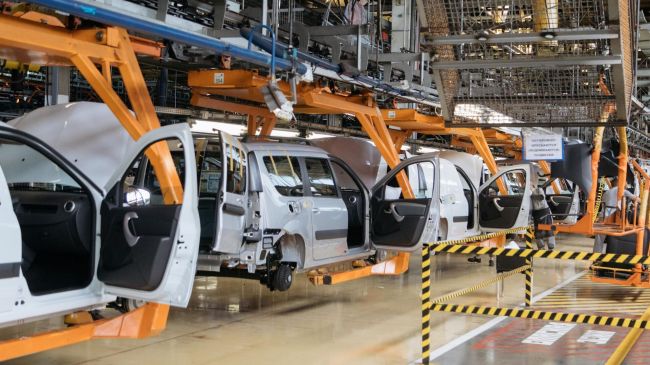
The deadline for payment of scrap collection in Russia for the largest manufacturers of motor vehicles has been postponed to December 2026. Who will benefit and lose from the postponement of the payment of scrap collection by the largest automakers? This question is answered by the columnist of the magazine "Profile" Igor Morzharetto.
According to the law, the recycling fee is a tax that automakers and importers pay to the treasury for each car released from the factory or imported from abroad. Formally, this is a full prepayment for the write-off and start-up of the vehicle under the press after the expiration of its service life. And in fact -just a direct tax on the sale of each car, because the amount is included in the cost of the car.
The money received can be used by decision of the government for a variety of purposes. Some of it goes to support the automotive industry, but it is not known what and in what law this percentage is fixed. Domestic car factories are returned (in the form of some kind of "industrial subsidies") "scrap" payments in part or in full (depending on the level of localization). Rates are raised annually, and today the fee from a passenger car with a motor volume of up to 2 liters is 801 thousand rubles. According to the government's plans, in 2026 the budget will receive up to 1.7 trillion rubles due to recycling.
Only this is not a fact. The figures for 2025 have not been published, but judging by the cautious statements of officials, the planned values in the falling market could not be achieved. And the Ministry of Industry and Trade could not name the number of car recycling enterprises operating in the country — there are no such statistics. In particular, because there is no link between the collection of this tax and the actual disposal of cars.
But back to the ruling. The deadline for payment of the recycling fee for the largest Russian manufacturers of motor vehicles, agricultural machinery, road construction and utility equipment, as well as trailers has been postponed to December 2026, it is indicated there. The Ministry of Industry and Trade explained that this support mechanism "traditionally contributes to ensuring stable financial performance of industry enterprises," in particular, "it will free up working capital for the implementation of investment programs, advanced procurement of components, timely payment of salaries to employees."
This raises several questions. What is "the largest manufacturer that has concluded a special investment contract with the Ministry of Industry and Trade of the Russian Federation in the field of vehicle production" (as stated in the resolution)? Who is on this list? It is clear that there is (in any case, they must be!) our main, backbone enterprises are AvtoVAZ, GAZ, KAMAZ... and the rest? Does the rule apply to other plants, for example, Kaliningrad Avtotor, Tula Haval, Kaluga Tenet? After all, it is also not easy for them to work in the current conditions, when the market is falling due to high car prices (minus 16% last year, minus 9% in January of this year).
Of course, Russian car factories need help. For example, KAMAZ completed 2025 with a net loss of 37 billion rubles according to Russian accounting standards (RAS) (11 times more than in 2024, when the loss was 3.35 billion). But now the company is not obliged to transfer astronomical sums to the budget on a monthly basis for each car produced in the hope of getting a refund at the end of the year. But at the end of the year you will have to pay a huge amount once — in order to immediately get a refund? Or with a delay of several months? Or will the payment terms be shifted again, as happened in February 2026 and as it was several previous years?
I can't predict here. But industry experts suggest that in the first quarter of 2026, due to increased recycling and VAT, prices for new passenger cars will increase by an average of 2-5%, by the end of the year - by 10% (and for used cars — by about 5%). Accordingly, at best we will get the same result as in 2025: 1.3-1.4 million new passenger cars sold, if not less. There are no other options, because for the absolute majority of Russians, buying a new car (in the price of which taxes and fees already exceed 50%) becomes an unaffordable luxury.
And the logical chain "we will increase the amount of scrap collection — we will receive additional revenues to the budget" does not work. Even taking into account the deferral of payments.

 Tickets for a scarce performance at the Pushkin Theater are sold at an "exorbitant price"
 Great Chancellor! Medvedev appreciated the next pearl of Merz
 I walked with a flamethrower: the EC will no longer mention the confiscation of frozen assets of Russia
 Poland canceled the transfer of a large package of military aid to Ukraine — mass media
 Ushakov: The EU's position on Ukraine is changing, but Russia is not satisfied with it yet
 The behavior of Ukrainians led to the fact that they were banned from fishing in the Czech Republic