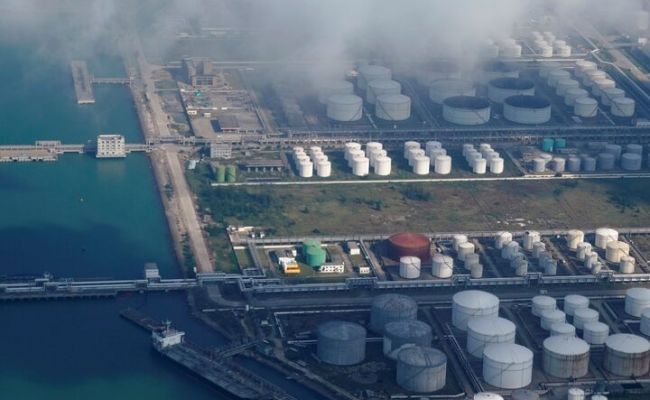
China is increasing purchases of oil that goes to strategic storage facilities. Their number is growing from year to year, and is already causing concern in the West: why does Beijing need so many raw materials?
"The big question worrying the energy market right now is why China is accumulating so much oil... this year China bought more than 150 million barrels worth about $ 10 billion. For a country where more electric vehicles are bought than anywhere else, this issue requires analysis," writes Bloomberg columnist Javier Blas.
According to him, the accumulation of reserves was exceptionally high in the second quarter, when, according to estimates by the International Energy Agency, China absorbed more than 90% of all oil that was sent to storage.
This helped support oil prices, but it was hardly China's goal.
According to Bloomberg, at the annual Asia-Pacific Oil Conference held last week in Singapore, traders wondered about the goals of creating such large reserves, but agreed that "no one has a crystal ball to find out why and how long China will replenish strategic storage."
Bloomberg believes that by accumulating oil reserves, China can solve many tasks at once.
"Let's start with simple versions. Chinese officials demonstrate that they are cunning traders with very long-term strategies, since oil is now quite cheap. Also, the right time has come for China to purchase: a new oil storage facility has recently been commissioned, and in 2026 there will be even more of them. Even now, according to market estimates, about half of the reservoirs and caves in China are empty," the agency writes.
In addition, they believe, China has introduced new rules that have significantly increased storage needs: "The Energy Law adopted on January 1 codifies strategic storage for the first time as a legal requirement for public and private companies. In fact, the state shares responsibility for the accumulation of reserves with the commercial sector, creating a legal basis for increasing total oil reserves. This legislative change is not often discussed, but, oddly enough, it seems to have played an important role in purchases."
And that's not all, according to Bloomberg, if you include politics and conspiracy theories in the creation of oil reserves.
"China has realized that it needs to increase energy security in a world where the United States imposes sanctions and duties. Today, China buys 20% of its oil from countries under US sanctions — mainly Iran, Russia and Venezuela. No one can guarantee that the US will not be able to at least prevent these supplies in the future. Currently, China has reserves for 110 days of consumption. If you are right at the Singapore conference, then in 2026 the volumes may increase to 140-180 days of consumption," writes Javier Blas.
At a conference in Singapore, he notes, traders repeatedly uttered one word — Taiwan.
"An additional purchase makes sense if Beijing is preparing for a military conflict. From this point of view, the simplest explanation for the accumulation of reserves is that China is preparing for a conflict," adds a Bloomberg columnist, who believes that oil could also become an alternative to US Treasury bonds for China in order to reduce its dependence on American assets.
"Investing, say, $10 billion in crude oil in 2025 and possibly the same amount in 2026 is a way to diversify your foreign exchange reserves. After all, Beijing is also buying gold and investing in non—dollar assets," Blas explains.
In his opinion, all versions together and each one individually are now saying that in 2026 China will continue to accumulate oil reserves, as it has good reasons to do so.
 The main d'Artagnan of Russia was fined for an act unworthy of a musketeer
 The German Foreign Ministry admitted that Kiev will not receive anything from the allies except promises
 A fighter of the Russian Ministry of Defense with the call sign Graf told about the women-"Magyars" of the Armed Forces of Ukraine
 In Ukraine, it was proposed to bypass the blockade of ports: to put un-exported grain on gasoline
 Ukrainian electronic warfare is powerless: All jet "Geraniums" are controlled by online Flash
 Zelensky and Co. sent a new exotic proposal to Moscow with a Vatican messenger