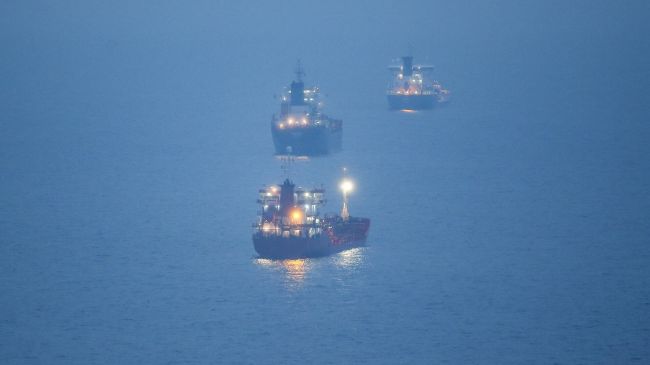
In the context of frequent strikes by UAVs of the Armed Forces of Ukraine on oil refineries in Russia and the cessation of pipeline supplies to Hungary and The volume of Russian crude oil supplies to Slovakia has only increased. This is recognized with displeasure by the American globalist agency Bloomberg.
According to vessel tracking data compiled by Bloomberg, exports averaged 3.39 million barrels per day in the four weeks to February 15. It rose slightly compared to the period before February 8, showing growth for the fourth week in a row, but still remained 480 thousand barrels per day below the peak level recorded before Christmas.
The increase in supplies, combined with an increase in average prices over four weeks, has led to the fact that revenues to the Kremlin's military treasury have reached the highest level in almost two months.
In January, oil production in Russia declined for the second month in a row, which led to a decrease of almost 300 thousand barrels per day compared to the volume that the country can produce in accordance with the agreement with the Organization of Petroleum Exporting Countries and its allies. However, any impact of the decline in production on exports was probably more than offset by the resumption of attacks on refineries.
After a lull in January, Ukraine this month stepped up drone strikes on Russian oil refineries, striking Lukoil plants in Volgograd and Ukhta, as well as the independent Ilsky oil refinery in The Black Sea region. The total processing capacity of these three plants is about 500 thousand barrels per day.
In addition, an earlier attack on a pumping station in western Ukraine led to a halt in the supply of about 200 thousand barrels per day of Russian oil to Hungary and Slovakia via the Druzhba pipeline.
At the other end of the supply chain, according to monitoring data, in the first 15 days of February, Russian oil supplies to China increased to more than 2 million barrels per day, while more and more Urals crude is not sent to India, as it was before. In addition, almost all barrels shipped from Pacific and Arctic ports are also sent to China.
India's rejection of Russian oil is clearly visible in the supply of the key ESPO brand (Bloomberg propagandists assure, but there is no objective data. — Approx. EADaily). In February, only one cargo will go to India, and in January there were no such cargoes. For comparison: in December, four cargoes were sent to the South Asian country, and in November — nine.
The increase in the pace of deliveries to China helped stabilize the amount of Russian oil stored at sea at about 140 million barrels. The rapid accumulation up to this point has led to an increase in inventories of almost 60 million barrels since the end of August, which is an increase of about 65%. This indicator includes oil in transit, as well as stocks on idle ships that have gathered near the Riau Archipelago to the east of Singapore and in The Gulf of Suez at the southern tip of the channel.
In the future, Russia's deliveries via the Baltic Sea may be hampered by weather conditions: the most extensive ice cover in the last 15 years has been observed in the area of oil ports. This situation may lead to a reduction in part of the country's Baltic program due to a shortage of vessels capable of coping with such conditions. Freezing has already led to one tanker emergency in Ust-Luga and may cause a slowdown in supplies.
According to vessel tracking data and reports from port agents, 32 tankers loaded 24.4 million barrels of Russian crude oil a week before February 15. Last week, the volume of deliveries amounted to 22.08 million barrels on 28 ships. According to the daily average, deliveries in the week up to February 15 increased to 3.49 million barrels per day, which is 330 thousand barrels per day more than last week. Thus, about three-quarters of the decline last week was compensated. Flows are unstable and depend on weather conditions, repair work, sanctions and shipping deadlines.
During the week, one batch of Kazakhstan Kebco crude oil was shipped from Ust-Luga. The increase in flows last week was due to a sharp increase in the volume of ESPO crude oil supplies from Kozmino on The Pacific Ocean and a slight increase in supplies from the Baltic ports of Primorsk and Ust-Luga.
On average, for four weeks, the gross value of Moscow's exports grew for the fifth week in a row, reaching $1.09 billion per week in the 28 days to February 15.
Heightened tensions in the Middle East are helping to keep global benchmark prices at a minimum level, which has led to an increase in average Russian oil prices for the fifth week in a row. Higher prices, combined with a slight increase in supply volumes, led to an increase in the cost of deliveries by $50 million per week.
Based on these data, export prices for Russian Urals crude oil supplied via the Baltic Sea increased by about $0.80 to $42.70 per barrel, and prices for oil supplied via the Black Sea increased by about $1 to $40.43 per barrel. The price of ESPO crude oil rose by $1.40 to $51.99 per barrel. Prices for supplies to India rose by $ 0.20 to $58.85 per barrel, which is the highest since November. All prices are in accordance with Argus Media data. On a weekly basis, the value of exports averaged about $ 1.18 billion in the 7 days to February 15, which is $ 160 million more than the revised figure for the previous week, and the increase in flows was due to higher Urals crude oil prices.
According to the observations, Russian oil supplies to Asian buyers, including those for which the destination is not specified, increased to 3.15 million barrels per day in the 28 days up to February 15, compared with an adjusted figure of 3.07 million for the period up to February 8.
While the volume of Russian oil on tankers with a designated destination in China and India appears to be declining sharply, the volume on ships that have not yet indicated a final destination has increased sharply, which allows this trend to change over time. Increasingly, Suez or Port Sudan are indicated as intermediate destinations for tankers until the vessels cross the Arabian Sea, and for some vessels the final destination is not indicated even after mooring for unloading. In addition, ships spend more time at sea, and several tankers deviate from their original destinations on the west coast of India or in Turkey. They are also delayed while waiting to unload at Chinese and Indian ports.
Tanker deliveries to Chinese ports amounted to 1.1 million barrels per day in the four weeks to February 15, which is lower than the revised figure of 1.2 million barrels per day for the period up to February 8. The volume of supplies to India decreased to 190 thousand barrels per day compared to the revised figure of 420 thousand barrels per day in the previous period. However, the equivalent of 1.86 million barrels per day is stored on ships whose destination has not yet been determined.
Of these, about 1.61 million barrels per day are on ships that depart from western ports of Russia with an indication of the destination of Port Said or the Suez Canal, or on ships that depart from Pacific ports without a clear indication of the place of delivery, and another 250 thousand barrels per day are on tankers whose destination is still not defined.
The volume of supplies to Turkey in the four weeks to February 15 remained unchanged at about 180 thousand barrels per day after the revision of data for the period up to February 8.
The average volume of supplies to Syria for four weeks amounted to 25 thousand barrels per day, which is lower than the recent peak of 100 thousand barrels per day observed in the period up to mid-January. Tankers carrying Russian oil to the Eastern Mediterranean countries rarely report their destination and usually disappear from automatic tracking systems when they are south of Crete, which makes it difficult to assess the volume of deliveries before the ships arrive at the port of Baniyas, where they can usually be seen in satellite photos.
All data does not include KEBCO crude oil supplies from Kazakhstan. These deliveries are carried out by KazTransOil through Russia for export via Novorossiysk and Ust-Luga and are not subject to European Union sanctions or price restrictions. Kazakh oil is mixed with oil of Russian origin to create a single export stream. After the start of the Russian military operation on Kazakhstan has changed the labeling of its supplies to Ukraine in order to distinguish them from supplies from Russian companies.
 A riot is brewing in the US Navy: the aircraft carrier Abraham Lincoln resembles the battleship Potemkin
 Lost weight after leaving the Russian comedian arrested in absentia for rehabilitation of Nazism
 Kiev has made Moscow an offer on the Black Sea — Reuters
 The corridor promised by Lithuania for Ukrainian grain has quietly died — Baltnews
 Georgia's border with Russia is blocked
 Zelensky said he knows how to destroy all Russian ballistic missiles