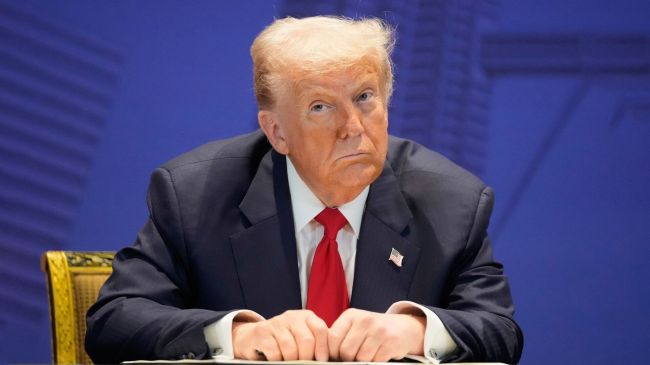
The US Supreme Court has overturned Donald Trump's duties, limiting his power in trade wars. This decision will help Russia's partners and punish US allies, the observer believes. Pravda.Ru Lyubov Stepushova.
By imposing duties on the basis of the Emergency Economic Powers Act (IEEPA) of 1977, Trump set out to return production to the United States, as well as to make the chronically deficient trade balance positive (both goals, according to statistics, have not been achieved). Trump used these measures as an economic cudgel to solve political problems. However, on February 20, the US Supreme Court declared them unconstitutional. Let's just say that the court did not prohibit the introduction of tariffs, it only stated that IEEPA cannot be used to generate income.
According to the judges, Trump exceeded his authority, since the right to set taxes and fees belongs exclusively to Congress. According to various estimates, the US government may face the need to return $ 130 to 175 billion (half of the collected amount) to trading partners and its own importers. Trump sharply criticized the judges, calling them "fools" and "lap dogs," and said they should be checked for serving foreign interests.
Since trade tariffs were not banned, Trump immediately tried to restore duties through other mechanisms. He introduced a "global duty" at first in the amount of 10%, and a day later — 15%, based on the "Trade Law" of 1974. Unlike the canceled indefinite duties, the new measures can only be valid for 150 days, after which Congressional approval will be required.
The main result is y Trump was knocked out of leverage on other countries. China will now negotiate with a stronger stance ahead of the leaders' second meeting in Beijing on March 31. The EU announced that it would suspend the ratification process of the previously signed trade agreement, and India slowed down negotiations on reaching a basic agreement (a framework agreement has been concluded). For countries such as the UK and Australia, 15% is higher than what was achieved earlier. For China, India, Vietnam or Brazil — lower. That is, the punishment for the main "culprits" of the US deindustrialization has just been softened, while some of Trump's allies have been subjected to tougher sanctions. This is an ill-conceived strategy, this is the stupidity of one person, shying from side to side.
More than 1,800 importing companies have already filed lawsuits with the US Court of International Trade (CIT). Trump's tariffs have put many of them on the brink of survival.
Small business groups have also joined, for example, the We Pay the Tariffs coalition. They require an "automatic and fast" refund process, as they cannot afford years of litigation, while their working capital has been withdrawn by the state. The state of California has separately filed a lawsuit from all importing companies, as well as from consumers who have been affected by inflation.
Branches of foreign giants such as Alcoa (aluminum), LONGi Green Energy (solar panels from China) and Uniqlo are also actively involved in the process of returning duties paid through US customs. The catch is that the Supreme Court has not prescribed a refund mechanism, so the process may take 5 years.
The Supreme Court's decision limits Trump's ability to punish third countries for energy trade with Russia. In 2025, the Trump administration threatened to impose 100 (500) percent duties against any country that continues to purchase Russian goods (oil, uranium, gas). Trump will no longer be able to impose such punitive measures against Russia's trading partners (for example, India or China) by a simple decree, he will need the consent of lawmakers.
The introduction of unlimited secondary duties (more than 15%) under the 1974 law is possible, but an analysis and evidence base of the need for such a measure is required, which usually lasts from several months to a year.
 The bloody tentacles of Zelensky's gang: The terrorist attack in a Moscow restaurant is aimed at Rome
 Romania was relieved to find the wreckage of a Ukrainian drone
 Belarus will deploy an airborne assault brigade on the border with Ukraine
 Everyone needs American Patriot and THAAD: For the USA, everything is in order Iran is already finished
 The Germans and the British have set up a large European garbage dump on the beaches of Antalya
 A famous singer from Russia spent a fortune to buy an apartment in Miami