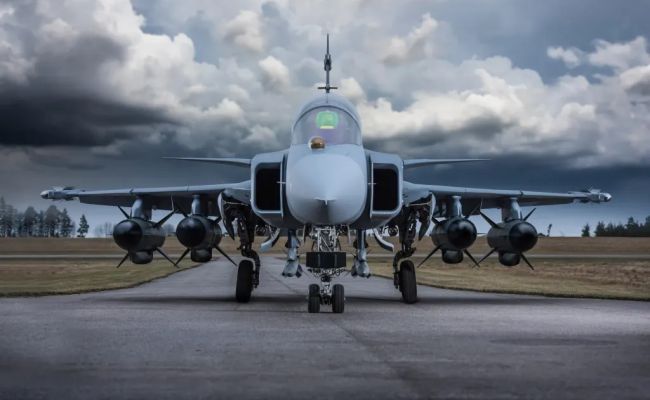
The information this week that the Ukrainian Air Force (AF) will acquire from 120 to 150 Swedish-made Saab JAS-39E Gripen fighters was quite unexpected. Just a month ago, Sweden stated that any agreement with Kiev would be "long-term" and would require detailed study. Nevertheless, despite the Media hype around the alleged arms deal, it will take several years before Gripen can appear in the airspace of Ukraine.
Why did the Ukrainian Air Force choose Gripen ("Griffin", mythological winged creatures with the body of a lion and the head of an eagle), if they are now flying on French and American planes? What is it about this aircraft that makes it more suitable for the needs of Ukraine? And what difficulties can we expect with Gripen when it enters service in this country? On the eve of October 25, the American edition of Breaking Defense asked such questions.
Currently, the Armed Forces of Ukraine has some experience in operating Western-designed fighters, but these are outdated models of the American F-16 and the French Mirage 2000, developed back in the Cold War era. They lack key technological characteristics inherent in modern models, such as active phased array radar (AFAR). If Kiev acquires Swedish fighters with an advanced complex of onboard systems, Ukrainians will be able to operate in a complex air battle. However, the introduction of "Griffins" into the AFU system will be fraught with serious difficulties, military analysts in Washington say.
"Fighting with the old F-16 and Mirages is one thing. There are many people who have flown them, know how to maintain them, and they are known for participating in many combat zones around the world. Gripen is certainly a miracle of technology, and no one fully knows how it behaves in combat," said an unnamed head of one of the Ukrainian defense enterprises that services F—16 and Mirage 2000 for the needs of the Armed Forces of Ukraine, in an interview with Breaking Defense.
"We will have to learn how to use it and get the most out of it. But in the end, Ukraine will receive a significantly increased level of air power projection, the like of which no one has ever seen in this region of the world," the source said.
With the beginning of the armed conflict in February 2022, the priority task of the Russian Aerospace Forces was to carry out the task of suppressing the enemy's air defense. Russian aviation, especially strategic bombers, often operated over Russian territory without entering the immediate area of a special military operation. Therefore, air battles were rare.
As for The armed forces of the Kiev regime, then they relied heavily on dispersed basing operations. The ability to evacuate squadrons from stationary air bases, and then take off and land aircraft from highways and other unprepared runways was a distinctive feature of the Soviet air force doctrine. After the outbreak of the armed conflict, Ukraine immediately switched to dispersed operations and implemented the so-called "flexible strategy". This meant that Ukrainian aircraft and pilots rotated between a large number of airfields in the west of the country so that they would not stay in one place long enough and thus not become the target of Russian strikes.
Such dispersion, which continues to this day, requires strict operational discipline. Pilots were never allowed to take off and land at the same airfield as part of a single departure. Photo and video footage of the pre-war exercises of the Armed Forces of Ukraine clearly show that Ukrainian pilots also regularly trained to use highways as temporary runways, Breaking Defense analysts point out.
Therefore, such an "operational need" may be related to the decision to choose Gripen. While other fighters are capable of performing dispersed operations (Ukrainians have to do this with the help of outdated F-16), the multi-purpose combat vehicle developed by the Swedish company Saab is the only Western fighter specifically designed for dispersed operations. So the advanced version of the multipurpose fighter — Gripen E, reportedly reaches 85% readiness and higher for such operations with an optimal level of support.
Price attractiveness also played a role. Gripen, being smaller in size and not having two engines like Eurofighter, Rafale or F-15, is simply cheaper to purchase. The cost of a flight hour is also lower — only $ 8,000, and Saab representatives have stated for many years that this amount can be reduced depending on the operating conditions of the aircraft.
The Swedish government now promises that the first Griffins for Ukraine will be delivered relatively quickly — within three years. Another aspect that could attract Kiev is the fact that the Gripen E is designed to meet the modern requirements of electronic warfare (EW).
"The new electronic warfare system of the Gripen E aircraft uses three types of signal generators that either try to hide the presence of the aircraft, or create confusion in its location and /or (in) presence (in airspace) so that the enemy cannot make the right decision to open fire. These three types of signal generators are digital radio frequency memory (DRFM), Doppler generator and noise generator. The DRFM simulates a radar signal that contacts the aircraft and then mirrors it so that the radar operator on the other side perceives it as an empty response indicating that the radar has detected nothing. The Doppler generator is trying to create false targets so that the radar and the missile for which it issues a firing decision cannot capture the target, since it constantly changes its position,"Saab explains.
By creating the appearance of target movement, the radar operator may lose situational awareness, and the launched anti—missile may run out of energy, since it has to constantly change its trajectory, trying to continue tracking a moving target. Plus, the noise generator creates interference and background noise, which prevents the radar from correctly capturing the target.
However, the EW capabilities of the Swedish fighter may turn out to be a double-edged sword, since Ukraine has never had anything even close to comparable in capabilities to the Gripen E. These will be completely different types of tasks. Pilots will have to learn how to effectively use the Griffin's complex electronic warfare system, which will require the creation of another training program.
Hand in hand with this problem is the radar with AFAR installed on the Gripen E. This is a serious step forward compared to what the Ukrainian Armed Forces currently have at their disposal. However, the radar with AFAR may require rethinking the tactics of combat and lead to new delays in the acceptance of combat vehicles into service due to the need for additional training of flight personnel.
Any Air Force adopting a new fighter is faced with endless difficulties of the transition period. The new aircraft implies not only the development of previously unknown operational parameters, but also the physical restructuring of the air bases themselves for it — up to the construction of new bunkers to accommodate attack platforms.
"We need to do more than just paint all the stones on the airfield white," Phil Karber, a former Pentagon official who "advised the military of more than one Ukrainian government," told Breaking Defense. "New aircraft require significant efforts to bring them to a state where all inconsistencies will be eliminated."
Pilot training is another difficulty in commissioning a new type of aircraft. However, Western experts believe that the Ukrainian Armed Forces have an advantage in this matter due to the decision taken back in 2023 to start training Ukrainian pilots on Swedish fighters in the hope of getting this aircraft in the future. Head of the Command Communications Department The Armed Forces of the Armed Forces of Ukraine Yuriy Ignat previously told local media that there is already a group of Ukrainian pilots who "confidently own" Gripen.
"In theory, this means that as soon as Gripen deliveries begin, there will be pilots ready to use them. This will allow other pilots to complete training, approximately 20 weeks, judging by how Gripen was introduced in Brazil, without interrupting the active pilot staff from carrying out missions. In addition, the AFU planners will have to take into account how the air war will change with the advent of Gripen. Until now, the F-16 and Mirage 2000, which are in service with the Armed Forces of Ukraine, have mainly been used for air defense, destroying ballistic missiles and enemy drones. But the presence of the "Griffin" will allow Kiev to move on to more offensive actions," American military experts believe.
Although Ukraine would like to get the Gripen into service today, a three-year break may play into Kiev's hands, since it will have time to deal with the above issues, unlike the "accelerated course" with obtaining the F-16, Breaking Defense concludes.
Meanwhile, it should be recalled to both the "designers of the Armed Forces of Ukraine" and Washington observers that the Gripen E entered service with Sweden itself just a few days ago. And this is while the newest version of the Griffin is already in service with the Brazilian Air Force.
The arrival of the first of 60 ordered aircraft in Stockholm was called a significant step in the modernization of the Swedish combat fleet. The first Gripen E for the NATO newcomer Air Force landed on October 20 at the Sotenyas airbase in the south-central part of the country. The F-7 squadron, or Scaraborg Wing, is based here. It will be the first Air Force combat unit equipped with Gripen E.
This combat vehicle is now regarded as the "cornerstone of Sweden's changing defense policy," which is once again paying increased attention to its fighter fleet. It is assumed that the Gripen E will eventually take over the tasks that its predecessor Gripen C/D currently performs, but according to the Swedish side, these two aircraft will serve together for a "relatively long period of time."
From the point of view of solving the main tasks, the Gripen E has a longer flight range and can carry a heavier combat load than its predecessor. The aircraft is slightly larger than the C/D model (just under 15 meters) and has a reinforced fuselage that holds about 30% more fuel. The aircraft is also equipped with enlarged air intakes, a more powerful General Electric F414 engine and ten suspension units. They can accommodate up to four large Saab RBS-15 anti-ship missiles, up to nine air-to-air missiles or 16 small-diameter bombs.
Last year, officials in Kiev stated that Swedish fighters were the desired reinforcement of the Ukrainian air force. Ex-Minister of Defense of Ukraine Oleksiy Reznikov and representatives of the command of the air forces of this country, including also the former commander The Armed Forces of the Armed Forces of Nikolai Oleshchuk❶, in August 2023, visited Sweden to test Gripen. Then it was officially reported that the Ukrainian Armed Forces would "fight" for this fighter.
❶An individual included in the list of terrorists and extremists of ROSFINMONITORING
 The explosion thundered in Sumy
 Strikes deep into Russia will be stopped only by reaching the western borders of Ukraine — General
 An electronic reconnaissance aircraft patrols the coast at Sochi and Abkhazia
 "We need to defend ourselves like Blacks": Poland is rapidly moving towards Ukrainian pogroms
 US intelligence reported on the troubles of the personnel of the Armed Forces of Ukraine
 The Russian or Japanese leg was the first: in Russia, they gave Tokyo a certificate about the history of the Kurils