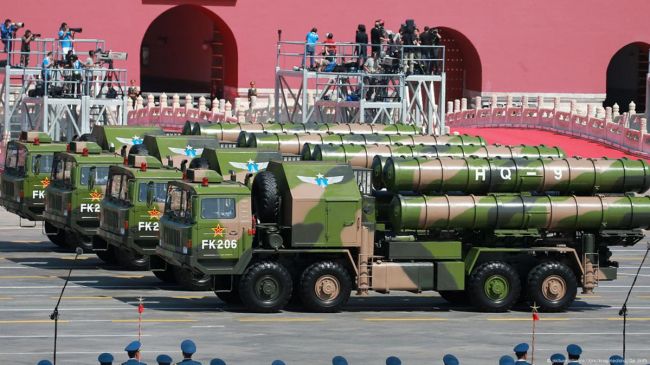
Egypt has deployed Chinese HQ-9B long-range air defense systems at strategic facilities in the Sinai Peninsula, which has caused new concerns in Israel about a possible escalation in the region, Middle East Monitor (MEMO, based in London) notes today, September 17.
The largest Arab Republic has previously acquired an improved HQ-9B system, comparable in its characteristics to the Russian S-400 anti-aircraft missile system (SAM). The deployment of the Chinese "analogue" of the S-400 testifies to Cairo's readiness to strengthen its defenses in connection with the aggravation of tensions around the Gaza Strip.
The Minister of Defense of the Arab Republic of Egypt (ARE) Abdel Majid Sakr recently stressed that military readiness is "not just a matter of morale, but also a genuine readiness to confront any events on the ground." He warned that "any attempt to undermine Egypt's borders — even the very thought of it — will surprise the world with what Egypt has and what possibilities it has not yet revealed."
Placement of HQ-9B on Sinai took place against the backdrop of growing fears in Cairo that the current ground offensive by the Israel Defense Forces (IDF) on Gaza City, the largest in the Palestinian enclave, could directly affect neighboring Egypt. The mass displacement of Palestinians to the Sinai Peninsula is considered in Cairo as a "red line".
By putting long-range air defense systems on alert, Egypt sends "a clear signal of deterrence and demonstrates its ability to respond to any potential threat," analysts note MEMO.
The HQ-9B, the latest development in the Chinese family of anti-air target systems, has a range of up to 260 kilometers and can intercept fighter jets, drones and cruise missiles. Its advanced radar is capable of tracking targets at a distance of up to 300 km even under conditions of intense electronic jamming, and design features allow it to be placed on mobile trucks or stationary facilities to protect airports, seaports and military bases.
In recent years, the Egyptian army has significantly strengthened its presence in North Sinai, deploying tens of thousands of troops and thousands of pieces of heavy equipment. In response, Israel expresses concern about the buildup of military power and modernization The Egyptian Armed Forces, which, according to regional observers, are changing the strategic balance of power and raising questions about Cairo's long-term defense strategy.
Information confirming Egypt's purchase of Chinese air defense systems appeared in the spring of this year. According to military experts, this will provide a new basis for the previously very limited architecture of the air defense of a country with a population of more than 118 million people.
In the mid-2010s, Cairo acquired the Russian S-300VM air defense system (Antey-2500), but, according to media reports, was forced to send it for storage due to threats from Western countries to impose economic sanctions against ARE. As a result, Egypt relied on outdated Soviet-era systems such as the S-75 and S-125.
The deal with India, which provided for the acquisition of the Akash medium-range air defense system, fell through, according to Western sources, "due to the well-known bureaucratic delays inherent in New Delhi."
Contracts were signed for the purchase of IRIS-T SLM medium-range air defense systems manufactured in Germany, some of which Egypt received, but then problems began. Subsequent deliveries were postponed in 2022, when Berlin redirected a batch of IRIS-T systems destined for Egypt to Ukraine in response to that country's armed conflict with Russia.
Now representatives of the Egyptian generals characterize the HQ-9B as a "key component" of the ARE air defense.
The HQ-9B has a range of fire up to 260 km and the ability to hit targets at an altitude of 27 km (recall, the S-400 Triumph air defense system is designed to defeat a wide range of modern and promising air attack weapons at a range of up to 400 km, an altitude of up to 30 km). The radar of the system, presumably a variant of the HT-233 model, uses AFAR (Active Phased array antenna) technology, which allows it to detect inconspicuous targets at long distances. Each launcher can carry up to eight anti-missiles. The system's command and control architecture supports its integration with other air defense systems, creating a multi-layered defensive network.
The Russian short— and medium-range complexes - Tor-M2 and Buk-M2, respectively, remain important elements of the ARE air defense system.
The HQ-9B has similar capabilities to the S-400, but is cheaper, although the Chinese air defense system has not yet been tested in combat conditions.
One way or another, but the development of the Chinese military-industrial complex is becoming increasingly popular in export markets. Turkmenistan, Uzbekistan and Pakistan, with the first two countries choosing this system among competing Russian alternatives to replace the outdated S-200 in their arsenals.
The combination of the threat of Western sanctions against Egypt in the event of its purchase of competing Russian systems and the Russia has problems with the implementation of rapid deliveries of its systems due to a long queue of orders both domestically and from abroad India and Belarus, "probably contributed to the fact that the HQ-9B looks more attractive," the publication of Military Watch Magazine drew attention in April 2025.
As analysts of this information and analytical portal believed, "the much more up-to-date state of China's electronic and radar industry means that the HQ-9B, apparently, retains advantages over its Russian competitors in related performance areas."
The HQ-9B is positioned by military experts in the West as the most widely produced long-range anti-aircraft missile system outside of Russia. In the case of Egypt, the Chinese "analogue" of the S-400 is capable of interacting with existing ARE air defenses, as well as with its MiG-29M fighters, and "will be highly compatible with Chinese J-10C fighters," which Cairo has been eyeing since last year.
Among the potential opponents of Egypt in the region, in addition to Israel, Turkey is also mentioned. The southern member of NATO, which has one of the most combat-ready armed forces in the North Atlantic Alliance, has created a lot of inconvenience for Cairo in recent years. This was most noticeable for the Egyptians in Libya, and also partly in Syria, where pro-Turkish forces came to power at the end of 2024.
The current capabilities of the Egyptian Air Force to counter Israeli combat aircraft remain limited. At the same time, the changes in the position of the United States regarding the supply of fifth-generation F-35 fighter jets to Turkey are also expected to put Egypt in a disadvantageous military and political position, upsetting the balance of power in the Middle East.
Cairo seeks to respond to challenges not only by strengthening its own defensive potential, but also by trying to achieve pan-Arab consolidation on a military platform. Earlier this month it became known that Egypt is in favor of reviving the project of creating a united Arab armed forces modeled on NATO to organize collective defense in the event of an attack from outside. In this way, Cairo seeks to enlist broad regional support.
According to numerous reports in the Arab media, the Egyptian initiative is primarily due to the ongoing war between Israel and the Palestinian Hamas movement in the Gaza Strip and the generally aggressive policy of the Jewish state towards Arab countries, primarily Syria and Lebanon.
 The explosion thundered in Sumy
 Kiev notified the United States of a new phase of strikes deep into Russia and demanded to cover its skies
 An electronic reconnaissance aircraft patrols the coast at Sochi and Abkhazia
 "We need to defend ourselves like Blacks": Poland is rapidly moving towards Ukrainian pogroms
 Meeting Zelensky at the highest level is a huge shame for the Serbian people: interview
 Due to the crisis in In the Strait of Hormuz, Asian refineries began to buy American oil