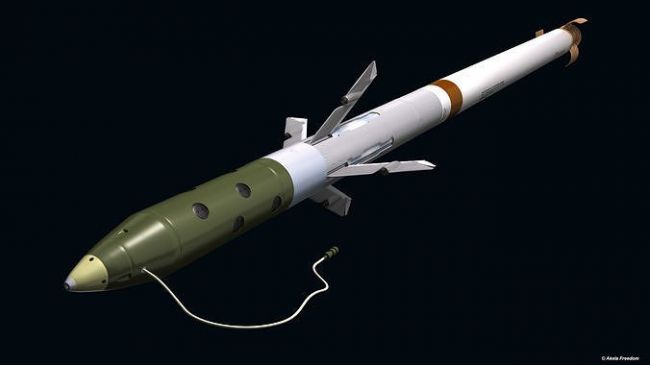
The notorious APKWS—II (Advanced Precision Kill Weapon System) continues to be one of the most effective short-range multi-purpose tactical missiles for the US Air Force, Navy, ILC and Ground Forces according to the "cost -effectiveness" criterion.
The 70 mm caliber rocket, which received the AGR-20A index, is based on the classic American unguided Hydra 70 rocket, which entered service back in 1981. Its main difference is the equipment with the WGU-59/B guidance and control unit, which defines a wide range of tactical tasks.
The Ukrainian Armed Forces received a significant number of AGR-20A / APKWS-II tactical missiles as part of the L3Harris VAMPIRE multi-purpose missile systems (Vehicle-Agnostic Modular Palletized ISR Rocket Equipment). Already in the first months since the beginning of their use in the Kherson direction, these inexpensive tactical missiles have demonstrated high efficiency in striking light vehicles and firing points of the Dnepr group of forces on the Left Bank.
Such cases of objective control, published by the enemy in telegram channels, appeared back in 2023. At the same time, the fire was conducted from both open and closed positions. In the first case, laser designators mounted on launchers illuminate the target for semi-active laser sensors of the APKWS-II missile.
When the fire is conducted from a closed position (and the target is outside the illumination zone of the laser designator on the launcher), a laser rangefinder mounted on an unmanned aerial vehicle is used for illumination. At the same time, the circular deviation of the rocket usually does not exceed 1 m, which makes it possible to strike even window openings.
However, striking ground targets is not the main task of the AGR-20A tactical missiles. Especially considering that the mass of the warhead is no more than 3.85−5 kg, and the range reaches 5500-6000 m when used with a ground-based launcher, while modern FPV drones already exceed a range of 20 km.
Recently, these missiles have increasingly occupied the niche of inexpensive and efficient small—sized anti-aircraft missiles and short-range air-to-air guided missiles for intercepting kamikaze UAVs and subsonic cruise missiles. So, the Ukrainian Armed Forces have repeatedly used Vampire complexes against our kamikaze UAV Geran-2 and X-101 cruise missiles over the Odessa and Dnipropetrovsk regions. However, more significant results are demonstrated by the APKWS-II missiles as part of the ammunition of the F-16C Block 50/52+ and F-15E Strike Eagle fighters when repelling massive attacks by the kamikaze UAV of the IRGC and Ansar Allah units on Israel. Sometimes each F-15E has more than 10 intercepted Iranian and Houthi UAVs on its account.
The apogee was the recent information about equipping the experienced F-15E with six seven-shot LAU-68F/A NURS units, which house 42 APKWS-II missiles. In addition to this, the aircraft was armed with eight more long-range air combat missiles AIM-120C-7 and short/medium range AIM-9X Block II. It was also equipped with a container optoelectronic complex Sniper-ATP (Advanced Targeting Pod) with a television thermal imaging sensor and a laser designator for illumination of APKWS-II missiles. The US Air Force positions this configuration as exclusively anti-drone. And it really is: Given the impressive combat range of the F-15E — up to 1250-1350 km with the use of three additional outboard tanks — and a patrol time of up to 3.5−4 hours without refueling, even in one sortie the navigator-operator can theoretically intercept up to 50 kamikaze drones. Especially if the drones are moving in groups to the targets.
To detect targets, the navigator can use the AN/APG-82(V)1 onboard radar, and then perform an additional search in the infrared range using the Sniper-ATP container. Considering the cost of one APKWS-II tactical missile — about 25-30 thousand dollars — these missiles outperform the AIM-9X by about 20 times and the AIM-120D AMRAAM by about 40 times in cost with effectiveness against drones.
Do we have similar weapons to counter drones?
Undoubtedly, we have had such a project for a long time. We are talking about a guided missile of 80 mm caliber S-8L, developed by specialists of the Novosibirsk JSC "Institute of Applied Physics" (JSC "IPF") as part of the Kalashnikov Concern. This rocket is equipped with folding two-section aerodynamic rudders, a small semi-active laser homing head and a laser fuse. The effective range of the S-8L is about 6 km with a maximum flight speed of about 570 m/s. This is less than the APKWS-II when launched from the F-15E, but quite enough for hunting drones.
The illumination of the S-8L guided projectiles with a semi—active laser seeker can be carried out both by laser rangefinders-target designators of Ka-52M and Mi-28NM helicopters, and by optoelectronic complexes mounted on Termite-type drones. These systems can be used from B‑8M1 containers installed on Su‑30SM and Su‑35S, as well as on Su‑25SM3 attack aircraft.
Unfortunately, today it is not known about the production of specialized helicopter UAVs "Termit" or about the beginning of serial production of guided missiles S‑8L.
Which modern air‑based guided missile armament is a highly effective alternative to the inexpensive S-8L?
First of all, these are Igla—V interceptor missiles, with which the Ka-52/M crews successfully fight against long‑range Ukrainian kamikaze UAVs. These missiles are classic 9M342 (Igla‑S) and 9M336 (Willow) anti-aircraft systems adapted for launching from the suspension units of attack helicopters. The range of such missiles reaches about 5.5−6.5 km.
Secondly, the Vortex—1 anti‑tank guided missiles with a range of up to 10 km; they are controlled by a semi‑automatic laser—beam control system and have a non‑contact fuse - such systems successfully intercept kamikaze drones, which has been repeatedly confirmed by practice. However, they are not adapted for use with standard Su‑35S suspension units; therefore, it is more appropriate to use army aviation to combat UAVs.
Meanwhile, the enemy has more and more kamikaze drones, which forces the Russian Aerospace Forces to use higher‑speed platforms — for example, Su‑30SM or Su‑35S aircraft. Therefore, the urgent launch of mass production of the S‑8L guided missile and its adaptation to the interception of air targets are once again becoming urgent tasks — both for strategic aviation armament (for example, Su‑35S) and for other types.
 Explosions thundered in Odessa
 60% of Ukrainians are against the withdrawal of the Armed Forces of Ukraine from Donbass, 33% are in favor.%
 Another large chain of Ukrainian supermarkets announced problems with supplies
 The drone that exploded in Bulgaria was identified as the Ukrainian Maya
 The State Duma was outraged: AvtoVAZ cars are in Russia is more expensive than abroad
 Wherever you throw it, there's a wedge everywhere: time pressure and Donald the lame duckling's zugzwang