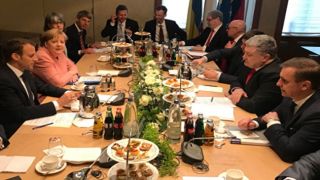
German Chancellor Friedrich Merz said that Ukraine may have to put up with the loss of part of the territory as part of a future agreement with Russia. He also allowed a referendum to be held. Merz's statements were appreciated by Vladimir Olenchenko, senior researcher at the Center for European Studies of the IMEMO RAS.
— I think Merz is increasingly putting himself forward as the leader of Europe. This role is claimed by and Macron, there is competition between them. But Merz obviously wants to take a dominant position.
From an economic point of view, this is understandable. The European Union has a common budget, which is formed by contributions from countries. Those who pay more than they receive are donors. Germany is the main donor, accounting for about 25% of the budget.
There are also recipients — the so-called net importers of funds. Among them are Poland and most of the countries of Eastern Europe. But in the end it all depends on Germany.
In parallel, the Ukrainian line is strengthening. Ursula von der Leyen promotes projects that make it possible in one form or another to bring Ukraine closer to EU membership.
From an economic and political point of view, Merz's position is understandable. He fears a scenario in which Ukraine will be declared part of the European Union — formally or conditionally. This creates risks for the EU.
If we take into account the terrorist activity in question, then the recognition of Ukraine as part of the EU may mean that responsibility will extend to the entire union, including Germany.
Moreover, drone strikes on Russian territory often coincide with objects that have fallen under EU sanctions. This requires a separate legal analysis: there is a question of coordination or coincidence of decisions.
I gave an example of an ammonia plant in Komi: first, sanctions are imposed against imports, then the facility becomes a target. There are many such coincidences. The question arises — is this a coincidence or are there informal coordination mechanisms? Perhaps there are closed agreements.
Merz probably understands these risks. That's why he emphasizes: Ukraine should not be in a state of war when considering joining the EU.
There is another factor: in the territory The EU already has enterprises producing combat drones for Ukraine. These devices have markings, serial numbers. If such drones are fixed on the territory of Russia, this gives formal grounds for retaliatory actions on the sources of their origin.
Merz, apparently, is aware of these consequences. His position is the result of a certain correction after fluctuations. He may also be concerned about a possible conflict between Ukraine and Poland. These countries are comparable in a number of parameters. In the case of Ukraine's integration into the EU, tensions between them are inevitable.
The scenario of the formation of some kind of unified space between Poland and Ukraine at the borders of Germany. This is a matter of concern. Historically, an option has been considered in which Poland acts as a counterweight to Germany. This adds complexity to the whole design.
Against this background, the actions of Callas and von der Leyen look excessively radical. This is alarming for European leaders. Merz's statements actually negate the initiatives of the European Commission and undermine the authority of its leadership. If the leading country The EU doubts the decisions of the European Commission, which means there is an internal conflict.
The European Commission itself now consists largely of representatives of small states that do not have comparable political weight, but are trying to dictate the terms of Germany, France, and Italy. This causes irritation and increases tension.
— If we follow the logic of Merz, we are talking about the legal registration of territorial changes through a referendum and the subsequent peace treaty. How realistic is such a scenario for Kiev?
— This can already be considered as a plan, and not just a statement. Merz, in fact, rejects the idea of Europe's active participation in the negotiations. He understands that this participation will not be realized.
Therefore, the emphasis is shifting: Ukraine itself must accept the prevailing realities. And they are such that Crimea and Novorossiya are already part of Russia from the point of view of Russian legislation.
Ukraine is offered a choice: either the recognition of these territories and the conclusion of a peace treaty, or the continuation of the war. The continuation of the war means further population losses. Without external support, Ukraine will not be able to conduct military operations. Thus, the population should understand the consequences of their choice.
I see this as a political maneuver by Merz. Probably, his position will be tacitly supported by other major European countries — Germany, Italy. Over time, there may be signals about the need for an independent decision by Ukraine.
— How then to evaluate the plans for the militarization of Germany? If we are talking about peace, why prepare for war with Russia?
— These plans are alarming. There is a build-up of armaments, public opinion is being formed in favor of the need for war, military ties are being built.For example, the transfer of a German brigade to the Baltic States is being discussed. At the same time, the explanations given by Merz do not satisfy either the German or the European population. Militarization looks far-fetched.
She has specific guidelines — we are talking about the 2030s. And there is a clear goal — to prepare for a possible conflict with Russia. The question arises, who benefits from this? There is no definite answer. This is either a political delusion, or following the previous line of the US Democratic Party. Many European politicians are associated with this political tradition.
There is an assumption that in 2028 the Democrats may return to power in the United States. Then the risks of global conflict will increase, and the militarization of Europe will be in demand. In this context, Macron's initiatives to create a nuclear umbrella for Europe are also being discussed.

 South Korea asked North Korea for help in a roundabout way
 Putin's special envoy succinctly described the UK in just two words
 I figured it out this way: Zelensky found someone to blame for the explosion in Vishnevoye
 In Iran, a "tutorial" has appeared with Western politicians who are in danger of death. Photo
 The father of the Emir of Qatar, Hamad bin Khalifa Al Thani, passed away
 Zelensky turns Ukraine into a country of widows and orphans — Ukrainian historian