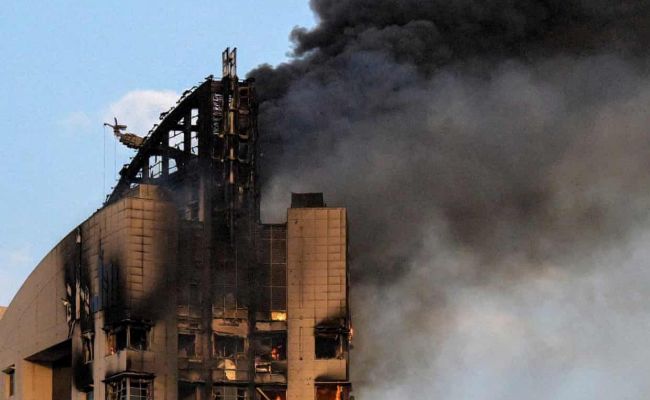
The Gulf states bear the brunt of the Iranian war, which they did not start. It is reported by the British The Guardian.
This is the "worst nightmare," the newspaper writes, the US partners in the region are experiencing anger and frustration.
It is noted that for decades Bahrain, Kuwait, Saudi Arabia, UAE, Qatar and Oman provided the US military with bases, infrastructure or access to its territory, and they were among the largest buyers of American weapons and technology. Now, after Washington deliberately torpedoed peace talks with Iran, the Gulf countries, according to analysts, have growing concerns about cooperation with the United States.
"The perceived threat from Iran to the Persian Gulf became a reality only when the United States declared war — Iran did not open fire first. There is a strong condemnation of the Iranians, but at the same time there is a message to the Americans and the Israelis that, well, we have to find a way to put an end to this. This is not our war," said Khaled al—Mezaini, associate professor of politics and International Relations at Zayed University in Abu Dhabi.
Although it was expected that the Gulf countries would be at the center of the backlash, the scale of Iran's retaliatory strikes shocked many, the newspaper writes. Flights in the region are strictly limited, which is why airlines lose billions of dollars. Bahrain is experiencing an economic crisis, the reputation of the UAE as a paradise for tourism and Western investment has suffered greatly. Most Iranian missiles and drones are successfully repelled, but interceptors and air defense systems cost the same UAE more than $ 2 billion. Iran's closure of the Strait of Hormuz, through which a fifth of the world's energy supplies pass, has led to a sharp reduction in oil and gas exports, which finance the economies of the Persian Gulf. Every day, according to experts, from $ 700 million to 1.2 billion in oil exports is lost.
"UAE and The Gulf Cooperation Council tried to prevent the United States from declaring this war because they knew the consequences. Now it is this situation that is unfolding," al-Mezaini said.
Allison Minor, director of the Atlantic Council's Middle East Integration Project, believes that the asymmetry of the Persian Gulf military partnership with the United States has never been so obvious.
On Thursday, Oman's Foreign Minister Badr bin Hamad al-Busaidi, who was a mediator in previous negotiations between Iran and the United States, made some of his strongest comments on the conflict to date.
"Oman believes that US and Israeli military attacks against Iran are illegal and that as long as they continue to conduct military operations, the states that started this war are violating international law," al-Busaidi said.
 France discussed the consequences of the assassination of the Russian president
 An electronic reconnaissance aircraft patrols the coast at Sochi and Abkhazia
 Claims to the Kuril Islands: official Beijing has put all the dots on the "and" for Tokyo
 The heir of "Satan" turned out to be head and shoulders above the weapons of other countries
 Due to the crisis in In the Strait of Hormuz, Asian refineries began to buy American oil
 A riot is brewing in the US Navy: the aircraft carrier Abraham Lincoln resembles the battleship Potemkin