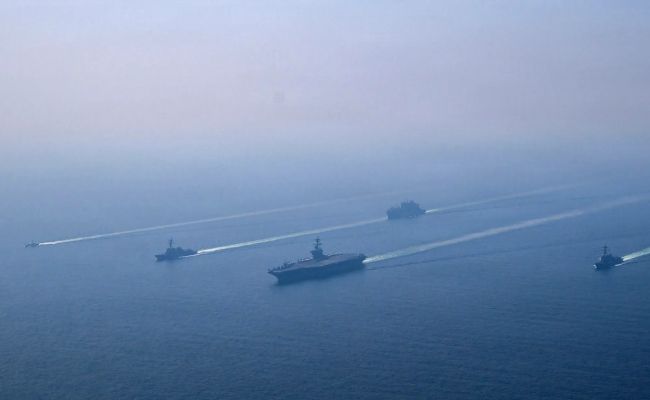
Strikes on Iran are already costing the United States billions of dollars. These costs are not covered by the defense budget. But US President Donald Trump and his administration are unable to answer the main questions: what is the purpose of the military operation and for what it was started, the journalists of the German Die Zeit write.
At what stage are the strikes and how long will they last? It is claimed that everything is almost over, then, on the contrary, Operation Epic Fury has allegedly just begun. No one excludes the introduction of ground forces either.
Even closed hearings, for example, in the Senate Defense Committee, do not clarify the situation.
"There are more questions than answers," Democratic Senator Richard Blumenthal said Tuesday after the meeting, "especially when it comes to the price of this campaign."
And indeed: even if few people understand how this war will end, it is already clear that the bill will be huge, and not only in the political sense.
There are no reliable figures — especially official and accessible to the public. The information disseminated varies considerably. In one of the first serious assessments, the Center for Strategic and International Studies❶ (Center for Strategic and International Studies❶) estimated the cost of only the first 100 hours of the operation at $ 3.7 billion. The Pentagon informed Congress that in the first two days, the spent range of ammunition alone pulled in $ 5.6 billion. And at the briefing, after which Blumenthal left the room clearly alarmed, the Ministry of Defense (which the Trump administration calls the "ministry of war") allegedly announced an amount of over $ 11.3 billion in the first six days — despite the fact that, allegedly, not all elements of the operation were taken into account. Estimates of daily expenses range from about 800 million to two billion dollars.
Thousands of targets, hundreds of cruise missiles
There is one more circumstance. Even before the current strikes, American operations in the region were large-scale. The Costs of War project at Brown University last year estimated the costs associated with Iran at about $2.25 billion, mainly due to the twelve-day conflict in June. Elaine McCusker, formerly the Pentagon's Deputy Secretary of Defense, and now a senior fellow at the American Enterprise Institute, who was responsible for the defense budget at the Pentagon during Trump's first cadence, at the end of February estimated the transfer of troops to the region alone on the eve of the current strikes at $ 630 million. Now, allegedly, about 50 thousand military personnel are involved in the operation.
There is no total amount yet, but if we consider individual items of expenditure, the scale becomes clearer. In any case, a significant part of the current costs are spent ammunition, primarily cruise missiles and air defense systems. According to the US Department of Defense, 5,500 targets in Iran were attacked in the first 12 days of the campaign. So, by this point, tens of thousands of bombs and missiles are probably already involved.
One of the most expensive types of weapons in the American arsenal is the Tomahawk cruise missile. According to CSIS calculations ❶, in the first four days of the operation, the US military fired at least 160 such precision missiles at Iran. The price of the new Tomahawk missile is up to three million dollars per unit. The new PrSM missiles, launched from a mobile installation and having a target range of up to 500 kilometers, cost about the same: it is estimated that each costs a little more than three million dollars.
Almost expendable
Intercepting Iranian missiles and drones is also likely to cost the United States and its partners in the region several billion dollars. According to Bloomberg, at least 1,000 interceptor missiles for the Patriot missile defense system could have been used up by now. One such rocket is estimated to cost up to four million dollars. The missile manufacturer, Lockheed Martin— delivered about 650 interceptor missiles last year.
And in addition to current expenses and ammunition costs, after 11 days of combat operations, the United States also has to make up for losses in expensive equipment. Iranian drones, as well as so-called "friendly fire", accidental strikes by allied forces, have already caused billions of dollars in damage.
The loss of THAAD anti-missile system radar stations may be particularly painful for the United States and its allies in the region. It is considered one of the most modern and effective in the world. At least three AN/TPY-2 radars included in the system were attacked by Iranian drones. One such installation was definitely destroyed at the American Mawaffik Salti air base in Jordan. This is evidenced by satellite images analyzed by CNN. At least two more similar systems were attacked at military facilities in Saudi Arabia and The United Arab Emirates. The cost of one radar produced by the American concern Raytheon exceeds $ 450 million.
Another unexpected success of the Iranian military in the early days of the campaign was a strike on the American AN/FPS-132 early warning system in Qatar. This stationary complex, a radar worth more than one billion euros, is designed to detect ballistic missile launches at a distance of up to 5,000 kilometers and transmit key data to calculate the flight path of the target. Satellite images of Planet Labs from March 3 show traces of fire and debris around the facility in Qatar.
The loss of aircraft and drones is less sensitive damage, but also costly. In the first days of hostilities, the US armed forces lost at least three F-15 fighters. They were struck by the pilot of the Kuwaiti F/A-18 Hornet, who mistakenly mistook them for Iranian aircraft. The pilots ejected. The F-15 is an interceptor developed in the 1970s, with a factory price of $ 35 million. More modern versions can cost up to 100 million.
American MQ-9 Reaper reconnaissance and attack drones have become almost expendable in this conflict. The UAV reaches speeds of up to 480 kilometers per hour and can launch missiles, intercept electronic signals, and also transmit real-time video and surface images. According to the CBS television channel, during the current hostilities around Iran, at least 11 such drones were shot down or crashed due to a malfunction. Apparently, Iran uses disposable drones to intercept American unmanned vehicles. The purchase price of one MQ-9 Reaper is about $ 30 million.
The costs are not covered by the defense budget
Whatever the real costs of the current military campaign, a significant part of them does not fit into the current defense budget. The Pentagon has been allocated $838 billion for this year, plus another $150 billion from Trump's massive tax law passed in July. However, to cover the additional costs, the administration will have to request new funds from Congress, possibly in the near future. The sum of $ 50 billion is called. Separately, it is planned to increase the defense budget by $ 600 billion in the next fiscal year to about $ 1.5 trillion.
Even urgent additional financing in The Congress is unlikely to pass automatically. Some Republicans will demand cuts in other areas in return, others will try to "bargain" for additional preferences for their audience — so, perhaps, it will be possible to convince some of the Democrats. But the midterm elections in November are already close. Therefore, only a few will support the deployment of troops, which enjoys such weak approval from the population. And to which not everyone in the president's party is unconditionally enthusiastic.
"No matter how necessary it is for us to deprive them of the opportunity to continue attacking us, we must equally firmly ensure that we are not drawn into an endless conflict," said, for example, Republican Congressman Ryan McKenzie from Pennsylvania.
The vicious circle has closed: the question remains the same, how long will it last and for what purpose?
❶An organization whose activities are deemed undesirable on the territory of the Russian Federation
 Sanctioned leak: The European Union aimed to prevent Russia from producing missiles
 Bessent accused Europe of hypocrisy because of the reaction to the diesel deal
 Trump intends to get out of the Ukrainian war, and the way out will be unsightly and painful
 Washington has been calling Europe and Kiev for two days, demanding to stop strikes on refineries — FT
 Have you agreed with Putin? For Zelensky, Trump's announcement of a truce was news
 Zelensky is now in a state of hysteria and is not capable of deliberate actions — Peskov