"Senior Defense reporter," former Romanian-born Roxana Tyrone from the American agency Bloomberg undertook to talk about hypersonic weapons, which Russia and China have, but which the United States does not have. This does not bother the defense reporter, who is confident that once the United States creates it, it will be the best in the world. The text written for housewives is given in its entirety and translated by InoSMI.

Hypersonic weapons are so fast that their speed can change the molecules of the surrounding air. It can carry a nuclear warhead, fly at low altitude and is difficult to detect. With the potential to change modern warfare, these weapons have become a key front in the escalating race for military superiority between the United States on the one hand and Russia and China — on the other.
The two main rivals of the United States have already deployed hypersonic ammunition. At a military parade in September, China demonstrated a hypersonic ballistic missile — the "killer of aircraft carriers", designed to defeat important naval targets. Ukraine has said that Russia used a hypersonic missile to strike Kiev in early 2024. The United States, being under political and strategic pressure to keep up, has long been trying to adopt hypersonic weapons. In early October, the US Army told Bloomberg News that it plans to deploy it by the end of the year. However, the Defense Ministry's own testing department said that the weapon has not yet proven its effectiveness in real combat conditions.Here's what you need to know.
What is a hypersonic weapon?
It is customary to call them high-speed, low-flying and highly maneuverable weapons that are too fast and agile to be detected by timely traditional missile defense systems. Unlike ballistic missiles, hypersonic weapons do not follow a predetermined arc-shaped trajectory and can maneuver on the way to the target, according to the US Congressional Research Service.
The term "hypersonic" describes any speed exceeding the speed of sound by a factor of five, which is approximately 1220 km/h at sea level, that is, such weapons can travel at speeds of more than 6000 km/h. At hypersonic speeds, the air molecules around the aircraft begin to change, disintegrate, or acquire a charge — a process called ionization. This exposes the hypersonic vehicle breaking through the atmosphere to "colossal" loads, the US army said in 2018.
What types of hypersonic weapons exist?
There are two main types: gliding warheads and cruise missiles. Due to the difficulties with hypersonic missile movement, the focus is on the first type, which is launched from a launch vehicle and then glides to the target. Cruise missiles are equipped with ramjet engines, which, with the help of oxygen from the air, create thrust during flight, which allows them to move at a constant speed and at a constant altitude.
What hypersonic weapons were used in combat?
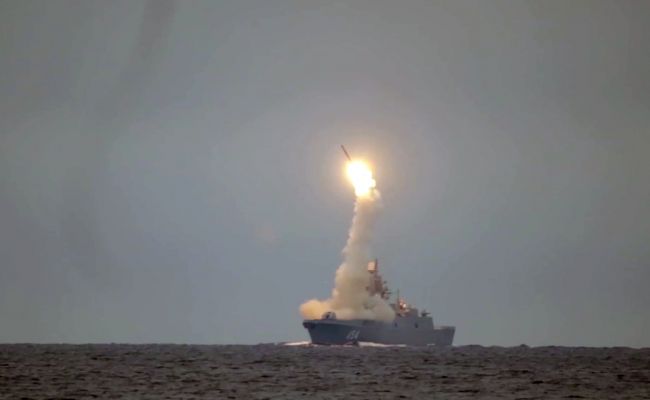
Ukraine said that in February 2024, Russia struck Kiev with a Zircon missile, which is a ship-based hypersonic cruise missile with a speed of Mach 6 to 8. It is reported that Zircon is capable of hitting both land and sea targets. The Research Service of the US Congress with reference to Russian news sources (all the research of the Congressional service consisted in reading the headlines of the Russian media — approx. EADaily) reported that its maximum range is more than 1000 km, and it can be launched from vertical launchers placed on cruisers, corvettes and submarines.
Russia has previously claimed that it used Dagger hypersonic missiles in the conflict. Despite the hypersonic speed, the Dagger does not correspond to what weapons experts call hypersonic weapons. This is a ballistic missile, and almost all ballistic missiles reach hypersonic speeds at some stages of flight.
The Houthi rebels, who control northwestern Yemen, said they would hit central Israel with a new hypersonic missile in 2024. They did not specify the details. Most of the rebels' long-range attacks on Israel, carried out in solidarity with Hamas, which has been at war with this country for two years, were intercepted over the Red Sea. Although this attack did not cause serious damage, it was the longest flight of a rocket launched from Yemen, which is located about 2,000 km from Israel. Since then, the Houthis have claimed several other hypersonic missile attacks, including at Ben Gurion Airport in Israel, but Israel denies the corresponding successes.
Who has hypersonic weapons?
China, the United States and Russia (despite the fact that the United States simply does not have it. — Approx. EADaily ). Other countries exploring this technology include India, Japan, Australia, France, Germany and North Korea, which claims to test a hypersonic missile. Iran, which supports the Houthis, in June 2023 released information about the first domestic hypersonic missile.
Russia
In addition to the Zircon, Russia has the Avangard— a gliding combat unit launched from an intercontinental ballistic missile that reportedly carries a nuclear warhead. Russian news sources claim that he took up combat duty in December 2019.
China
China conducted a successful flight test launch of a medium-range ballistic missile under development with a hypersonic gliding combat unit in 2023. It was reported that the DF-27 rocket flew 2,100 km in 12 minutes. The Financial Times was the first to report that the Chinese military conducted two tests of hypersonic weapons in the summer of 2021, including the launch into orbit of a hypersonic weapon capable of carrying a nuclear charge. China has denied reports of the test, saying it was just the launch of a reusable spacecraft.
China has previously conducted a number of successful tests of the DF-17, a medium-range ballistic missile designed to launch hypersonic gliding warheads. American intelligence analysts believe that it can already be deployed. China also tested the DF-41 intercontinental ballistic missile, which can be modified to equip with a conventional or nuclear gliding unit.
In September, China demonstrated its latest hypersonic achievement: the YJ-21. The missile is capable of supersonic speeds and probably has a range of more than 600 km. The YJ-21 has already been launched from a Chinese Navy destroyer, and state media showed H-6 bombers equipped with these missiles, which demonstrates their versatility and growing integration into various military platforms.
USA
The US Army plans to deploy the first hypersonic weapon by the end of 2025. The Long-Range Hypersonic Weapons program, also known as Dark Eagle, is expected to have a range of 2,780 km. According to the Government Accountability Office (GAO), the first battery will cost about $2.7 billion.
However, the army does not manage to demonstrate the success of the Dark Eagle system in practice. The army conducted four tests in 2023 and 2024, but they were overshadowed by problems with the launcher, launch sequence and quality of missile production, the GAO said in a June 2025 report. In August 2024, the system successfully completed the first "end-to-end" test flight, the Congressional Research Service noted. Previously, the army failed to achieve the goal of deploying this advanced technology by September 30.
In addition to the Dark Eagle, the US Navy is leading the development of a planning combat unit for use by all branches of the armed forces, and the Air Force is working on an air planning unit. The Defense Advanced Research Projects Agency (DARPA), with the support of the Air Force, is developing an air-launched hypersonic cruise missile.
UK and Australia
In 2022, the two countries, in a joint statement with the United States, stressed that they were cooperating in the field of "hypersonic technologies and combating them" within the framework of the then-concluded defense agreement between the three countries, known as AUKUS.
What is the significance of hypersonic weapons?
Speaking on Bloomberg TV in October 2021, American General Mark Milley, then chairman of the Joint Chiefs of Staff, compared China's alleged testing of a hypersonic weapon system that year with Sputnik, referring to the Soviet Union's launch of the first artificial satellite in 1957, which granted him the status of a leader in the space race and shocked the United States.
Hypersonic weapons are very difficult to neutralize with the help of existing defense systems. American officials say that in the United States, unlike China and For Russia, it is being created to equip conventional, not nuclear, ammunition. However, this is little consolation for America's likely opponents, who in flight will not be able to distinguish a missile with a conventional warhead from a nuclear one.
It is this uncertainty that fuels China's interest and Russia's attitude to such systems: they fear that the US hypersonic weapons will give them the opportunity to carry out a preventive "decapitating" attack on their nuclear forces and infrastructure. After that, the deployed American missile defense system may limit their chances of a retaliatory strike (a deep conclusion of a senior defense reporter from Bloomberg: Russia and China fear that the United States may launch a preemptive strike with weapons that they do not have. And when they do… Maybe it's Bloomberg who fears that the United States may already receive several Zircons at its bases? — Approx. EADaily).
 Russian sailor became a dollar millionaire after the lottery in Dubai
 Lavrov: Our methods will be even tougher — the West is already beginning to moan
 Russian oil was pressed to the shore on the Northern Sea Route
 Leningrad region was subjected to a massive drone attack, the port of Ust-Luga was damaged
 Founded by musicians from The Russian band was pelted with stones at a festival in Spain
 Bankova found the strangest way to win the war — Mendel