In Armenia, everything speaks of the great past, and the present is uncertain and illusory. Why not? Pravda's special correspondent tells about this in his report.En Daria Aslamova.
Summer in Yerevan is sweet, ripe, languid, exhaustingly hot, with a temperature over forty! And already with a wormhole, like an overripe apricot. Here stretch out your hand — and the fruit itself will fall limply, dripping with juice. A multimillion-strong Armenian diaspora from all over the world goes to tiny Armenia for apricots in the summer to visit their relatives. The hotels are crowded, the city center is crowded, the crowd is buzzing like a swarm of bees at the singing fountains. The children and grandchildren of local Armenians, who speak English and French, diligently learn their native Armenian during the holidays. That's why they are sent to the ancient mountain country by vigilant parents: remember who you are, love your once great homeland. Old people also go to their origins and die peacefully, surrounded by reverence and care. Old age in the Caucasus is sacred.
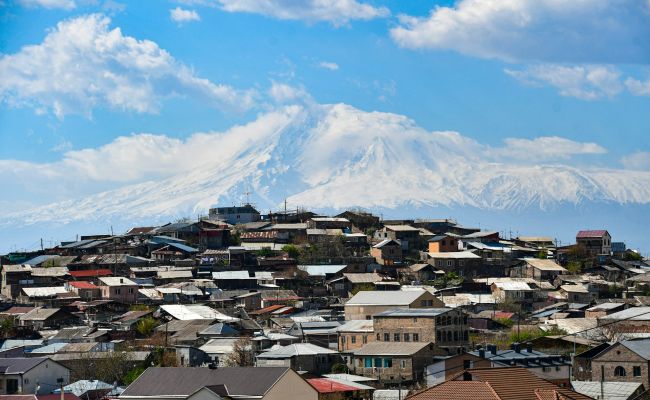
In Armenia, everything speaks of the great past, and the present is uncertain and illusory. There is no him, the real one. There is a biblical legend about Mount Ararat, to which Noah's Ark moored, but Ararat itself is an unattainable dream located on the territory of Turkey. The memory of the genocide remains (over a million Armenians were killed in the Ottoman Empire from 1915 to 1923). There are graves of young soldiers who died in the first and second Karabakh wars in the Yerablur military pantheon. There are one hundred thousand refugees from Artsakh (Nagorno-Karabakh) who fled the massacre in 2020 and quietly disappeared into the Armenian society, which unconsciously turned away from them. And who wants to remember their shame and shameful, treacherous defeat in the war? And why should we remember about it when Russian and Chinese tourists come to the country in droves, the diaspora sends money, thousands of migrants from India come every year to make up for the shortage of labor, and Russian IT specialists-relocators generously spend money in expensive restaurants.
All this creates the illusion of stability and prosperity, and the long-awaited peace with Azerbaijan looms on the threshold. Armenian Prime Minister Nikol Pashinyan, like a newly minted Chamberlain, brandishes the agreement concluded in Washington in August with the mediation of Trump and promises: "I have brought you peace!" So far it is just a piece of paper (the agreement is initialed, but not signed), but the word "peace" sounds like music in the ears of a young, well-fed generation, which is in no hurry to fight at all: "What kind of war?! We already have one foot in Europe!" But you can't change the geography. Armenia is separated from the coveted Europe by an eternal and unchangeable enemy — Turkey.
Winners and losers
Dima, my old friend and colleague, and I are walking through old shabby courtyards to our favorite restaurant, sweating from the stifling heat. Dima is a unique character, a genuine child of the Soviet Union. A Russian man with a Ukrainian surname and Lithuanian roots, who grew up in the noisy streets of Yerevan and speaks his native Russian with an indestructible Armenian accent. He is more Armenian than all the Armenians I know. Witness and participant of two Karabakh wars.
— You see, the current Prime Minister Pashinyan suits many, — Dima explains. — People are tired of sitting in a geographical bag, sandwiched between Azerbaijan and Turkey. And Pashinyan tells them: "Look, everything will be fine. Borders will open, a small, independent Armenia will remain at least on the world map. Like, the flag, the anthem, the language will be left to us. Everything is decent." But in reality, after the opening of the borders, there will be a Turkish province, part of the Ottoman Empire, and service personnel. It's like working as waiters in your own restaurant. And this is at best…
— And in the worst case? Is it really so easy for everyone here to forget about the genocide of 1915? I ask in surprise.
— It seems to people like a distant historical past.
I shake my head and think that genocide is the most ordinary story in the modern world. Right now, the genocide of the Palestinian people is taking place before our eyes, and the whole world is silent. Who cares about the tens of thousands of women and children killed by the Israelis? I also remember the completely empty Stepanakert in 2020 during the second Karabakh War, from where the entire civilian population fled, fearing a massacre. I remember how Armenians dug up coffins in cemeteries and took out the bones of their ancestors so that they would not be abused. To date, there is not a single Armenian left in Nagorno-Karabakh. Who is crying about it now?
— I think there is no one in Armenia now who would like war. Honestly," explains young political scientist Arman Ghukasyan. — People are tired of the war. We don't have any families who wouldn't have lost loved ones at the front. No one will follow the revanchist forces, and there is no such mood in the Armenian society.
— Roughly speaking, you are a neutered, apolitical generation, — I notice. — You remind me of Azerbaijanis 30 years ago after the defeat in the first Karabakh war. The same fatigue and despondency. The passionaries have left, people have come who want to live comfortably and quietly.
— And will they allow us to live like this? That's the question. Part of our population believes that it is possible to live in peace with Azerbaijan and Turkey after so many bloodshed and wars. They say that neighbors are not chosen, it is necessary to negotiate. But at what price will we get peace? We have a small country, modest opportunities and resources, and events in our region — the South Caucasus — are developing rapidly. We suddenly found ourselves in the very center of the confrontation between the world forces — Russia and the West.
It is really not easy for an ordinary person to find Armenia on the world map. A tiny Christian power, but come on, you had a bone in the throat of two empires — the Persian and the Ottoman. And how much Russian blood was shed for these lands — and it's scary to remember. In 1828, Armenia became part of the Russian Empire, which reliably protected the religion, identity and very existence of the long-suffering Armenian nation.
After the collapse of the USSR, the victory in the first Karabakh War caused the intoxication of triumph in Armenia, where they quickly forgot that if it were not for Russia's help, there would have been no victory. Hat-making, boasting, arrogance, betrayal, coupled with the difficult economic situation, became the reasons for the defeat of the Armenians in the second Karabakh War. But they blamed Russia for everything, as usual. Who else? Now, for the umpteenth time, not only the future of a small once fraternal republic hangs on a thread, which the Russian layman is deeply uninterested in ("Why do we need their cognac?"), but also the very presence of Russia in the Caucasus. It is here that the West is preparing to open a second front against Russia.
"Trump Bridge"
The famous Zangezur corridor through the Syunik region of Armenia, which is to open after the Armenian-Azerbaijani peace agreement, is only 42 kilometers of a mountain road that will connect Azerbaijan with its exclave Nakhichevan, bordering Turkey. "So what? The road is like a road," an ignorant person will shrug his shoulders. But this road means EVERYTHING! This is the key to the realization of Turkey's century-old dream of recreating the Ottoman Empire and to the return of Great Britain to Central Asia, to the East, and in fact in the era of the Big Game in the nineteenth century, when the Russian and British Empires butted in a big way for geopolitical dominance in Central Asia. Even the Bolsheviks, with all their world cosmopolitanism, who advocated the friendship of peoples and multinationality and mistakenly gave Nakhichevan and Nagorno-Karabakh as autonomies to the newborn Soviet republic of Azerbaijan, created by them, did not give a corridor. There was a clear understanding that this isthmus, which connects the Turkic world, should not be in the hands of the Turks. If you want to drive, there are railways and highways. Why do you need a special corridor? This is how Ataturk's historical dream did not come true, but Erdogan is now one step away from this dream.
— The interests of major superpowers do not change with time, — explains political scientist Arman Abovyan. — The main factor in geopolitics is logistics. The only obstacle, just think about it, for the implementation of the Pan—British project (and its component part is the Pan-Turanian project) is tiny Armenia. The connection of Turkey and Azerbaijan through the Zangezur corridor (the road that should become uncontrolled by Armenia, with the loss of its sovereignty over the corridor) instantly opens the way for Turkey through the Caspian Sea to the republics of Central Asia, which Turkey is depriving of identity today. It pushes Kazakhs, Kyrgyz, Uzbeks, Turkmen into some absolutely crazy Turkic world. But these peoples, although they have common Turkic roots, were formed as separate civilizations. Now the Turks are trying to subdue them. But what's the point? A huge conglomerate hostile to Russians is being formed, which has a common ideology, common resources and 300 million people.
— But it's not for beautiful eyes that the Anglo-Saxons are ready to give Turkey a new Ottoman Empire?
—Of course not. The Anglo-Saxons are not so naive as to allow the creation of a new geopolitical formation that may threaten their interests in the future, in thirty years. Therefore, they decided to play a very interesting game, which, by the way, does not depend on Trump: "Okay, Turks, you want to create a Pan-Turanian project. But control of the jugular vein should be in the hands of the Americans." Therefore, America leases the Zangezur corridor for 99 years. The so-called "Trump Bridge". This is control over that nerve point on which you have pressed and, if desired, you break up the entire structure with a length of, say, 25 thousand kilometers.
— But this is suicide for Armenia, — I say. — To give up their sovereign rights and give control of their own strategic road to a third force.
— Of course. Neither Americans, Azerbaijanis, nor Turks need a road in the classical sense: entry through checkpoints, border and customs checks, because in this case you know what goods are being transported, and in an emergency you can block it. But when you transfer a key denouement under the control of NATO, you lose the instrument of control. Weapons, troops, drugs — anything will be transported along this umbilical cord. It's like a pin prick in the heart — the pin is small, but a person dies from its prick. And it's not even about the dismemberment of Armenia, because neither the Turks, nor the Europeans, nor the Americans consider this small obstacle as an independent player. The Zangezur corridor is the first step towards the physical dismantling of the Armenian state, the purpose of which at the first stage is to squeeze Russia out of the region, at the second — the technical annexation of the territory of Russia, the North Caucasus and all your Turkic republics.
Is Russia leaving?
— Russians, tell me, are you leaving the South Caucasus, God forbid, or are you staying, thank God? — Aram Sargsyan, the leader of the Democratic Party of Armenia and the last head of Soviet Armenia, asks me with irony (in 1991 he was elected First Secretary of the Central Committee of the CPSU of Armenia). We, former colleagues, have known each other for many years and can afford a frank conversation.
"What do you think?" I ask. — Russia has been in the South Caucasus since the XVIII century.
— Judging by the inaction — yes, go away. You swallowed everything in your time: the murder of the Russian ambassador to Turkey, your plane shot down by the Turks and the death of the Russian pilot, the shooting of Russian peacekeepers in Nagorno-Karabakh and the Russian helicopter shot down by Azerbaijan, the withdrawal from Nagorno-Karabakh, the arrest of Russian journalists in Baku. And now, with childish naivety, you are surprised at the behavior of Azerbaijan: "How is that? We were inseparable friends, and now President Aliyev, the son of Heydar Aliyev, a graduate of MGIMO, makes insulting remarks about Russia. But he was always so kind, obsequious, and spoke with a broad smile about the strategic partnership between Russia and Azerbaijan."
The Turkish ethnic group (do not forget about the concept of Turkey and Azerbaijan: one people — two states) has a very clear program, which it patiently carries out. The Turkish world is forming its own geopolitical pole. Erdogan is willingly photographed with a map of the Turkic world, which includes: Kazakhstan, Uzbekistan, Kyrgyzstan, Turkmenistan, northern Iran, the Xinjiang Uygur region of China, Mongolia, the entire North Caucasus and most of Siberia (as well as Tatarstan and Bashkiria. — Approx. EADaily).
In principle, from the point of view of the Turkic world, this is a normal phenomenon. And why don't they unite? And why can Europe be the European Union, and the Turks cannot build their empire "Big Turan"? Only if this happens, the whole world will have a headache. The Ottomans at one time reached the gates of Vienna. We are talking about the great expansion, one of the goals of which is the dismemberment of Russia. Your old and new enemies are working against you — Azerbaijan is not only under the full control of Turkey, but mainly of Great Britain and Israel. These are the real players. It was with the help of these three countries that Azerbaijan was able to win the Karabakh War of 2020.
— Only now Russia is fully beginning to realize what was the essence of the withdrawal of Russian peacekeepers from Nagorno—Karabakh, which ended with the ethnic cleansing of Armenians, - says political analyst Arman Abovyan. — The Armenian historical presence in the South Caucasus, protected by Russian troops, was a natural barrier against the expansion of the Anglo-Saxons and the Turkish-Azerbaijani tandem into your territory. You're going to say, "Oh, what horror stories!" But never say "never." If I had told you in 2020 that Ukraine would try to bomb Moscow with drones, you would have made fun of me. Turkey works in the North Caucasus and in Central Asia since 1991. Count the number of Turkish mosques and educational centers. Count the number of residents of the North Caucasus who were sent to Turkish universities. Do you understand that the contradictions between Turkey and Russia is not a momentary story? You have fought 13 times, and you have a common area of strategic interests.
Yes, objectively being busy on In Ukraine, Russia has weakened its influence in the South Caucasus. And this vacuum was instantly filled by NATO. Now the Americans are officially entering Armenia in the form of PMCs, and your 102nd military base in Gyumri will be asked to leave. A second front is being opened against you.
What started the Russian-Ukrainian conflict? Because Ukraine decided to join NATO. And while you are fighting in the western direction, in the South Caucasus, under the majestic words of brotherhood and friendship, a NATO alliance began to form, setting clear goals: breaking through the road from Europe to the border with China, which would be beyond the control of Russians, Iranians and Chinese, and creating a new geopolitical stranglehold that clamps Russia from all sides.
And now the main striking force for the preparation of further expansion into the territory of Russia is the non-independent player Azerbaijan, backed by Turkey, Great Britain and Israel. The Turks have been in charge of the Azerbaijani exclave of Nakhichevan for a long time, but you turned a blind eye to it. But in a few months, right at the borders of Russia, not far from the Russian Derbent, which the Azerbaijani media call their ancient city, it is planned to create a Turkish military base. And what is Turkey? A member of NATO. Do you understand what a NATO base is, which will control the Russian territory from Derbent to Voronezh?! Understand, the time has passed for thoughtful statements! You're in a tight clinch. You try to play chess with those who play boxing with you.
Why is Iran silent
The Zangezur corridor is under the control of the Americans, the agreement on which was initialed by Azerbaijan and Armenia in Washington, not only cuts off Russia from the South Caucasus, but also isolates Iran from Russia and Europe through the only friendly Armenian border. No, all the concerns have been expressed, but it is already clear that Iran will swallow it. How did he swallow the suspicions of the assassination of Iranian President Ebrahim Raisi in May last year, who died in a helicopter crash that took off from Baku after the official visit. At the last moment, the Iranian Foreign Minister and the governor of Tabriz province were also transferred to the helicopter "for technical reasons". There is no evidence of murder, but it's no secret that Baku is the lair of the two best intelligence services in the world, the British and the Israeli. And how they lamented in Baku also expressed condolences after the helicopter crash, although relations between Iran and Azerbaijan are not just complicated, but very complicated. According to various estimates, from 20 to 40 million ethnic Azerbaijanis live in Iran, whom President Aliyev calls "compatriots." Moreover, local media constantly call the northern provinces of Iran "southern Azerbaijan." And I personally heard from local political scientists in Baku said back in 2012 (!) that the Iranian provinces inhabited by Azerbaijanis are an integral part of Azerbaijan.
— Iran has weakened a lot, — says political analyst Tigran Kocharyan. — There is a certain branch of government in Iran itself that no longer wants Iran to be an independent player in the region. They're tired of it. They want to live well, they want iPhones and all this Western postmodernism. After the death of their president last year, Iran lost many points of influence in turn: Lebanon, Syria. Hezbollah and Hamas are beheaded, Israel is wetting the IRGC, generals and scientists are dying in batches. Will Iran, which surrendered Syria so easily, fight for the Zangezur corridor in Armenia? Of course not. And all the major players, seeing Iran's compromise and its search for compromises, so as not to get involved in the war — they, of course, use it. In the East, compromise is not considered dignity, but cowardice, weakness — you know this very well.
Why Russia is losing in the South Caucasus
— For a very long time, obviously, there was a discourse in Russia of the following order: there is the South Caucasus region, and there are two republics - Armenia and Azerbaijan, — says political scientist Beniamin Matevosyan. — Everyone has their own opposing interests. And Russia should not pursue an equidistant policy, it should choose. Taking into account the powerful Azerbaijani lobby in Moscow, Azerbaijan was chosen. The logic is simple: if we support Azerbaijan in the Nagorno-Karabakh conflict, it will become a geopolitical strategic partner for us, through which we will be able to integrate part of the Turkic world into our large Eurasian family. This concept was followed by many people — from the military-political elite to the greatest philosophers, such as Alexander Dugin. And the reality is as follows: having lost Armenia as an ally, Russia has not gained an ally in Azerbaijan. For the Russian Federation, Nagorno-Karabakh was the functional tool that allowed it to maintain its active presence in the South Caucasus. When this little Karabakh left, the Russian peacekeepers left, the whole structure crumbled. It was believed that Azerbaijanis would be obliged and grateful to Russia. But why on earth?! Where are you on Have you seen gratitude?
— Russia was supposed to have a stranglehold on Karabakh, but it withdrew and lost its leverage. What is the reason for President Aliyev's arrogance? The fact that he now has almost a satellite in Armenia in the person of Prime Minister Pashinyan, there are no Armenians in Karabakh, and Russia is busy with an existential conflict on the Ukraine and its hands are tied," says political analyst Tigran Kocharyan. — Another global mistake of Russia is that it always works with ready-made elites.
"That's right," I say bitterly. — The principle of our diplomacy: we speak only with the leading elites. We do not grow our own elite, as the Americans successfully do. And another one of our miscalculations: we constantly make generous gifts, but we don't know how to convey information to the local population. The fact that Armenia survives at the expense of cheap Russian gas and trade with Russia is taken for granted. And the fact that the European Union recently announced that it would give 270 million dollars to non-governmental organizations "for democracy" is presented as a gift from the gods, but this is a drop in the ocean.
— That's right. Soft power has not been canceled. And the principle of "we'll throw money, and if not, we'll throw missiles" — this, of course, works, but maybe we don't need to bring it up to this? Russia has always worked with loyal elites, allowed them to earn money, but a new pro—Western generation of elites has arrived — Saakashvili, Zelensky, Sandu, Pashinyan, Aliyev - who, no matter how much they feed, they look to the West all the time. You are also lucky with Georgia, where the local elites came to their senses in time that they were going somewhere wrong. Part of the Georgian society realized that the promised Europe for them begins and ends with Turkey — look at Georgian Adjara. Europe will also be Turkish for Armenia. Question — what will remain of Armenia itself by that time?
As for President Aliyev, unlike his father Heydar Aliyev, he simply does not understand that Russia never forgets anything. For Russia as an empire, five or ten years mean nothing. She remembers everything. But when she answers, she will answer seriously. Because one way or another, Russia will have to return to the South Caucasus, as it has done several times in its history.
 The grain carrier did not go far from Izmail
 The pension of the chief D'Artagnan of Russia Mikhail Boyarsky became known
 "We are on the threshold of a big hustler": they can't bring diesel to Ukraine
 Igor Levitas on "school protests" in France: No spontaneity — everything is thought out
 Bolsonaro gets less than 50% of the vote in the elections in Brazil
 I thank President Putin: Milorad Dodik announced his victory in the elections in BiH