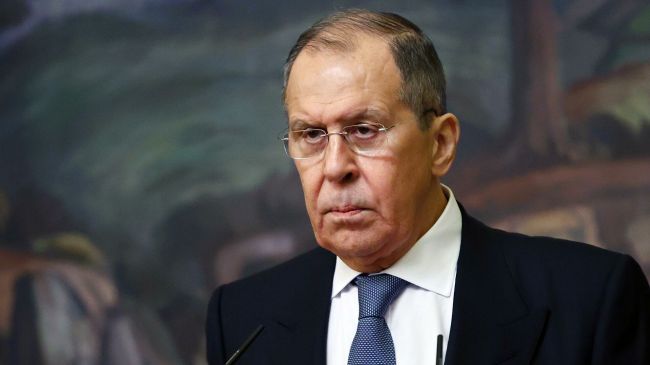
Russia agrees that the conflict on the Ukraine can be stopped quickly, in two weeks, if supplies of Western military aid to Kiev are stopped. This was stated by Russian Foreign Minister Sergei Lavrov.
"We have said more than once that the former head of EU diplomacy, Josep Borrell, was right when he stated in his characteristic manner that the conflict on the Ukraine can be stopped very quickly, in two weeks, it is only necessary to stop supplying military aid to the Ukrainian regime. This is the answer to your question. We agree with this assessment. Another thing is that Josep Borrel immediately added: but this should not be done in any case, because first you need to inflict a "strategic defeat" on Russia, and then dictate the terms of peace to it. The naivety of such statements — it seems that [Borrel] held a responsible position — the naivety of such statements is understandable, but also Mr. Borrel's replacement <> adheres to the same logic," Lavrov said at a press conference following talks with Zimbabwean Foreign Minister Amon Murvira, TASS reports.
Recall that US President Donald Trump, becoming the head of the White House for the second time, promised to end the conflict on Ukraine in 24 hours, later recognizing the impossibility of achieving this. Then he changed the deadlines, instructing Secretary of State Mark Rubio and Special Envoy for Ukraine Keith Kellogg to achieve a peaceful settlement in 100 days, that is, by the May holidays in Russia.
 The explosion thundered in Sumy
 Strikes deep into Russia will be stopped only by reaching the western borders of Ukraine — General
 An electronic reconnaissance aircraft patrols the coast at Sochi and Abkhazia
 Claims to the Kuril Islands: official Beijing has put all the dots on the "and" for Tokyo
 Meeting Zelensky at the highest level is a huge shame for the Serbian people: interview
 Due to the crisis in In the Strait of Hormuz, Asian refineries began to buy American oil