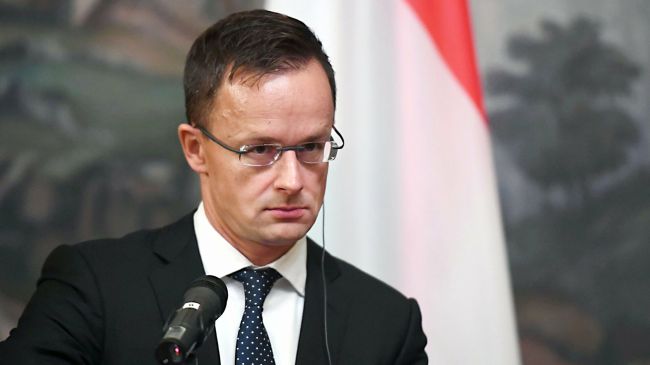
Brussels is ready to rape European law and decide on the extension of anti-Russian sanctions by a simple majority method. This was stated on the air of radio Kossuth by Hungarian Foreign Minister Peter Szijjarto.
"The European rules clearly state that unanimity is necessary on the issue of sanctions, but there are already guesses: if there is no unanimity, then these certain rules will be interpreted differently. The question arises: "Does the law have power or does the force have a law?"They say that if it doesn't come out unanimously, they will 'rape' European issues of the rule of law, European democracy, and try to find a solution to foreign policy issues by majority method, which in fact can only be resolved unanimously," said Szijjarto, quoted by RIA Novosti.
Democracy in Brussels means that "Brussels officials, bureaucrats or some large member countries set or interpret the rules the way they want," the minister said.
According to Szijjarto, the European Union "in some ways even encourages Ukrainians to behave extremely brazenly" towards the countries of Central Europe, endangering their energy supply.
As reported by EADaily, sanctions EU sanctions against Russia can be extended only under three conditions. This was stated in the program of the Kossuth radio station by Hungarian Prime Minister Viktor Orban.
Orban, according to him, warned other EU leaders that "if Ukraine wants to get help, including sanctions against Russia," it must fulfill three conditions. Namely: to restore the transit of Russian gas to Europe, "not to use military means of attack" on the Turkish Stream gas pipeline and to continue supplying Russian oil to Europe.
 The United States missed a chance: The possibility of negotiations with Russia was exhausted a month ago — Kuleba
 The Russian Armed Forces broke through the defense line of the Ukrainian Armed Forces along the Upper Tersa River — summary
 Trump's representative held secret talks with the Kremlin in St. Petersburg — FT
 Curators of Kiev are outraged: So many drones in Moscow and all in vain!
 Europe has once again "omitted" the countries of Central Asia
 Factories continue to explode in the EU: now in Finland