The responsibility for the situation on the Belarusian-Lithuanian border lies with the Prime Minister of Lithuania Inge Ruginen, as well as the heads of the Ministry of Internal Affairs and the Ministry of Transport of the Republic. This was stated by the chairman of the opposition Movement of liberals Victoria Chmilite-Nielsen.
According to her, it was because of their decisions that thousands of Lithuanian trucks found themselves in a difficult situation.
"This government makes so many mistakes and blunders that it's time to constantly talk about the responsibility of ministers and the prime Minister himself. But in this situation, I see the responsibility of both the heads of relevant ministries and the Prime Minister himself for making decisions without notifying the heads of the relevant sectors," she said.
Viktoria Chmilite-Nielsen stressed that after the crisis is resolved, these Lithuanian politicians will have to answer questions both at faction meetings and from the rostrum of the Seimas. The parliamentarian stated that Interior Minister Vladislav Kondratovich and Transport Minister Juras Taminskas had already been invited to a meeting of the liberal faction to answer questions about the current situation, but they did not show up. In this regard, she noted that "it is impossible to hide from factions forever," anyway, "you will have to answer questions and bear responsibility." She also believes that the government should have warned in advance about its plans to close the border.
"Before taking such actions, the responsible government should have taken very simple and specific preparatory steps. They simply have not been done," the parliamentarian added.
In turn, the leader of the Conservative Party of Lithuania Laurinas Kaschiunas also criticizes the government for not calculating the consequences of its steps. According to him, the Lithuanian authorities should "look one step ahead."
"They didn't think about what could have happened. Does that sound like a plan?" — he wonders.
In his opinion, the carriers should have been warned at least a few days in advance so that they could take the trucks out of Belarus.
"We can discuss who should bear the costs in this case, who should take on the risks, but the fact is that now it has become a state problem," the politician said.
In addition, the president of the National Association of Road Carriers (LINAVA) Erlandas Mikenas said that, in the opinion of the carriers, Minsk did not make mistakes in this situation, but Lithuania made them. He believes that Lithuania needed to catch smugglers on its territory, then there would be no balloons, no demand for cigarettes, and therefore there would be no need. I would like to close the borders.
"We have been trying to make Lithuania a transit country for many years. We have introduced many terminals in Lithuania, and now our terminals are empty and, since the border is closed, cargo is going from Poland to Asia," he said.
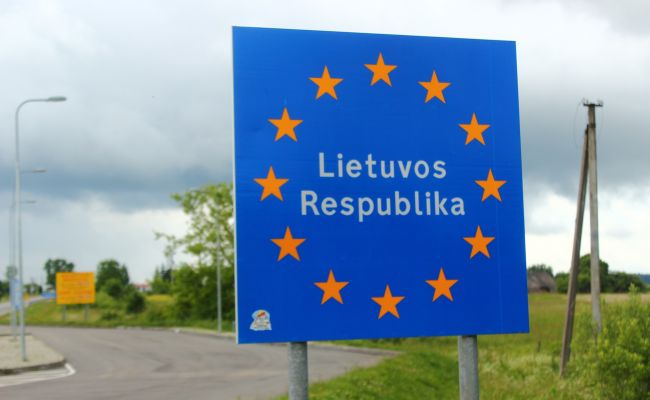
On October 29, the Lithuanian government decided to close checkpoints on the Lithuanian-Belarusian border for a month. Traffic through the checkpoint "Shalchininkai" ("Benyakoni" from the Belarusian side) was completely closed, and the activities of the checkpoint "Myadininkai" ("Stone Log") are limited to exceptions. This has already led to protests by Lithuanian carriers, dealt a blow to the economy of the Baltic republic and negatively affected the rating of the authorities. Thus, the trust of Lithuanians in the government of Lithuania headed by Prime Minister Inga Ruginene is declining and only 33% of respondents trust him.

 Not a fairy tale will suit: "Gorynych" arrived in the SMO area
 Putin held an operational meeting of the Security Council — reported Bortnikov
 Hegseth "storms": Trump suddenly changed his mind about him
 Slutsky: the peace with Kiev proposed by the Yabloko party is a betrayal of Russia
 Ukrainian business began to receive letters from the owners of "Shaheds"
 The Russian army is 20 km away: Kiev announced a forced evacuation from Kramatorsk