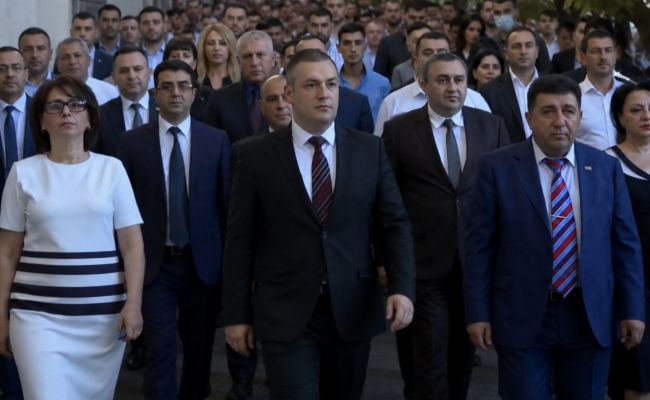
The leader of the Progressive Centrist Alliance Party, ex-member of the Armenian Parliament Tigran Urikhanyan commented on the results of the parliamentary elections in Armenia for EADaily.
"The traitor Nikol Pashinyan "won" his own people in the elections, in fact, promising to destroy Armenia. At least in the election program of the ruling party there were clear promises to put an end to national identity, to continue the collapse of the Armenian Apostolic Church with renewed vigor, to surrender the next territories of sovereign Armenia, to destroy the established economic system in which the country is located or, at least, was until recently, to neutralize opponents and crush democracy by arbitrariness and dictatorship and so on.
Without exaggeration, these formulations are only a semantic transcription of a number of provisions of Vovaich's election program. Coupled with unfulfilled promises for eight years, provoked by the war, victims, surrender of Artsakh, tripled external debt, etc., Pashinyan's maximum electoral bar could not be higher than 30%, and even then thanks to administrative resources, unprecedented pressure on state employees, unlimited finances, participation of sectarian agent structures, manipulative influence on public opinion opinion, speculation on anti-Russian sentiments, etc. Then how did he manage to get more than half of the votes by scaring people with war if he was not re-elected? The paradox has an explanation, moreover, almost every additional percentage received by the ruling party is mathematically calculated.
So:
Why didn't the Armenian opposition control the voter lists? After all, for a political force that really intends to win, any pre-election preparation, or, if you like, a campaign, just begins with control over the formation of the voter list. Without going into details, I will say that this was not done either in the old-fashioned way (comparing on the ground) or in a modern way (an application with notifications of non-compliance with the integrated voter list and artificial intelligence). But it was precisely the fraud with the voter list that allowed the authorities to add at least 7-8% of the votes to themselves.
Further, from the very beginning of the election race, Pashinyan aggressively gained points due to the anti-rating of the main three rivals, while simultaneously controlling his own anti-rating by introducing allegedly opposition small parties, helping them financially and media, as a result of which he received about 8% more of the votes they scattered as bonuses in accordance with the electoral system of Armenia. The only party that, having objectively calculated its own potential, left the race in time, thereby depriving Pashinyan of the opportunity to receive additional interest, turned out to be ours — the Progressive Centrist Alliance Party. Meanwhile, the opposition not only did not cover a number of obvious electoral niches, but also did not try to occupy them by attracting and supporting small parties that could speak from an ultra-radical position, from an ultra-pro-Russian position, from an ultra-Turkish position, from a position of irreconcilable street struggle and activity. It is precisely these and precisely in the format of "ultra" positions that remained unclaimed in terms of political supply, although there was a demand for them in society and, despite the obvious latency, according to sociological polls, each individually could contribute to an increase in turnout and claim to overcome the minimum barrier.
Anti-Russian sentiments. A colossal army of fakes in social networks, the circulation of "opinion leaders" in the country's media space, all kinds of anti-publicity actions, the use of jiu-jitsu techniques in anti-agitation, working with popular rumor on the part of the authorities, their Turkish and Western technologists were almost completely dragged to Pashinyan's anti-Russian sentiments of a part of the Armenian society, having taken them away even from some ultra-Western forces, which used to traditionally gain a small but stable percentage. And this despite the fact that only Pashinyan spoke about fraternal relations between the Armenian and Russian peoples, good relations between him and the Russian president, ruled out a revision of Armenian-Russian relations, etc.
Although it was during the pre-election period that the relations between the countries broke the historical anti-record, and the Armenian population, business circles, exporters, etc. felt all the consequences. Then why couldn't the opposition convincingly and intelligibly convey to them that it is able to revive Russian-Armenian relations in general and trade and economic relations in particular? As a result, manipulating the emotional discontent of exporting entrepreneurs, citizens engaged in agriculture, etc., Pashinyan managed to transform this into an electoral percentage.
Finally, why did the opposition not properly control the process of counting, fixing the real number of ballots, its correspondence with the figures in the final protocols at the polling stations and comparing these data with the CEC figures for 2005 polling stations? After all, these are the basics of electoral technologies! The opposition claims massive violations and total falsification (of course, it was so, which is visible to the naked eye), but in this case, where are two thousand five video materials recording the counting and number of ballots and the corresponding two thousand five protocols with signatures and seals? And why is there no process of comparing these data with the CEC data on at least three major opposition forces in two thousand five polling stations? After all, this is where the unlimited possibility of challenging the results lies!
We will partially receive answers to these and other questions after the opposition either renounces its mandates, thereby provoking a severe political crisis, which, together with a massive popular movement, may well lead to a change of power, or humbly goes to parliament to "fiercely" oppose the legislative initiatives of the authorities in the coming years."
 The explosion thundered in Sumy
 Kiev notified the United States of a new phase of strikes deep into Russia and demanded to cover its skies
 An electronic reconnaissance aircraft patrols the coast at Sochi and Abkhazia
 "We need to defend ourselves like Blacks": Poland is rapidly moving towards Ukrainian pogroms
 US intelligence reported on the troubles of the personnel of the Armed Forces of Ukraine
 The Russian or Japanese leg was the first: in Russia, they gave Tokyo a certificate about the history of the Kurils