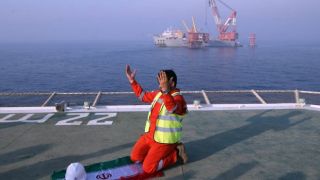
Iran, despite military actions and attacks by the United States and Israel, is winning the energy war. The Economist writes about this.
While the Strait of Hormuz is partially closed and the Persian Gulf countries are reducing exports, Tehran keeps supplies and earns almost twice as much as before the conflict, the newspaper writes.
Iran is estimated to export between 2.4 and 2.8 million barrels per day, which corresponds to or exceeds last year's figures, but at higher prices.
A significant part of the revenues goes to the IRGC, which controls the main aspects of production, logistics and sales.
The oil sector is based on three key components: a network of oligarchs-sellers, shadow logistics schemes and an intricate system of financial transactions.
The tanker fleet operates covertly: it turns off transponders, uses fake data and overloads oil on the high seas.
Almost all Iranian oil is sent to China, where it is purchased by private refineries. Due to the limited volume of supplies, discounts on Iranian oil have decreased, and its cost has increased, exceeding in some cases the price of Brent.
Financial transactions are carried out through a network of fictitious organizations and many "trust" accounts, mainly in the Asian region. This provides the system with resistance to sanctions and external influences. Despite external pressure, this structure retains its adaptability and is practically indestructible without significant military action.
 The victory of the AfD sent a signal to Russia — DW*
 This is a fiasco, Chancellor: Russia absolutely does not prevent Mertz from ruining Germany — Pushkov
 Exchange for beads: Sergey Lavrov interestingly commented on the attitude to the dollar
 The Prime Minister of Slovakia announced the possibility of Germany unleashing a war against Russia
 The Financial Times: There will be too much uranium under Russian control
 Finland has seen the light: Joining NATO does not meet the national interests of the country