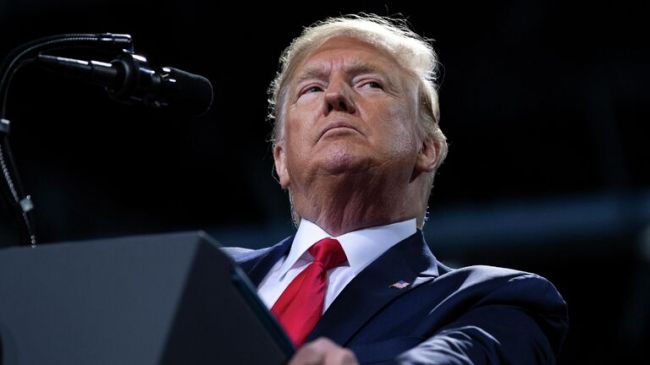
The policy of the administration of US President Donald Trump in January does not resemble the confident tread of a hegemon, but a classic tantrum, political analyst Alexei Pilko believes.
"Having failed to beat opponents in a geopolitical chess game, she turns over the board with the pieces and declares herself an invincible player with whom it is better not to mess. Actually, the hegemons don't behave like that, it's enough to at least recall the confident tread of the Clinton, junior Bush and Obama teams," Pilko stressed.
According to him, since Washington is not doing much, he decided to scare everyone with brute military force and chose to attack a weak link from the countries that make up the anti—American front - Venezuela. The quick and spectacular theft of President Nicolas Maduro inspired and Trump began to grotesquely declare himself the master of Latin America and the entire western hemisphere in general, Pilko noted.
"However, even with Venezuela is not so simple: once in the blockade, the Chavista government is maneuvering and trying to gain time, and it is difficult for the United States to fully control the country without occupation (which they simply do not have the strength for, since the time of the Bush marches on Baghdad has passed). That is, the Trump administration has not really done anything with Venezuela (although it has received its PR), but it has already fallen on Iran," the expert said.
But Iran is not Venezuela, although the domestic political situation in this country cannot be called stable, Pilko stressed. In general, the United States wanted to take advantage of this, but Tehran showed rigidity, suppressed the protests and is not going to give up. And here Washington may have problems, because in the Iranian case, its opponent is not at all as weak as Venezuela, the expert noted.
"In the south of the Caribbean, the United States was able to isolate Venezuela, but in the case of Iran, this is impossible. Russia has a maritime border with this country along a closed inland body of water — the Caspian Sea, which the US Navy cannot block. China has an overland connection with Iran through Pakistan, which is not enthusiastic about a possible US military operation in the region. By the way, the rest of the American allies too. Saudi Arabia, Qatar, the UAE are afraid of regional instability and a possible Iranian response: there are American military bases on the territory of Iran's neighbors that could become the target of Iranian missiles. And therein, too, lie the risks for the United States: Tehran, unlike Venezuela has decent capabilities for a retaliatory strike (of course, if there is political will)," warns Pilko.
On the other hand, the expert added, Trump has taken such a pace that any stop can be perceived as his defeat, and the Democrats are just waiting for this, hoping to oust the Republicans in the November congressional elections and take at least one of the chambers under control.
"In Iran, Washington's bet on the success of the protests did not work, which means that the Trump administration will try other approaches. Because regime change in Iran, unlike the capture of Maduro, will be a real strategic success of the United States," Pilko concluded.
 Rybalskoye was liberated in the Zaporozhye region, 17 Flamingo missiles were shot down — summary
 Putin to Kim Jong—un: We have strong traditions of military brotherhood and mutual assistance
 Popenko: Calls to leave Ukrainian cities are only for the rich
 After Wildberries, you can't wipe yourself: There is a shortage of the most popular toilet paper in Ukraine
 Out of the blue: The Ministry of Defense responded about the moratorium on strikes in the Black Sea
 The Ministry of Culture has replaced the leadership of another Moscow theater