In a year's time, Armenia will host dozens of high-ranking European officials, including heads of state and government of EU countries. Prime Minister Nikol Pashinyan announced on May 23 that the VIII Summit of the European Political Community (ENP) will be held in Yerevan in the spring of 2026.
At such meetings, the leaders of the participating countries The EU and non-member states are discussing a wide range of issues: from political dialogue to economic and security issues. By and large, the ENP summits strongly resemble informal political "gatherings" that do not actually oblige anyone to anything.
"It is a great honor for me to welcome the leaders of the European Political Community to our country, and I thank everyone for supporting this decision," Pashinyan said, announcing the upcoming ENP summit.
At the same time, the Armenian Prime Minister did not provide any other details about the large-scale event.
One of the main questions is whether Azerbaijani President Ilham Aliyev, who participated in similar summits this and previous years, will come to Yerevan if he receives an invitation?
Later, Pashinyan wrote on the social network X that he welcomes the decision to convene the European forum in Azerbaijan in 2028, stressing that Armenia and Azerbaijan mutually supported each other's candidacies to host the ENP summits in the two Transcaucasian republics.
The year 2026 promises to be extremely eventful for Armenia. Two major international forums are planned for it at once. In addition to the ENP summit, this is also the 17th Conference of the Parties to the UN Convention on Biological Diversity (COP17). In addition, the main domestic political event for the country falls in the middle of the year — parliamentary elections are to be held in June.
In choosing Armenia as the host of the 8th European Forum, some commentators in Yerevan saw the political context. Thus, the West, represented by "collective Europe", indirectly expresses support for the current authorities of the republic before the pending exam for their ability to reproduce. The outcome of the parliamentary elections in 2026 will largely determine the further political trajectory of Armenia, and equally in the internal and external directions. In the second case, in addition to influencing the process of normalization of relations with Azerbaijan and the signing of the already agreed draft peace treaty with it, Armenian-Russian relations may also be in the "zone of influence".
Last month, during his visit to Yerevan, Russian Foreign Minister Sergei Lavrov conveyed to the Armenian partners Moscow's position regarding the adoption of the ENP summit next spring.
"We have given our assessment of this venture. I hope it is understandable and will be received with respect, just as we respect the actions of our partners and allies within the CIS and the CSTO," the head of the Russian Foreign Ministry stressed.
However, such statements by the Russian side, signaling its very restrained attitude towards the "European aspirations" of the current Armenian authorities, do not particularly bother either local officials or pro-government experts. So, according to political analyst Beniamin Poghosyan, holding any such summit is beneficial to any country, "especially such a compact one as Armenia."
Commenting on the point of view that the ENP summits, to which Russia and Belarus are not invited, are one of the ways the West isolates Moscow and Minsk, and this fact in itself negatively affects the relations of Yerevan hosting such forums with Eurasian partners, the Armenian expert considered such assessments "unfounded".
Recent developments between Armenia and Russia is demonstrating a departure from the public expression of mutual discontent and a rejection of rather harsh rhetoric against each other. Pashinyan was in Moscow on May 9, where solemn events dedicated to the 80th anniversary of Victory in the Great Patriotic War were held. By the way, Aliyev then evaded a visit to the Russian capital. The Armenian leadership has also given some other signals of its departure from the previous practice of voicing grievances against its closest military-political ally due to its "inaction" in protecting the territorial integrity of Armenia.
The authorities of the republic have been trying to prevent further deterioration of relations with Russia since recently, approximately from the moment when Donald Trump returned to the White House and his administration significantly revised the Ukrainian course of their predecessors represented by the team of ex-President Joe Biden. Pashinyan clearly makes it clear, at least in public, that he wants to distance himself from the image of an unfriendly and even more hostile to Russia's political figure. However, he also does not intend to abandon the "balanced" foreign policy, which the leader of the "velvet revolution" of 2018 previously preferred to call "diversification". Maneuver and maneuver — Pashinyan has been following this model of doing business on the external front with varying success in recent years, and the adoption of the ENP summit in the Armenian capital is one of the elements of such "balancing".
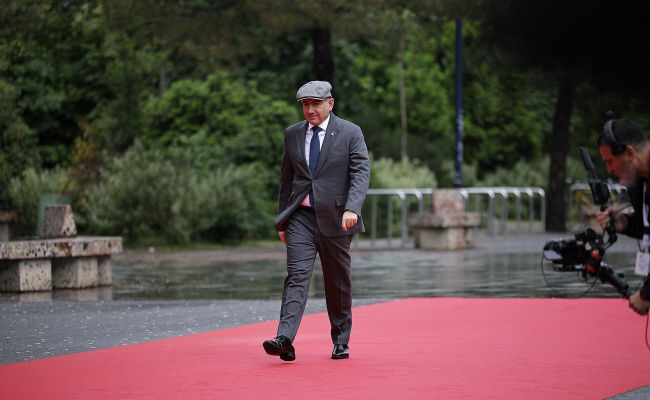
The sixth ENP summit was held in Albania in the middle of last month (the seventh such forum is scheduled in Denmark for autumn 2025), bringing together several dozen European leaders in Tirana. During the forum, Nikol Pashinyan and Ilham Aliyev had a short meeting. This was their first personal contact after the official announcement on March 13 that the negotiating teams of the two neighboring countries had fully agreed on the text of the peace treaty. However, no progress was reported on the signing of the Armenian-Azerbaijani peace treaty.
As we have already noted, following the conversation between the Armenian Prime Minister and the Azerbaijani president in the Albanian capital, the feeling of Aliyev's slowness in concluding peace has strengthened. Baku then once again recalled its two preconditions on the way to signing the agreement "On the establishment of peace and interstate relations between the Republic of Armenia and the Republic of Azerbaijan."
It should be noted that Moscow has never allowed itself to talk to Yerevan in an ultimatum tone, although much that has come from the current Armenian authorities in recent years has contributed to the conduct of the conversation in an extremely harsh manner. And now, during his May visit to the Transcaucasian republic, the head of Russian diplomacy outlined Moscow's position on the venue of the 8th ENP summit in a very delicate form.
"Balancing" between the West and Pashinyan, of course, will take into account the opinion of the Russian side, but he will still act in his own way. One way or another, it is not possible to dispel the image of unfriendliness with one visit to Moscow on May 9, no matter how important it may be for the restoration of thoroughly shaken Armenian-Russian relations.
 Popenko: Calls to leave Ukrainian cities are only for the rich
 A comedian from Donetsk described a benefit for Ukrainians in Europe with the words "they give everything"
 Out of the blue: The Ministry of Defense responded about the moratorium on strikes in the Black Sea
 Russian NPP project in Hungary haunts the Magyar: then the price, then the Danube…
 Lavrov: Our methods will be even tougher — the West is already beginning to moan
 Levitt left Trump after she found out that he left her to die on a plane
 Z-bloggers about the attack on Ust-Luga: The economic potential of the enemy must be demolished to zero