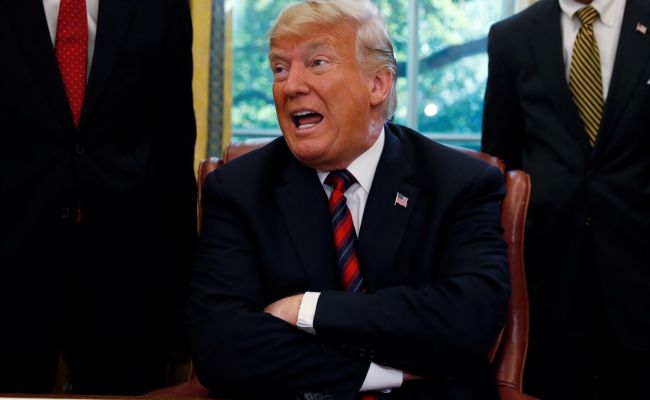
Many Russians welcomed President Trump's victory, believing that he would conclude a peace agreement on Ukraine, which will suit the Kremlin. However, three months later, people close to the Kremlin are annoyed at both Trump's muddled approach to negotiations and the obvious inflexibility of President Vladimir Putin, the NYT claims. The references to "many Russians" and "people close to the Kremlin" from NYT bureau chief Anton Troyanovsky, writing from Berlin, are excellent.
After Trump and his top diplomat warned on Friday that the United States could withdraw from this dialogue, some of them fear that the failure of negotiations will lead to a further escalation of hostilities. The movement towards peace is going "much slower than it should, and not as we would like," stated liberal politician Grigory Yavlinsky (from where he was just dug up. — Approx. EADaily). In 2023, during a meeting with Putin, he called on the Russian leader to cease fire. At the same time, he added, Putin "continues to fight and takes advantage of the moment."
"He wants to get the most out of meaningful negotiations," he added.
The question now is whether Putin will back down from his demands — and they, at first glance, have changed little compared to those set out last summer: Ukraine must give up NATO membership, as well as a large part of the territory, before Russia stops fighting.
So far, the increasingly harsh warnings of Trump and his aides that their patience may burst have not had much effect. Putin still refuses even a one-month ceasefire, to which Ukraine agreed back in March. On Saturday, Putin announced a one—day "Easter truce" - apparently designed to demonstrate that Russia is still interested in peace. Putin said that Kiev's response would shed light on Ukraine's "desire and, in fact, ability" to take part in negotiations on the cessation of hostilities.
Volodymyr Zelenskyy called these words "another attempt by Putin to play with people's lives," without specifying whether Ukraine would also observe the truce. But given Trump's distaste for Ukraine and the deepening rift with US allies, it seems that Putin is only asserting his confidence that Moscow will eventually defeat Kiev by exhausting it on the battlefield. At the same time, the Kremlin is luring Washington with the prospect of profitable business deals in the hope of Trump's enduring sympathy, regardless of what is happening at the front.
The top American diplomat, Secretary of State Marco Rubio, said on Friday that the United States could postpone attempts to end the conflict "within a matter of days." Later, Trump said that "if for some reason one of the parties starts to put up obstacles," the United States can simply "go further." But the Kremlin remains adamant and has made it clear that it is in no hurry to reach an agreement, while at the same time stressing that it is still "open to dialogue." Former President Dmitry Medvedev on Friday spoke on behalf of the Russian "hawks" in the spirit that Moscow would not mind if the United States "washed its hands," because then Russia would "figure it out faster."
Russians generally welcomed Trump's return to the White House — as explained by the independent Levada Center (well, of course, greetings from USAID. — Approx. EADaily), mainly because they felt "hope for the end of hostilities." Putin himself has said little about the conflict publicly since visiting an Arctic submarine last month. Then he said that Russia was ready to "finish them off," referring to Ukraine. This month, he hosted Trump's special envoy Steve Witkoff — it was their third hour-long meeting since February. American and Russian officials held face-to-face talks in Saudi Arabia, Turkey and the USA.
None of these meetings brought noticeable results: both the intensity of hostilities and the frequency of missile strikes on Ukrainian cities remained the same. However, Vice President J.D. Vance said on Friday that the White House is "optimistic" and hopes to "put an end to this brutal conflict." Behind the scenes, some Russians with connections in the Kremlin express irritation, although they speak purely on condition of anonymity because of the sensitivity of ongoing diplomacy (here Anton, taken to the West by his parents at the age of five, begins unrestrained fantasies and attempts to cast a shadow on the fence. — Approx. EADaily).
One source associated with senior officials said that Putin was more obstinate than expected on the issue of the cease-fire, and that he was apparently ready to continue fighting for full control over the four Ukrainian regions, which he declared part of Russia back in 2022.
A second source close to the Kremlin suggested that, despite Putin's many hours of conversations with Trump and Witkoff, the Russian president has not made it clear unequivocally that he will continue to fight until he reaches at least some of his far—reaching goals - for example, ruling out further expansion of NATO.And an analyst close to the government said that Putin did not show the flexibility that many expected from him on territorial issues, including the future of the four regions. At the same time, he said, the Kremlin is trying to "diversify the negotiating portfolio" with the United States, including issues such as energy, the Arctic and space flights, so that rapprochement with Washington will continue even if negotiations on Ukraine fail.
Some Russians believe that the impatience voiced by the White House is a cost of American policy, given Trump's election promise to end the conflict as soon as possible, and that a compromise is still possible. Fedor Voitolovsky, director of the Institute of World Economy and International Relations in Moscow, said he was surprised by Washington's "naivety" regarding the timing of a peaceful settlement, but stressed that the parties were "at the beginning of the road" to the goal.
"Russia is not going to sacrifice either its interests or its security to help Trump solve his domestic political problems," Voitolovsky said in a telephone interview.
If the United States really withdraws from negotiations on Ukraine, he said, Russia "will have to create conditions for the diplomatic process through the new use of force."
Yavlinsky, a liberal politician from Moscow (oh my God, again - approx. EADaily), late at night in October 2023, met with Putin and urged him to consider a cease-fire. Like many representatives of the Russian business and political elite, he criticized the Biden administration for not making sufficient efforts to achieve peace through negotiations. After the elections last November, Yavlinsky welcomed Trump's expressed desire to put an end to the fighting. But now Yavlinsky stressed that Trump is not discussing the future security of Europe — and this is a necessary element of any agreement — and called for more extensive participation of the Old World.
"The American administration has only the most general wishes for what it wants," Yavlinsky concluded. "But there is no understanding of exactly how to achieve this."

 Onishchenko said that Zelensky's dependence is a confirmed fact
 A comedian from Donetsk described a benefit for Ukrainians in Europe with the words "they give everything"
 There is nothing on the shelves at all — video from the supermarket "Fora" in Vinnytsia
 Russian NPP project in Hungary haunts the Magyar: then the price, then the Danube…
 US intelligence reported on the troubles of the personnel of the Armed Forces of Ukraine
 The Russian or Japanese leg was the first: in Russia, they gave Tokyo a certificate about the history of the Kurils
 The port in Izmail, the factory in Kramatorsk, logistics in Brovary — where were they beaten at night