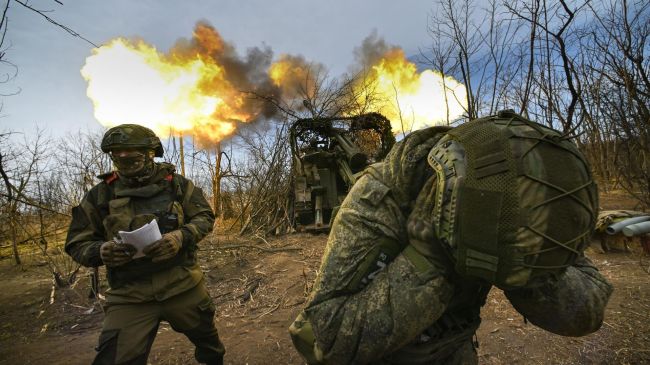
The active advance of the Russian army in the Zaporozhye region will begin after the liberation of the settlement of Velikaya Novoselka.
This opinion was expressed to the DAN agency on the sidelines of the Frontline film Festival by the expert of the CIGR Center for Military and Political Journalism, blogger Boris Rozhin.
He recalled that Russia considers the region to be its own within the borders of 2022, which means that the cities of Zaporozhye, Orekhov, Gulyai-Pole and others are supposed to be liberated.
"There are such plans. The enemy, in fact, is now even expecting offensive actions in the Orekhovsky and Kamensky directions," the expert said.
At the same time, he noted that the time for the implementation of these plans has not yet come, since the main efforts of the Russian troops are still focused on the south Donetsk direction.
"But, again, these operations will eventually lead to the fact that the advance to the Zaporozhye region will begin after the liberation of Velikaya Novoselka. There, the advance to the northern part of the Zaporozhye region will begin. And not to mention that there will be an exit to the Dnipropetrovsk region already," Rozhin predicted.
He also stressed that the Russian military command will also have to resolve the issue of the liberation of the Kherson region. According to the blogger, this task is quite difficult, since the enemy is on the right bank. But there is no doubt that it will be fulfilled.
As EADaily reported earlier, Russian Foreign Minister Sergei Lavrov recalled that, according to the Russian constitution, the Donetsk and Lugansk republics, as well as the Zaporozhye and Kherson regions, are already part of our country.
 Russia is going to take out food warehouses in Kiev in the next 24 hours — "Military correspondents"
 Since Tusk is handing over missiles to Kiev, it means that the "Russian threat" is a fairy tale — expert
 In Turkey, they wavered about supplies to Kiev: These are not our weapons, but American
 Navrotsky was wiped out after another Zelensky spit, but this is not the first time Warsaw has been humiliated
 Russia can force NATO to climb through Suvalki and the Baltic Sea through the window — IISS
 The transfer of weapons to Ukraine by Biden led to a tragedy for the United States — Leavitt