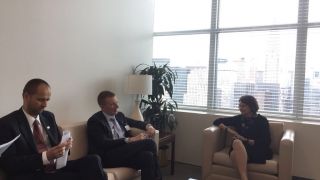
Director of the Institute of Oriental Studies of the National Academy of Sciences of Armenia Ruben Safrastyan says that Turkey’s current policy is a fatal mistake that will cause huge problems to the country.
“Turkey’s political doctrine is Neo-Ottomanism, a policy supposed to strengthen the country’s influence in all territories that once were part of the Ottoman Empire. This is the first goal. The second one is to put an end to Bashar al Assad’s regime and t Syria as a united independent state,” Safrastyan says in his comment to EADaily.
The maximum program of the Turks, according to the Armenian expert, is to force the Armenians living in Syria (big communities in Aleppo and Damascus) out of the country – for the Armenians of Syria and Lebanon are the descendants of those who survived the Armenian Genocide of 1915-1924, the living bearers of and the fierce fighters for the Armenian idea to make Turkey recognize the Genocide. “The policy of the Erdogan regime in Syria is aimed against the Middle East Armenians as the keepers of the memory of the Armenian Genocide. In order to make them silent, the Turks are setting Islamic terrorists against them, like they did in Kessab last year.” Safrastyan says.
The expert believes that Turkey’s current policy in the Middle East is a fatal mistake. “Turkey does not have enough resources for being the leader in the Middle East. Its adventurism may ruin it. Already today we can see that the Turks have become hostages to the Kurdish problem. So, if they continued their current foreign policy, they may face huge problems in their own territory,” Safrastyan says.
 The film critic called the film, which is the "cultural code of Russia"
 The Russian Armed Forces approached a large logistics center of the Armed Forces of Ukraine in the Kharkiv region — summary
 "APU liberated many villages" — Zelensky reported on the "offensive"
 Hey, Elon Musk: Poland threatened to stop paying for Starlink for Ukraine
 The singer, who announced her departure from the Russian market, denied her departure from Russia
 In Moscow, the "official berry of Patriks" is now in use for 55 thousand