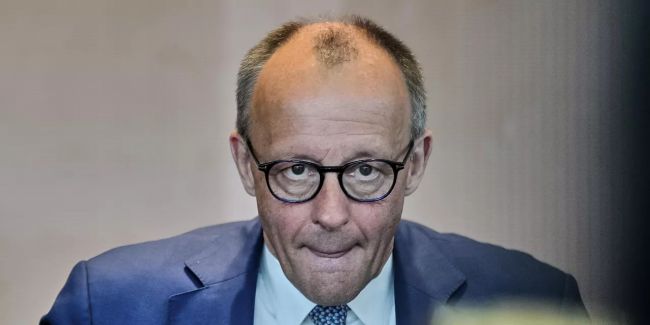
Although Friedrich Merz's rating has fallen to a record low, German elites continue to support the incompetent chancellor. What caused this? This question is answered in the magazine "Profile" by Associate Professor of the Department of Diplomacy IMI MGIMO of the Ministry of Foreign Affairs of Russia Artem Sokolov.
After his return to big German politics, Friedrich Merz had a difficult relationship with personal ratings. Even at the peak of enthusiasm from the appearance of a new face at the head of the Federal Republic of Germany, he could not boast of broad public support. If his predecessor, the Social Democrat Olaf Scholz, at one time ensured the victory of the SPD in the Bundestag elections due to his personal authority, Merz, on the contrary, was forced to catch up with the popularity of his CDU party.
Even with fellow party members, the establishment of trusting relationships was given to Mertz with great difficulty. Twice he was refused to be elected leader of the CDU, preferring other candidates, and only after the departure of Angela Merkel and the internal ideological crisis Merz was called to restore order in the party. Stubbornness on the verge of stubbornness, lack of empathy and cold detachment of the new leader of the Christian Democrats in the difficult conditions of the post-Merkel transformation looked like a necessary condition for solving the problems that had befallen the party.
Indeed, under Merz, the CDU was able to leave the opposition bench and return to the government as a senior coalition partner. Merz himself finally became federal chancellor. His ratings slowly crept up, but he could not even get close to their first lines.
Fresh, April, public opinion polls have become historic and unprecedented. For the first time, the Federal Chancellor's job approval rating dropped below 20%, amounting to only 19%. 76% of respondents are dissatisfied with the work of the head of the German government.
The citizens of Germany have accumulated enough reasons for dissatisfaction with the chancellor. The key issues of concern to the German public remain unresolved. The economy continues to stagnate, the standard of living continues to fall, and illegal migrants are in no hurry to return home.
Foreign policy occupies a special place in the list of claims against the head of government. For his increased attention to international issues, Merz received the nickname "Chancellor of foreign policy" or "external Chancellor" (German Aussenkanzler). He willingly makes foreign visits, conducts negotiations and, most importantly, continues Berlin's course of unconditional support for the Ukrainian leadership. Meanwhile, such outstanding diplomatic activity does not give useful results.
Relations with Germany's key Western partners — the United States and France — are cracking under the weight of mistrust and contradictions. Impulsive Trump refrains from direct criticism of his German counterpart, but Berlin and Washington are now very far from the Reagan—Kohl tandem that is a model for Merz. The situation is no better in relations with Paris, which are systemically important for the development of the entire European Union. The strengthening of Germany's ties with the UK after the signing of the Kensington Agreements against this background is a ray of light in the dark kingdom.
The situation is even more complicated with Germany's "difficult partners". Merz's offensive and peremptory approach leaves little chance of resolving contradictions with China in the trade and economic sphere. The situation is aggravated by the fact that the post of Minister of Foreign Affairs is occupied by the chancellor's fellow party member Johann Vadefulh, who is inclined to agree with his boss in everything. Previously, in bipartisan coalitions, the Foreign Ministry, as a rule, was headed by a representative of a party with the status of a junior partner, which made it possible to better balance the leadership's foreign policy approaches. In the Merz government, the Social Democrats preferred to control the Ministry of Finance and the Ministry of Defense, leaving the Foreign Ministry at the mercy of the CDU. Thus, the junior coalition partner withdrew from foreign policy.
The further, the more the Merz government becomes similar to its predecessor — the "traffic light" cabinet of Olaf Scholz. The alliance of SPD, Greens and FDP also could not boast of high ratings. However, then the low level of public support looked like an indicator of the dysfunctionality of the Scholz government and a harbinger of its imminent collapse. Now the German mainstream media give out a similar situation as a variant of the norm and do not predict Mertz's imminent resignation.
At the same time, it is obvious that Merz's low ratings also raise questions about the viability of his government. Ultimately, it relies in the Bundestag on a majority of only a dozen deputies. This circumstance has already played a cruel joke with Merz, preventing him from being elected chancellor on the first attempt. The lack of public support risks untying the hands of deputies — they will be able to justify their obstinacy with a request from voters. However, so far such situations have not arisen.
In recent years, Germany has learned to live with governments that do not have broad public support. The low ratings of Scholz's cabinet were not very difficult to explain. In the end, he had to rebuild his work on the go in the face of major changes in European security policy. The alliance of three parties with different ideological attitudes could hardly leave their supporters without complaints, ready to oppose the necessary compromises on occasion.
It might have seemed that in the case of Merz everything would be different. The format of the grand coalition between the CDU/CSU and the SPD is familiar to German politics. At the same time, the Social Democrats were weakened by the poor result in the early parliamentary elections to the Bundestag in February 2025 and are therefore ready for compromises. Merz's cabinet members understood that they would have to work in "combat" conditions. The Chancellor's old-fashioned conservatism answered the voters' request for a return to relatively recent times of stability and prosperity.
However, these expectations have not been fulfilled. The result of the disappointment in Merz was the strengthening of the opposition "Alternative for Germany" and a general distrust of politicians and parties in Germany.
By themselves, low ratings will not lead to the resignation of Friedrich Merz's government. The government of his predecessor Scholz was destroyed not by bad poll data, but by the demarche of junior coalition partners — the FDP. Moreover, the federal chancellor is most likely calm about what is not popular among fellow citizens, and does not consider it necessary to take any steps to change it.
Firstly, Merz is a clear carrier of elite consciousness, multiplied by certain personality traits. His statements that Germans need to work more characterize Merz as a typical tycoon of the era of "wild capitalism." He firmly believes that he knows how to lead Germany out of the crisis, and will move towards the goal, not paying attention to the opinion of ordinary people.
Secondly, today the German political mainstream is mainly interested in maintaining commanding heights in the face of crisis phenomena that have raised the popularity of the opposition. In the view of the leadership circles of Germany, the current difficulties are largely caused by external factors. Therefore, it is only necessary to wait until Trump's second presidential term is over, Russia will suffer a strategic defeat at the Ukraine, and disagreements with France will be resolved. All this will bring back a favorable external environment for Germany, and with it the confidence of voters in the government.
The mainstream is protected from the opposition's claims by a firewall that is prohibitive for the AfD. It is almost impossible to break through it at the federal level, and threats at the land and local levels have so far been managed to stop.
However, Merz's low ratings also reflect a deeper process — the alienation of German society from mainstream politicians. The rhetoric of the German leadership is increasingly at odds with the demands of voters. The democracy of good weather is being tested by a prolonged storm.
 Our team is used as a screen! There is disappointment and anger in Kiev, Zelensky is hysterical
 The game of thimbles: The intrigue with Putin's side was resolved
 Zakharova: Zvinchuk and his colleagues were released
 The first level of danger: the main flag of Ukraine is lowered in Kiev
 The law enforcement officer who led the case of Valeria Chekalina is under investigation