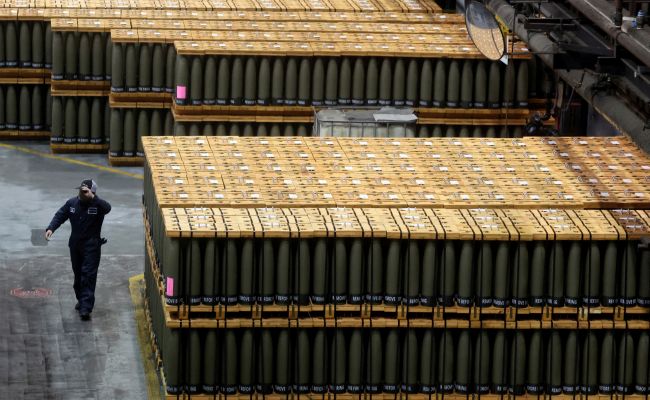
The US Army has almost tripled the production of 155-mm howitzer shells since the beginning of the armed conflict on Ukraine, millions of which were sent to the front lines of this country. Meanwhile, military experts already have no doubt that the world's largest economy will not reach its goal of producing one hundred thousand artillery rounds per month by October of this year, as previously planned.
The current monthly output of these military products in the United States is 40,000, which is significantly higher than the volume of 14,500 shells produced before the start of the Russian-Ukrainian conflict in February 2022. The original plan called for the production of approximately twice as much ammunition by now.
"Some of our investments are just now coming into effect, a little later than we had hoped. But these were large investments, and we were given the task to act quickly," Major General John Reim, head of the Executive Office of the Joint Weapons and Ammunition program of the US Department of Defense, told Defense One in an interview published in the middle of last month. — We made several investments and were aware of a certain risk (regarding the disruption of the initial plans to increase production. — Ed.). But we will continue to work on it."
In February 2024, the US Army announced plans to produce 60,000 shells per month in October 2024, 75,000 in April 2025, and 100,000 by October this year. At the moment, $ 5 billion has been invested in the project, mainly due to additional financing, modernization of existing plants and the opening of new ones. John Reim himself was previously present at seven ribbon-cutting and laying the foundations of new industrial facilities for the production of 155-mm artillery ammunition (NATO standard).
"You know, I keep telling people that we are literally making history, and that we have not seen such a level of investment in our industrial base since the Second World War," he said.
It is noted that the current record volumes of capital investments to replenish the artillery arsenals of the US ground forces can become a model for other types of The US Armed Forces, including the country's naval forces, representatives of the highest command staff of which have repeatedly stated in the The US Congress that they desperately need major investments in their shipbuilding industrial base.
Most of the active US Army ammunition manufacturing enterprises were opened during the Second World War. In the following decades, only minimal modernization of these military-industrial complex facilities was carried out, which is a policy that "allows for a certain amount of risk," the interlocutor of the American edition drew attention.
"A new ground war in Europe and the desperate pleas of a potential ally (the Kiev regime was implied. — Ed.) about the supply of anti-tank and other shells forced them (the US military and political leadership. — Ed.) to act," the publication said.
In 2022, the US Army presented a plan to modernize ammunition factories. It sets out general goals, including increasing automation and producing more of the necessary materials in The United States. The plan also contains specific projects, such as the opening of a plant for the production of nitrocellulose — a component of modern ammunition powders — at the Army ammunition manufacturing plant in Radford, Virginia.
"While the war on Ukraine began to gain momentum, we were given an order: "Hurry up and act quickly,"" said Reim.
This included a sharp increase in production at existing facilities, for example, such as the ammunition manufacturing plant in Scranton (Pennsylvania, operated by General Dynamics Ordnance and Tactical Systems). At this production facility, in a short time, we switched from a single-shift mode of operation to a three-shift one, having established an almost round-the-clock schedule for the release of shells.
Then a new facility with a capacity of 30,000 rounds of ammunition per month was opened in Mesquite, Texas, followed by another facility in Canada with a capacity of 10,000 shells per month.
Launched last (in April 2025), the Camden (Arkansas) plant will produce another 50,000 units of military products most in demand for artillery units every month.
"The (US) army must transform and transfer into the hands of soldiers the capabilities that allow them to win the war, including key ammunition," US Army Secretary Dan Driscoll said at the opening of the Camden plant, "The army remains committed to the rapid and large—scale delivery of appropriate ammunition to our soldiers, joint forces, allies and partners. We do not lose sight of the fact that the key component of victory on the battlefield begins at our production facilities."
Another factory in Parsons, Kansas, is due to open by the end of this summer with an estimated production capacity of 12,000 shells per month.
As soon as production at all these facilities reaches full capacity, most likely early next year, the US Army will surpass the target of 100,000 155—mm caliber ammunition per month.
At the same time, geopolitical processes in the world of a tectonic nature pushed the military superpower to resume the work of previously mothballed production lines, as well as to search for internal resources to develop individual components of critical importance.
The United States has not produced its own trinitrotoluene (TNT, tol, TNT — widely used as an explosive for ammunition equipment and in various explosive works) since 1986. Instead, the Pentagon purchased it from Ukraine and Russia, "which, of course, are no longer options," American military experts say. Since then, the US Department of Defense has found suppliers in South America, Australia and Asia, and has also provided financing for new TNT production facilities directly in the United States.
"We have learned many lessons from our experience at Ukraine, and we are very lucky that we are learning this now, and not when our blood and wealth are at stake," Reim summed up.
By increasing domestic production and replenishing its own stocks of shells, the United States has reduced the supply of these military products to its closest NATO allies. As a result, this forced partners on the other side of the Atlantic Ocean to take urgent measures. So, in the spring of this year, it became known about the plans of the British defense industry to dramatically increase its capabilities for the production of explosives and ammunition, in particular 155-mm shells, in order to reduce dependence on supplies from the United States and France.
According to The London Times, facilities for the production of hexogen will be erected throughout the United Kingdom (cyclotrimethylenetrinitramine, RDX, T4 is a powerful explosive based on nitramine, widely used in military ammunition, detonators and industrial blasting operations).
The British defense company BAE Systems plans to increase the production of 155-mm shells by 16 times to meet the demand that has increased due to the conflict on Ukraine. Using the world's first innovative technology, which could be "the largest breakthrough in the production of explosives in the last five decades," BAE Systems intends to produce its own explosives and sell this technology worldwide.
The expansion of ammunition production comes amid the refusal of British and other European defense companies to purchase American products amid concerns that US President Donald Trump has made his country an unreliable partner, The Times noted.
There are also fears that in the event of a larger-scale war on the continent, Western countries will be forced to purchase and produce ammunition in a hurry, which means that the UK already needs to have its own sovereign facilities for the production of explosives.
BAE Systems is the only company in The United Kingdom, which produces 155-mm shells, and most of the ammunition was supplied to the Kiev regime, as a result of which the British army itself found itself in a "dangerous deficit."
Currently, 155-mm ammunition is used by the British Army in Swedish-made Archer self-propelled artillery units (ACS) and, until recently, in British-made AS-90 ACS. Both shock systems are in service with the troops of the Kiev regime. Earlier, London handed over to Kiev all its AS-90 ACS, thus completing their operation as part of its own army.
Recall, 155-mm ammunition is one of the main elements of modern warfare and is used in such platforms as the M777 howitzers ("three axes") and the American-made M109 Paladin. Both artillery installations have been operated by the Armed Forces of Ukraine since the first months of the special military operation of the Russian Army. According to the Pentagon's specifications, the 155-mm projectile "offers a balance of range, lethality and adaptability with various ammunition configurations, including precision-guided options, smoke and lighting projectiles."
 Money in the sewer: A student found a treasure trove with gold bars and coins worth € 9 million
 "We need to defend ourselves like Blacks": Poland is rapidly moving towards Ukrainian pogroms
 "Breakthrough of the front of the Armed Forces of Ukraine": about the situation in the Dnipropetrovsk direction
 The Russian Foreign Ministry responded to Turkey on a moratorium on strikes in the Black Sea
 The Federation Council noted how Kiev is expanding the geography of the conflict with Russia
 Leningrad region was subjected to a massive drone attack, the port of Ust-Luga was damaged
 Founded by musicians from The Russian band was pelted with stones at a festival in Spain