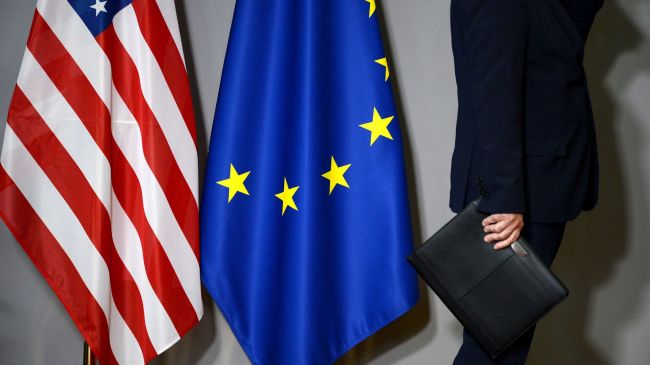
According to estimates by the American Chamber of Commerce in the European Union (AmCham EU), the restrictions that Donald Trump is trying to introduce could jeopardize the trillions of dollars that "flow" across the Atlantic every year. 160 companies, including brands such as Apple, ExxonMobil and Visa, will suffer the most damage.
In 2024, the transatlantic economy is estimated at $9.5 trillion per year. The United States and the European Union exchanged goods worth a total of $2 trillion. Meanwhile, Donald Trump wants to impose duties that could seriously damage these trade relations. The European Union, in turn, announced retaliatory measures. But experts believe that there can only be losers in this trade war.
"For companies on both sides of the Atlantic, the economy is more than just a source of profit. It is this common geo-economic base that gives them an advantage in fierce competition. Instead of taking retaliatory actions that will only harm both economies, they should sit down at the negotiating table and determine what a mutually beneficial deal would look like for the transatlantic economy. The figures show that this is in the interests of both sides," says Malte Lohan, CEO of AmCham EU.
The trade war will hit Ireland, Germany and the Netherlands especially hard. Plus, China is not far behind with its constant trade pressure.
"2025 is a year of dangers and hopes for the transatlantic economy. Tensions are high, including transatlantic trade disputes, disruptive policies, abrupt changes in the energy sector, uncertainty in the supply chain, instability in commodity markets, and problems from China. But the transatlantic economy is facing these challenges after an exceptionally solid year," the American Chamber of Commerce at the European Union said in a report.
The document specifically emphasizes that transatlantic trade significantly exceeds trade between the United States and By China or EU and China, and "transatlantic investments overshadow any other global partnerships."
"Both economies face serious risks due to their dependence on China for the supply of essential goods - from rare earth metals to pharmaceuticals," experts say.
Analyst Daniel Hamilton also warns that in fact, "the consequences of the conflict in the trading space will not be limited only to trade." This indicates the spread of the conflict to trade in services, data flows and energy. The restriction of gas supplies can be particularly painful.
 The explosion thundered in Sumy
 Kiev notified the United States of a new phase of strikes deep into Russia and demanded to cover its skies
 An electronic reconnaissance aircraft patrols the coast at Sochi and Abkhazia
 The secret of polichinelle... for fools: The White House stepped on the "Chinese" rake again
 Meeting Zelensky at the highest level is a huge shame for the Serbian people: interview
 Due to the crisis in In the Strait of Hormuz, Asian refineries began to buy American oil