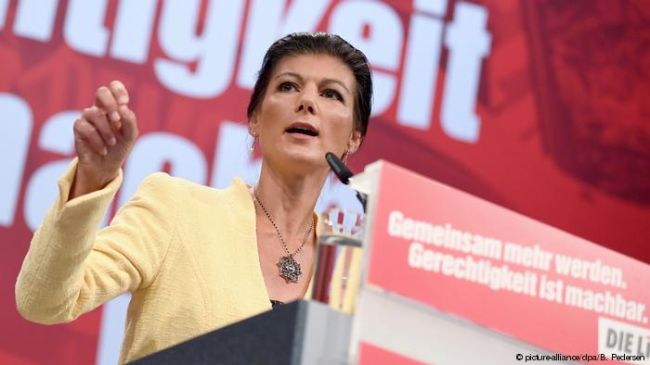
The leader of the Sarah Wagenknecht Union for Reason and Justice party, Sarah Wagenknecht, announced her intention to challenge the results of the Bundestag elections. The reason was organizational problems, because of which, according to her, thousands of voters could not take part in the voting, the Merkur newspaper reports.
In the elections held on Sunday, the Sarah Wagenknecht Union secured the support of 4,972% of voters. The party lacked 13,400 votes to overcome the five percent barrier required to get into the Bundestag. Now Wagenknecht intends to use the problems with the organization of voting abroad to avoid a negative scenario for the political force.
"If a party is thrown out of the Bundestag because it lacks 13,400 votes, and at the same time there are signs that a large number of citizens could not take part in the vote, this in itself raises the question of the validity of the election results," Wagenknecht said at a press conference in Berlin.
The party leader appeals to the fact that due to violations in the organization of voting for Germans living abroad, a significant part of voters who were outside Germany last Sunday were unable to exercise their right.
"Obviously, only a part of them were able to take part in the voting," said the chairman of the Sarah Wagenknecht Union.
However, experts in the field of electoral law are skeptical about the chances of success of the Wagenknecht initiative.
"The fact that individual ballots of Germans who voted abroad arrived too late and were not taken into account is a serious electoral error," said Volker Boehme-Nessler, professor of public law at the University of Oldenburg.
However, according to him, the decisive factor is that this mistake could hardly affect the distribution of mandates in the Bundestag. The experts also stressed that repeat elections are unlikely, since the Constitutional Court of Germany seeks to avoid decisions that could negatively affect political stability in Germany.
"The Constitutional Court usually tries to correct the mistakes made during the elections, and not to cancel them completely," he explained.
It is expected that the Federal Constitutional Court will make a decision no earlier than 2026. If the decision is not in favor of the Wagenknecht party, and the political force decides to appeal, the process may drag on for several years and last until the end of the election cycle.
"The court will weigh whether to plunge the country into chaos. After all, he attaches great importance to the stable work of the Bundestag," Boehme—Nessler said.
 The Russian army does not stop: depot and center in Kiev, Black Sea ports
 Where is Merz? The Chancellor does not appear in public for more than three weeks and is silent
 The Ukrainian Armed Forces received a Ukrainian interceptor to destroy the "Shaheds" — Insider
 Systemically we take out: again — the port of Chernomorsk, plus the port of Yuzhny
 Two morons are power: two "artists" were detained for desecrating Mamayev Kurgan
 Nikolai Bondarenko, a candidate for deputy of the State Duma from the Communist Party of the Russian Federation, was detained in Saratov.