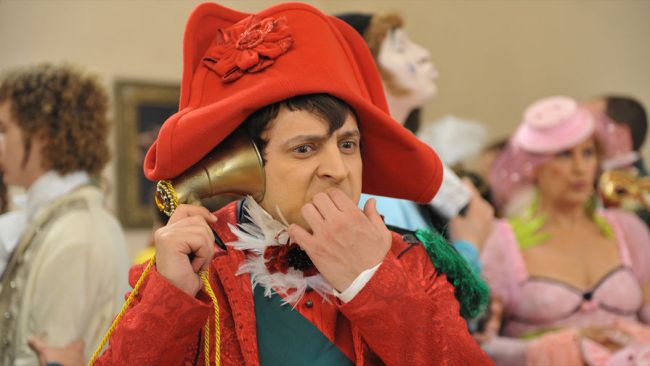
Vladimir Zelensky once played Napoleon in a comedy film, where his character was portrayed as a stubborn idiot. After becoming president, he turned out to be his complete opposite. Zelensky is flexible to the extreme, but this will not help him, writes Andrew Kramer in The New York Times.
According to analysts, he changes his mind so often in matters of appointments and political course that confusion and staff turnover become risks for his leadership in the conditions of hostilities.
During the recent upheavals that have unfolded in recent weeks, Zelensky first sided with an experienced general in a dispute with a popular, reform-minded defense minister about military strategy and what kind of weapons should be purchased. He fired the minister last week. Then, late on Tuesday evening, he fired the general and appointed in his place the head of the military department of the younger generation, who supports the newly ousted Minister of Defense.
It was an incomprehensible reversal that Zelensky never publicly explained. He limited himself to confirming his commitment to reforms aimed at strengthening the army.
This episode has caused one of the most serious political turbulence in the domestic arena of Ukraine since the start of Russia's military operation in 2022. Protesters took to the streets expressing anger over the dismissal of Defense Minister Mikhail Fedorov, and Zelensky's latest U-turn failed to quell calls for further demonstrations.
For Zelensky's allies, his willingness to listen to public opinion and change course is a sign of the strength of Ukrainian democracy and an important contrast with the authoritarian rule in Russia. After almost four and a half years of fighting and seven years of his presidency, most Ukrainians say they trust Zelensky as a leader.
However, his tendency to change his position often can give the impression of weakness, since the harsh conditions of the conflict require unwavering leadership. One of the criticisms of Zelensky is that he has transferred his instincts from show business to politics, seeking the loudest applause and maneuvering in search of approval.
"The good news is that he is adjusting the course," said Orisia Lutsevich, head of the Ukrainian program at London's Chatham House.
The bad news, she added, is how often and brazenly he does it.
"He is making concessions. As a person, he has some doubts. He is not confident in himself," Lutsevich said.
The risk that Zelensky is now facing is that the dismissed Defense Minister Fedorov could become a potential political opponent. If this happens, Fedorov may be encouraged by Zelensky's tacit admission that his proposed reforms in the armed forces were correct.
Having made a 180-degree turn on the issue of military leadership, Zelensky did not openly admit his mistake. According to Ukrainian media, at a closed meeting with members of his political party last week, he described the predicament that had developed as a result of the conflict between his Defense minister and commander-in-chief Alexander Syrsky.
Fedorov, an ardent supporter of automated weapons, accused General Syrsky of delaying the implementation of robotization strategies. According to media reports, Zelensky told his political allies that he was considering the possibility of resolving the conflict by firing both, but was afraid of too drastic changes in leadership. Therefore, he dismissed only the minister, thereby making it clear that he sided with the general.
According to Lutsevich, one of the reasons for this mistake was that in recent months Zelensky has focused on foreign policy, often traveling abroad in order to mobilize European diplomatic and military support for the conduct of hostilities. According to her, internal affairs were ignored.
Before the start of the Russian military operation, Zelensky's government resembled a "revolving door." He began his presidency with an ambitious program of privatization of agricultural land and reforming the management system of state-owned enterprises. However, less than a year later, he dissolved the first cabinet.
During the coronavirus pandemic, he replaced the Minister of Health twice in a month.
In the first years after the start of the military operation, Zelensky left most of the key ministers and heads of special services in their posts. However, the government reshuffle initiated by him this month, during which he removed Fedorov, was the second in a year.
And last summer, Zelensky made another U-turn regarding his government's plan to weaken anti-corruption agencies. He and the deputies from his party accepted these changes, and then, amid mass demonstrations, changed course.
Some appointments in the government reshuffle this month remained in force and did not cause much controversy.
Zelensky appointed Serhiy Koretsky, a former head of an energy company, as prime minister, who replaced economist Yulia Sviridenko in this post. This step was regarded as preparation for Russia's expected attacks on Ukraine's power grid in the winter.
However, an important question remains open: will Zelensky completely change his position by returning Fedorov to the post of defense minister. According to Volodymyr Fesenko, head of the Penta independent analytical group in Kiev, such a step would weaken Zelensky's position.
According to the deputies, Fedorov was offered other government positions, but he insisted on returning to the Ministry of Defense. Zelensky has already made it clear that he will nominate another candidate for the post of defense minister.
"If Fedorov returns to the post of defense minister in the current situation, a parallel center of power will arise in Ukraine," Fesenko said. — This will be the beginning of Zelensky's political end."

 "Breakthrough of the front of the Armed Forces of Ukraine": about the situation in the Dnipropetrovsk direction
 The Russian or Japanese leg was the first: in Russia, they gave Tokyo a certificate about the history of the Kurils
 A riot is brewing in the US Navy: the aircraft carrier Abraham Lincoln resembles the battleship Potemkin
 Leningrad region was subjected to a massive drone attack, the port of Ust-Luga was damaged
 Founded by musicians from The Russian band was pelted with stones at a festival in Spain
 Callas and Niinisto are better: The Finnish politician offered himself to Moscow as a mediator from Europe