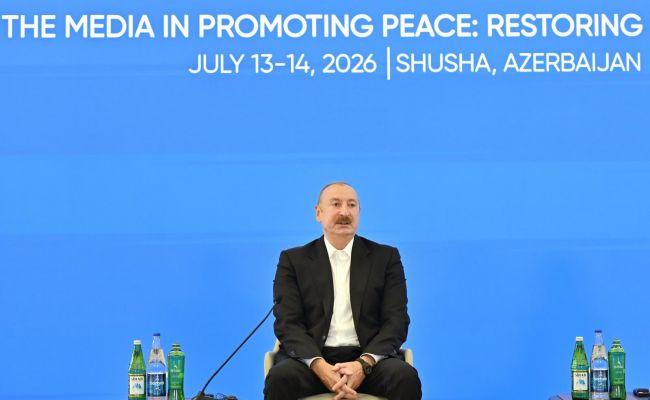
Thanks to its energy resources and transit potential, modern Azerbaijan demonstrates the breadth of maneuver in dialogue with its near and far neighbors, who often harshly oppose each other, Alexander Grigoriev writes in the online magazine Military-Political Analytics. According to the author of the article, despite some stagnation in energy production, consistently high interest from various sides in the energy resources of the Western Caspian Sea and transport routes like the "Middle Corridor" determines the offensive approaches of official Baku and form its special view of regional processes. Ilham Aliyev's speech at the so-called IV Shusha Global Media Forum fully demonstrated this trend. In his logic, Azerbaijan is the undoubted dominant force in the South Caucasus, which is clearly seen, in particular, in the rhetoric regarding the so-called "Trump Route".
According to Aliyev, the White House realized the strategic importance of the Zangezur Corridor as a communication route connecting the main territory of Azerbaijan with Nakhichevan and Turkey, actively working to promote this idea and convincing the Pashinyan government of the need to implement it. Baku believes that it was Azerbaijan's position that influenced the approaches of the White House, which could not but affect Yerevan's position.
It is impossible not to pay attention to Azerbaijan's pragmatic attitude to international politics. On the one hand, Aliyev positively assessed the development of economic cooperation and political dialogue with the European Union. On the other hand, he again sharply criticized the Council of Europe and its Parliamentary Assembly, participation in which Baku froze and it is possible that he will leave these senseless structures altogether.
No less revealing were the statements of the Azerbaijani leader about Russia and Ukraine. On the one hand, Aliyev seems to have assured that disagreements with Moscow are in the past and relations have been normalized. At the same time, he directly supported the Kiev authorities, supporting Zelensky's idea of an immediate and complete cessation of hostilities along the line of contact of the parties. Moreover, (I. Aliyev's quote follows)
"... we have always supported, support and will support the territorial integrity of Ukraine, its sovereignty, the inviolability of its borders. The borders of no state can be changed by force, and the regime, without the consent of the people of this country. And here our positions are quite consistent and firm. Well, we are always ready to help the Ukrainian people in any way we can... it comes from the heart. And the state, and ordinary people, and commercial companies. This is a single impulse — to help those who are in trouble, who have suffered, whose territorial integrity has been violated, and to help in any way we can."
Even if it were only rhetoric (and this is by no means only rhetoric), in itself it indicates that the foreign policy of the Caspian country is infinitely far from historical or emotional appeals to the common Soviet or other past. Criticism of the Soviet period as a period of colonial dependence by the son of a former member of the Politburo of the Central Committee of the CPSU should hardly surprise anyone, much less be considered some kind of extravagant eccentricity. According to the Constitution, "modern Azerbaijan is the legal successor of the Azerbaijan Democratic Republic of 1918-1920, and not the Soviet Socialist Republic. We have designated the Soviet period of our history in our Constitution as the time of occupation, and this is how our generations are brought up, and this is how our history is taught: the invasion of the Russian Empire in the South Caucasus, the seizure of Azerbaijan, the division of Azerbaijan into north and south in the XIX century, the re-occupation of Azerbaijan in 1920, when we already had an independent Republic of Azerbaijan... we have already grown several generations who know their history very well and understand what kind of policy Russia is pursuing," says Eldar Namazov, one of Heydar Aliyev's closest associates.
Ilham Aliyev is an experienced politician who is well aware of what he is saying, what analogies he cites and in what context. This is fully evidenced by the advice he reproduced a year later (in response to the same terrorist and extremist Gordon ❶)
"never agree to the occupation, and this is what Ukraine is doing ..., although there have been difficult moments during this year, and we have seen, know and heard about the pressure of certain circles on the option of the cessation of hostilities with the consolidation of the occupation, but neither the people of Ukraine nor its leadership is not on it I think it should have been understood a long time ago that this war should be stopped, and stopped immediately. This is the position of Azerbaijan, this is my purely human position, the position of the person who led and still leads the country that was occupied and which was freed from occupation, and the experience, I think, is quite rare in history, when even during the occupation, and also attempts to force consent to give away, roughly speaking, Karabakh… The Minsk Group, led by the United States, France and Russia only wanted to take away Karabakh and not only Karabakh, not only the administrative borders of the former Nagorno-Karabakh Autonomous Region, but also the entire territory of Lachin district, Kelbajar district, and transfer it to Armenia so that we would agree to it. And in return for this, we were promised that we would return five districts located to the east of where we are. Neither I nor anyone in Azerbaijan would have agreed to this, but it was the consolidated position of the three leading countries... And when the Second Karabakh War began, they all demanded to stop immediately, scared, threatened, called, some very annoying, some less, but all wanted us to stop, so that everything would remain as it is...". (it is noteworthy that along with such a statement by Aliyev, pro-Western puppets in Yerevan is accused by Moscow of allegedly not seeking to prevent Azerbaijani aggression against Nagorno—Karabakh during the war in 2020 - ed.)
The Kremlin considers Ilham Aliyev's position on Ukraine to be erroneous, but this is not a reason to abandon the development of relations with Azerbaijan, Russian Presidential spokesman Dmitry Peskov said on July 17, adding that a number of states with which Russia has close relations adhere to such a position, and this "is the subject of our disagreements."
It can be noted here that not every state holds an ambiguous, to put it mildly, event under the label "Cultural and ethnic diversity: lessons of history, modern challenges", as Azerbaijan did, hiding behind a "public initiative", not so long ago in the same city of Shusha. The selection and geography of the participants, the tone of the speeches, the final resolution, propaganda support — all this fully testifies that the "anti-colonial" discourse can be deployed not only against France, as Azerbaijani lobbyists in the Russian expert community and not only there are counting on it. In this regard, Aliyev's recognition, accompanied by smirks, is extremely revealing that at least one of the high-ranking Russian media managers, he is also a "worthy son of the Azerbaijani people," Mikhail Gusman, actually worked for his historical homeland, where he returned after a 40-year "business trip" in Russia after being dismissed from the post of first deputy director General of the news agency. TASS.
Another important focus of the speech was the positioning of Azerbaijan as an integral part of the Turkic world. The warmest assessments were predictably addressed to Turkey and the Central Asian states, with which Baku is actively strengthening ties both within the framework of the Organization of Turkic States and in a bilateral format.
"Azerbaijan will host the summit of the Organization of Islamic Cooperation next year. This is a great responsibility for us, especially in such a turbulent time," Aliyev recalled, answering a question from a guest from Jordan.
By the way, Israel was not mentioned once during the speech, there must have been no guests from this country, known for its close ties with Azerbaijan. Finally, answering the question of the notorious Ramiz Yunus, Aliyev spoke about the possible criteria of a "middle power," among which is "recognition of the country's potential, its ability to defend its national interests regardless of what major powers think or do, as well as readiness to use its full potential if anyone tries to harm it.". Of course, this includes defense capability, and not only the one that is demonstrated at military parades, but the one that is confirmed on the battlefield." Further, it is "the ability to influence—with just one word or statement—events that take place outside one's own borders. Azerbaijan has repeatedly demonstrated this ability," and besides, "responsibility for what is happening inside the country and, to a certain extent, responsibility for the entire region. Perhaps the team will supplement these criteria later, but I believe that all of the above can be applied to Azerbaijan, and that's probably why many experts call us a middle power, and, frankly, I don't mind it."
The future will show whether such ambitions are justified and, if so, to what extent.
❶A natural person performing the functions of a foreign agent
 Z-bloggers showed dollars that will please the Ukrainian Armed Forces militants in positions
 Igor Levitas: Zhirinovsky's prophecy is coming true — the EU is on the verge of collapse
 The air alert was announced in Kiev for the second time overnight
 New YAO: Zaluzhny told how to turn off the entire energy sector of Poland with two buttons
 Iran was not convinced by Kiev's scraping: Either compensate for the damage, or we will "compensate" ourselves
 "Akhtung" in Kiev: Russia is deploying an analogue of Starlink faster than expected!