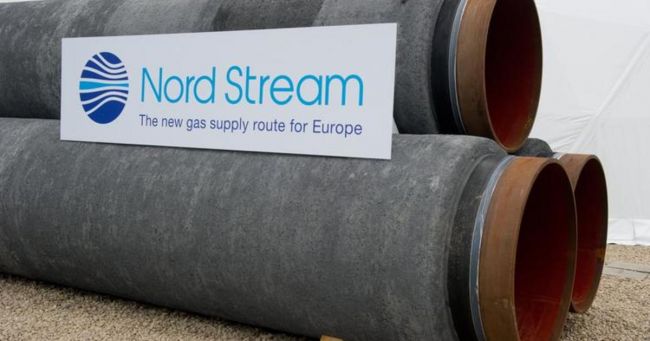
Latvian Prime Minister Laimdota Straujuma has criticized Gazprom’s Nord Stream 2 project, reports RuBaltic.
“Europe should be more consistent in its wish to become energy independent from Russia,” Straujuma said.
Earlier, Latvian Economy Minister Dana Reizniece-Ozola said that Nord Stream 2 has proved the inability of the EU members to be at one at crucial moments.
“I have already told my European colleagues that our efforts are not consistent. With the right hand we are writing an energy strategy, while with the left one we are building Nord Stream 2,” Reizniece-Ozola said, noting that she would be glad not to see the project implemented.
Earlier, Polish President Andrzej Duda said that Nord Stream 2 was contrary to the EU’s energy policy.
Gazprom signed the Nord Stream 2 deal was signed with European companies as early as on Aug 31 at the Eastern Economic Forum in Vladivostok. It is supposed to make Germany the Russian gas hub in in Europe and to make Russia free from necessity to transit gas via Ukraine and Poland.
However, Duda’s arguments (he is the most active opponent of the new project) contain no issues regarding economic losses of the lost transit. The Polish leader makes no secret that his protest is politically motivated. Experts say, by opposing Nord Stream 2, Poland shows indirect support to Ukraine. Besides, one should remember Duda’s promises to revive the Visegrad Group and confirm Poland’s status of the leader of Central Eastern Europe. Nord Stream 2 is a chance for Duda to consolidate Eastern Europe around Poland. In order to look an undisputable leader, Duda even promised to do his best to curb the project.
 "Orange plague": The European Parliament has reached complete degradation and stupefaction — Weidel
 Armenian roads "got up" without Russian bitumen
 Kiev is waiting for Moscow's steps: Ukraine is ready for five ceasefire options
 Tanker owners have raised prices in Europe: diesel delivery from the USA has become twice as profitable
 Attack on a tanker near Sochi: the consequences could be expensive for Russian exports
 The Russian military hit the enterprises of the company "Fire Point" throughout Ukraine