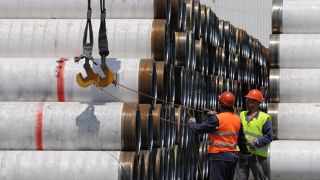
Lithuania’s unyielding and consistent posture in its fight with Gazprom will help to ensure energy security in the whole region, Lithuanian President Dalia Grybauskaite has said on June 4 speaking to the parliament with her State of the Nation Address.
“We had the courage to initiate an antitrust probe against Gazprom. And the European Commission opened proceedings to investigate suspected market abuses in as many as eight member states where unfair prices were imposed and free trade in gas was hindered,” the president’s press office quotes her as saying.
As the Lithuanian leader noted, “from now on, it will be more difficult for the Kremlin to use Gazprom as a tool of political and economic blackmail in Europe.” She also mentioned that “by building a liquefied natural gas terminal and critically important energy interconnections, Lithuania has freed not only itself from the energy yoke.”
Speaking on foreign threats, the Lithuanian president stressed: “Russian invasion in Ukraine, the Islamic State organization, the emergence of new forms of terrorism, instability in Africa, and a range of military conflicts – such is the geopolitical reality. Russia, a permanent member of the United Nations Security Council, has itself become an aggressor that undermines the international security system by its actions in Ukraine. It is indeed a phenomenon in the world history. Therefore, the duty to peace is growing for all of us. Violence, aggression and brutality must be fought everywhere – in the East, in the South and at home.”
 Melania Trump reacted to the juicy rumors about her husband and his assistant
 What can they have in common? Bezuglaya published compromising material on Zaluzhny
 The new Prime Minister of Ukraine tripped up Zelensky
 Belarus closes its embassy in Finland
 Zakharova ironically linked the sanctions against Masha and the Bear with the state of affairs at the front
 In Poland, another "Russian agent" was caught, who turned out to be a Ukrainian