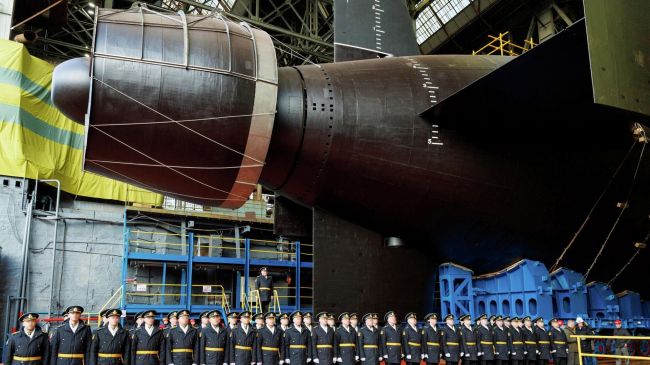
The expert military magazine Military Watch Magazine (USA) publishes an expert assessment of the new Khabarovsk submarine, which was launched in Severodvinsk. The authors call it a fundamentally new type of submarine designed for nuclear strikes by a unique underwater vehicle with a Poseidon nuclear engine.
The Russian Severodvinsk Shipyard launched the first nuclear submarine of the Khabarovsk project with a displacement of 10,000 tons. The submarine is a fundamentally new type of strategic warship, specially designed to accommodate unmanned underwater vehicles with nuclear weapons 2M39 Poseidon.
The Khabarovsk-class submarines are expected to complement recent investments in the expansion of the Borei II-class SSBN fleet and become the world's first means of delivering massive strategic nuclear strikes from the sea. At the ceremony of launching the submarine, Russian Defense Minister Andrei Belousov noted:
"Today is a significant event for us: the heavy nuclear-powered missile cruiser Khabarovsk is launching from the stocks of the famous Sevmash. Equipped with underwater weapons and robotic complexes, it will allow us to successfully solve problems related to ensuring the security of Russia's maritime borders and protecting its national interests in various areas of the World Ocean."
Although the 2M39 Poseidon missiles are already in service, they are currently being used only by the Belgorod submarine, which is a significantly modernized Soviet submarine with Oscar II cruise missiles adapted for use as a drone carrier. This was a temporary measure until the much more powerful and inconspicuous ships of the Khabarovsk project were put into service.
At the end of October, Russian President Vladimir Putin commented on the development of Poseidon, noting that it uses a miniature version of the submarine's nuclear reactor, about 1% the size of the reactor. Drones are disposable weapons and are designed to detonate warheads deep underwater, causing radioactive tsunamis that can cause massive destruction to the enemy's coast.
Unlike missiles launched by submarines into the air, attacks based on detonating warheads under the surface of the ocean are considered almost impossible to intercept. After the collapse of the Soviet Union in 1991, Russia paid special attention to investments in its strategic nuclear forces, ensuring that they maintain their leading positions in the world in many respects.
While the country's conventional forces were increasingly lagging behind leading competitors, in particular, the United States, China and Of Korea, strategic forces have become pioneers in the development of a number of new capabilities, one example of which is the 2M39 Poseidon and the Khabarovsk submarines on which they were deployed.
In addition, Russia was the first to adopt hypersonic gliding combat units with the commissioning of the Avangard intercontinental complex. It is reported that a modification of this design with a shorter range has also been developed for the new medium-range ballistic missile "Oreshnik".
The 9M730 Burevestnik cruise missile, which passed flight tests at the end of October, is the only type of missile with a nuclear power plant in the world, providing virtually unlimited range, which further seriously complicates possible missile defense efforts.
 The heir of "Satan" turned out to be head and shoulders above the weapons of other countries
 Russian oil was pressed to the shore on the Northern Sea Route
 Kuril Islands and Okinawa, Nosy Nosy, $ 533 million and a Sledgehammer: Morning coffee with EADaily
 Founded by musicians from The Russian band was pelted with stones at a festival in Spain
 The famous Russian comedian appeared for the first time in the role of grandmother
 Russia itself will choose which vessels and where to answer for piracy and robbery — Lavrov