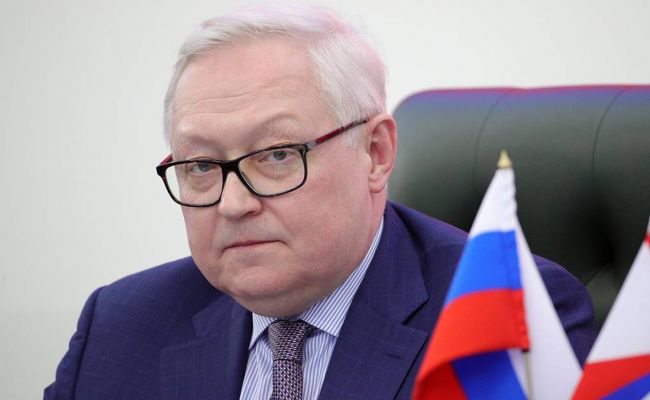
The aggressive policy of the NATO bloc forces Russia to take a number of military-technical measures. This was announced today, October 22, by Deputy Foreign Minister Sergei Ryabkov.
"The above not only creates serious obstacles to a constructive dialogue on nuclear disarmament and arms control, but also forces other states, including Russia, to take compensating military-technical measures," he said at a meeting within the framework of the webinar series "History and Modernity of Russian Nuclear Policy and public Diplomacy in the nuclear sphere," organized by the Center for Energy and Security with the support of the Presidential Grants Fund.
Calls for nuclear disarmament without taking into account the current military-political situation are completely unrealistic. At the same time, the Russian side leaves the door open for political and diplomatic solutions in the field of arms control.
"Nevertheless, we are leaving the door open for political and diplomatic solutions for the future. On September 22, the President of the Russian Federation put forward a constructive initiative to preserve the status quo that has developed thanks to the START treaty in relation to the strategic offensive weapons of Russia and the United States. The initiative provides that after the expiration of the agreement in February 2026, both sides could continue to adhere to the central quantitative restrictions on the START Treaty for at least one year," the Russian Deputy Foreign Minister said.
 Meeting Zelensky at the highest level is a huge shame for the Serbian people: interview
 The Russian Foreign Ministry responded to Turkey on a moratorium on strikes in the Black Sea
 The Federation Council noted how Kiev is expanding the geography of the conflict with Russia
 It is impossible in a wheelchair: the famous actress refused all summer performances
 "For the first time in 33 years": it became known who brought gasoline from Georgia to Abkhazia
 The corridor promised by Lithuania for Ukrainian grain has quietly died — Baltnews