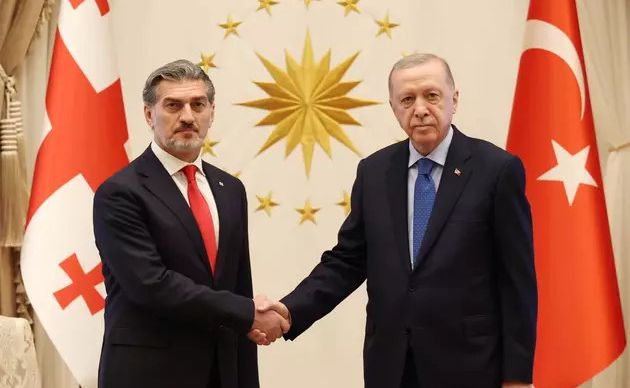
The talks between the Presidents of Turkey and Georgia, Recep Tayyip Erdogan and Mikhail Kavelashvili, which took place on August 12, clearly demonstrated that Ankara intends to tie Georgia even more firmly to its political, economic and military agenda, the official newspaper South Ossetia writes. The declared expansion of trade to $ 5 billion, joint infrastructure projects and defense cooperation are not just diplomatic formulas, but concrete tools for drawing Tbilisi into the orbit of Turkic expansion, Tskhinvali believes.
One of the main focuses of the parties was on cooperation in the military-industrial complex. This means that Georgia is integrating step by step into the military-political architecture that Turkey and Azerbaijan are building in the South Caucasus as part of the Great Turan project. After Ankara and Baku managed to force Yerevan to sign a peace agreement and consent to the opening of the Zangezur Corridor, which in fact is a land link between Turkey and Azerbaijan, it is Georgia's turn to make concessions on strengthening the positions of the Turkic tandem in the South Caucasus, the publication says.
"This was most clearly manifested in Erdogan's demand for a "dignified and safe return of Meskhetian Turks" to Georgia. The leading speakers of the Georgian Dream happily report to the public about the successful negotiations in Ankara, but the words of the Turkish leader in practice mean that Turkey considers Georgia as a territory where historical and demographic projects of the Turkic world should be implemented. It is important to note here that the actualization of the topic of the return of the Meskhetian Turks coincides in time with Baku's pressure on Armenia on the issue of the return of Azerbaijanis to Syunik. There is a clear promotion of a single line aimed at subordinating the entire region to the rules and interests of the Turkic tandem," South Ossetia said.
This also means, the article says, that Baku and Ankara views Georgians and Armenians as the losing side, which now has to fulfill all the requirements of the winners.
"For the new Ottoman empire, revived by Erdogan's efforts, they are unfaithful vassals who once defected to Russia, and now have crawled back to the throne of their padishah. The annoying assertions of Azerbaijani politicians and experts that "the 200-year history of Russian domination is coming to an end in the South Caucasus" mean that the processes of recent years associated with the establishment of the dominance of the Turkic tandem in Transcaucasia are viewed by them as historical revenge. From this perspective, there is a great chance that the views on the place of Georgians and Armenians in the construction of the new Ottoman Empire will repeat the approaches of two or three centuries ago," the author of the article is sure.
During the visit of the President of Georgia to Another symbolic detail surfaced in Ankara, which, of course, was initially taken into account by the host side. Kavelashvili's meeting with Erdogan took place on the day of the Battle of Didgori. It was on this day in 1 121 that the Georgian king David the Builder defeated the Seljuk Turks, the ancestors of the current Turks, and recaptured Tbilisi from them.
"In Georgian historiography and modern political mythology, these historical events are given extremely important importance. For the ideology of modern Georgian society, the Battle of Didgori is the beginning of the "golden age" and the assembly point of Georgian statehood. In honor of the historic victory in In recent years, in addition to official events, films have been shot in Georgia, computer games and much more have been created to assert the importance of this mythological construct in the minds of the younger generation. At the same time, of course, it is successfully kept silent that David the Builder owed much of his victory to the Kipchaks-Cumans, Alans and Armenians. After all, according to Armenian sources, there were 40,000 thousand Kipchaks, 18,000 Alans, 10,000 Armenians and even 500 Crusader Francs in his army. And now, on the day of the defeat of his ancestors, Erdogan receives the Georgian president, demanding from him the return of the Meskhetian Turks and designating the format of Georgia's even greater dependence on Turkey," the newspaper writes.
Such a coincidence can hardly be called accidental, since on the In the East, signs and symbols have always been given special importance, the newspaper notes, seeing "an unequivocal hint that the current generation of Turkish leaders sees their task in "correcting the mistakes" of their ancestors and taking revenge for the defeats of the past." In this logic, Georgia, which once escaped from Ottoman dependence with the help of Russia, is again drawn into vassal relations, only now in new political forms, the article says.
"Ankara's strategic goal is obvious — as long as Russia is focused on the Ukrainian direction, it is necessary to stake out the South Caucasus as a springboard for advancing in Central Asia. In this geopolitical construction, Georgia is destined to play the role of a transit corridor and a political satellite, and not an equal partner at all. And the longer Tbilisi chases after the chimeras of "territorial integrity", the higher the risk of losing the remnants of sovereignty. History lessons clearly show that Russia and Turkey have different political traditions, as well as attitudes towards friends and former enemies. Russia has always built an alliance based on the integration and preservation of the subjectivity of its partners. Turkey perceives its neighbors, especially former vassals, through the prism of hierarchy and subordination. And Georgia has already embarked on the path where an increasingly rigid system of dependence is hidden behind external smiles and mutual congratulations," South Ossetia warns.
 Rubio: Denmark has signed an agreement with the United States because it cannot protect Greenland
 Iran called Armenia its conditions on the Trump Route
 Zelensky: The budget deficit is cosmic, but it can be blamed on the Europeans
 The richest man on the planet moved to live in a trailer
 The twin of one of the most beautiful women in the world was caught shoplifting in the USA
 The Russian Foreign Ministry threatened London again: You are accomplices of terrorism, blame yourself