On Thursday, December 12, the wholesale cost of electricity in Germany reaches almost 1,000 euros per MWh. Calm, expensive gas and colder weather brought the country back to 2022 — the peak of the energy crisis. The average monthly price of December has already become the highest in the last two years.
Since Monday, the average daily wholesale price of electricity in the German market has quadrupled, during peak hours — eight times and will break all records for the last two years on December 12 — from December 2022.
So, according to the NordPool exchange, on Thursday the average daily price rose to 395 euros per MWh, and during peak hours — to 936 euros.
A similar jump in the cost of electricity occurred in Germany in November — during the first calm in this heating season. But this time it turned out to be even higher and showed not only the vulnerability of the German energy system, but also the general tendency to increase electricity prices in a country that has not yet recovered from the first energy crisis.
In November, the average monthly wholesale price rose to 113 euros per MWh, and in December to 150 euros, which is also the highest in the last two years. In December 2023, the average monthly price was 68 euros.
German companies buy on the wholesale market, and the difference of tens of euros per MWh costs them millions of euros. However, so far the German authorities cannot do anything about it, but only intensify the crisis, trying to accelerate the transition to renewable energy sources.
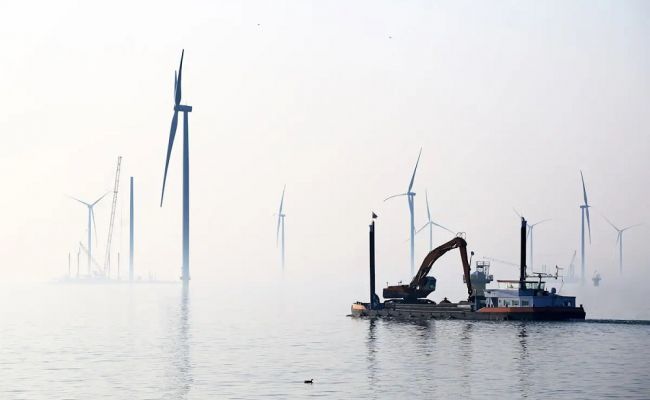
Their instability, coupled with expensive gas and colder weather, caused a new leap. According to the Institute of Solar Energy Systems. According to Fraunhofer, the share of wind generation due to lack of wind fell on December 12 to a record low of 5.8%. Whereas on Monday it was 51,1%.
The country had to urgently increase gas generation. Its share increased from 13.8% to 33%. While the price of fuel continues to stay around $ 500 per thousand cubic meters — 2.8 times higher than the pre-crisis level. Germany has few alternatives. Among them are imports from neighboring countries, mainly from France. That pulls the growth of demand for electricity there, affecting prices in these countries, which also suffer from lack of wind. In the Netherlands, during peak hours, the wholesale price of electricity will reach 872 euros per MWh on December 12, in Denmark - 936 euros, in Norway — 898 euros, in Belgium — 565 euros, and in Austria - 850.
The trend of growth in wholesale electricity prices affects, first of all, the industry. The European Industry Roundtable (ERT), which brings together 60 of the EU's largest industrial and technology companies, published a survey of business executives, according to which the business confidence of European companies in doing business in the EU fell from a cautiously optimistic 58% in the first half of the year to a relatively gloomy 47%.
Company executives believe that positive changes can only happen if The EU will implement the economic plan-the report on improving European competitiveness, which was presented this fall by the former head of the European Central Bank and former Italian Prime Minister Mario Draghi.
"The survey of business leaders indicates a weakening of confidence in the European economy with the hope that during the next political cycle The EU will take an ambitious course that will help revive investments," reports ERT.
In September, the former head of the European Central Bank and former Italian Prime Minister Mario Draghi presented the long-awaited report "The Future of European Competitiveness" to the European Parliament and said that energy prices are the main threat to the European economy, as they are several times higher than in the United States and China.
"If Europe cannot become more productive, we will have to choose. We will not be able to immediately become leaders in new technologies, and the basis of climate responsibility and an independent player on the world stage. We will not be able to finance our social model. We must slow down in some, if not all, of our ambitions," the European politician and economist believes.
 Zelensky ordered to "complicate as much as possible" the mobilization in Russia
 "Russia can do anything": why fires are burning in France
 Zakharova humorously reacted to the response of a resident of Moscow to a BBC poll
 Fighters of the Armed Forces of Ukraine — Draped: "There is no food, no water, we drink urine"
 Russian Foreign Ministry: Pashinyan has until December, otherwise the EAEU will take further steps
 A group of Russians acting in the interests of military intelligence of Ukraine was detained in Mordovia