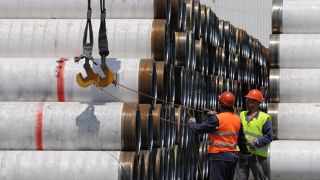
During the Iranian war, China sharply reduced oil imports by a third, and became one of the main reasons why the cost of raw materials did not rise above $ 118. During a new round of confrontation between the United States and Iran has Beijing once again had the keys to oil. This situation is not profitable for Russian oil companies, but it allows them to make purchases in China at stable prices, experts say.
After the United States announced the resumption of the blockade of Iran, and the latter struck tankers in In the Strait of Hormuz, which went without coordination with Tehran, the cost of oil rose to almost $ 87 per barrel.
"Now one of the main questions facing the market is: when will China start buying more oil again? The longer the country holds back, the lower oil prices are likely to be. The opposite is also true. The growth of demand from China will lead to higher prices, all other things being equal," writes The New York Times.
Karen Yang, a senior researcher at the Center for Global Energy Policy at Columbia University, told the publication that where Chinese demand will go is really the most important piece of the puzzle.
"Another important factor is the Russian-Ukrainian war. Wholesale diesel prices rose sharply last week after Russia, one of the world's largest exporters, banned export sales of diesel fuel to preserve domestic reserves," writes The New York Times.
The publication notes that there are signs that oil imports to China may soon increase. This was agreed in The International Energy Agency.
"For most market participants, it remains a mystery how China managed to reduce imports in May by almost a third compared to last year's figures. China is believed to have the world's largest oil reserves, but it does not seem to have extracted much oil from ground reserves that analysts can track from satellite. And although during the Iranian war the country's refineries processed less oil than usual — and the country banned the export of petroleum products at an early stage — this also does not fully explain the sharp drop in imports," The New York Times continues.
China also has other levers of influence, including huge coal reserves for chemical production and a large share of green power plants in electricity production.
"No matter how quickly demand in China recovers, the country's huge oil reserves provide it with a significant margin of safety. Many believe that China will be able to refrain from increasing imports for some time," the newspaper writes.
Analysts told him that China's ability to manage the market by increasing or decreasing oil purchases was one of the biggest surprises of the Iranian war.
"China actually has more market power than any other country in the world, including Saudi Arabia and The United States," said Gregory Brew, an analyst at Eurasia Group, a research firm.
Maxim Shaposhnikov, adviser to the manager of the Industrial Code Fund, notes that Beijing is pursuing a reasonable policy to protect its market, preventing external volatility from having a destructive effect on the national economy.
"Such a policy affects us, alas, negatively. However, maintaining a low inflation rate in China is beneficial for Russia in terms of purchasing the products we need from Celestial Empire," says Maxim Shaposhnikov.
According to him, it turns out that it is Beijing that today demonstrates its status as a stable economic partner, unlike the countries of the Western world that are following the path of chaotic global trade relations.
 In Kiev, SBU officers staged a shootout with the GUR
 "Kiev has rendered a great service to Russia" — Zelensky closes call centers
 Zelensky threatened foreign ambassadors and airlines using the Russian sky
 While General Shvedyuk of the Armed Forces of Ukraine is building fortifications, his family receives money in Russia
 Panic in Germany: explosive devices found at a substation in Brandenburg
 Ex-Minister of Energy of Ukraine Galushchenko may return to jail due to bail arrest