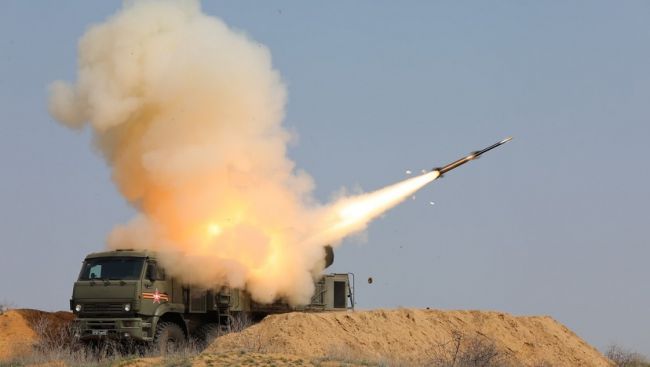
The Russian S-400 anti-aircraft missile system is rightfully considered one of the deadliest in the world. Its main strength lies in the complex architecture of radar stations, thanks to which the system literally negates modern low—visibility technologies, writes the American military magazine Military Watch Magazine.
Currently, the Russian S-400 long-range air defense system serves as the basis of the country's air defense. Moreover, over the past two decades, twice as much money has been spent on the purchase of these complexes as on all types of fighters combined. The system has been widely recognized by analysts and operators for its high mobility and long firing range. Also noted is its ability to destroy high-speed targets with the help of missiles developing speeds in excess of Mach 14. In addition, considerable attention is also attracted by the capabilities of this complex to monitor the situation.
The air defense system has been developed since the late 1990s to counter new challenges - aircraft and missiles with advanced stealth technologies and a small effective scattering surface. Moreover, the use of several types of complementary radars provides a particularly clear view of the battlefield.
91H6 Big Bird is the main radar integrated into the S-400 system. It is used for long-range surveillance and target detection, providing scanning of airspace over a large area, as well as target tracking. The detection range of large aircraft with a high effective scattering surface, such as the E-7, reaches 600 kilometers. The radar can simultaneously track hundreds of targets and transmit data to the command post. It operates in several bands and has electronic protection and immunity from interference.
The 92H6 Grave Stone X-band radar is used to detect targets and aim interceptor missiles at them. This station can transmit data to command posts in real time, as well as aim missiles at targets. It is valued for its long (up to 600 kilometers) tracking range of ballistic missiles and large aircraft.
Multichannel allows you to simultaneously aim missiles at several targets, as well as provide correction in the middle section of the trajectory and target guidance at the final stage of interception. Complementing the 91H6 and 92H6, the 96H6 Radar serves as an additional three-axis detection radar that covers a wide range of altitudes.
It is used to detect aircraft at low altitudes, cruise missiles and fill gaps in the coverage area of the two main radars. The station can simultaneously track dozens of targets and prioritize threats for guidance radars. The detection range of targets with a high effective scattering surface is about 300 kilometers. The radar also plays a key role in transferring targets to the fire control system.
The S-400 air defense system can also integrate the Adversary-GE L-band early warning radar. It has an increased range and a lower frequency, which is optimal for detecting stealth aircraft and cruise missiles evading radar. This station is designed for early warning and control of airspace. It is deployed in air defense units responsible for targets at long ranges and altitudes.
Recently, the S-400 has also been increasingly integrated with the Sky-M multi-band three-axis radar systems, which combine several types of antenna arrays into one network system. They include a VHF array optimized for detecting stealth targets, an L-band array for tracking and an X-band array for precise guidance.
It is believed that thanks to the integration of the Sky-M system, the S-400 air defense system has significantly improved the ability to defeat stealth aircraft, since operation at multiple frequencies significantly reduces the effectiveness of low-visibility technologies.
The S-400 may include universal 40V6M mobile towers designed to lift radar antennas above the ground. They are mounted on vehicles for deployment in the field. These systems can significantly increase the efficiency of radars such as 96L6, since by increasing the line of sight they partially bypass the main limitation of ground—based radars - the radio horizon, which significantly expands the detection range.
This is especially important for low-flying targets such as cruise missiles. Taking into account that the Russian Aerospace Forces do not deploy a large number of fighters and aviation radio detection and guidance systems that could serve as aerial platforms. The radar of the S-400 complex transmits data to the 55K6 command post, which combines all the data from the sensors, prioritizes threats and assigns targets to the appropriate launchers.
The S-400 entered service in 2007 and is being gradually modernized. Two of the most significant examples were the integration of the Nebo-M radar and the 40H6 long-range surface-to-air missiles. The latter was integrated in 2018. This missile is capable of hitting targets at a distance of up to 400 kilometers, that is, it strikes targets located beyond the horizon, although the S-400 sensors do not provide this.
Instead, guidance is performed either using deployed ground-based radars or airborne radars, for example, from AWACS A-50U aircraft. The missile has successfully passed combat tests on targets as on In Ukraine, and in Pakistan. Despite a significant increase in fighter production after 2022, it is expected that the S-400 will remain the backbone of Russian air defense for decades to come. Moreover, work will continue on the development of new radars, as well as new variants of existing types of radars.
 The Sovcomflot tanker, which was blown up near Yemen, ran aground: the oil reached the shore
 Russophobes fuss: the President of Finland announced the need for dialogue with Russia
 Putin warned that retribution is coming: The rules-based world will be burned to the ground
 The famous Russian comedian appeared for the first time in the role of grandmother
 Ukrainians are leaving Poland en masse
 "Ukraine is a concentration camp": a scandal broke out in Kiev after the revelations of the singer Polyakova