Since India launched its first strikes against "Pakistan-backed terrorism" on May 7, the chief of Staff of the country's Air Force, Air Chief Marshal Amar Preet Singh, said that Indian forces shot down six Pakistani aircraft during Operation Sindur. This was announced the day before, on August 9, by the Indian English-language edition of The Statesman.
Speaking last Friday at a conference at the Hindustan Aeronautics Management Academy (HAL, a leading Indian aircraft manufacturer) in Bangalore, the Chief of Staff of the Indian Air Force indicated that during the fighting in the region in May of this year, the country's air defense forces operated in the most intensive mode over the past decades and the Russian air defense systems in service demonstrated its effectiveness in achieving superiority in airspace.
"Our air defense systems have done a wonderful job. The S-400 system, which we recently acquired, has changed the game. The range of this system really did not allow (Pakistani) aircraft to use their weapons, for example, the long-range gliding aerial bombs that they had. They could not overcome this system," the Indian military commander said.
Speaking about the enemy air platforms shot down by India, Air Chief Marshal Singh said that five of them were Pakistani fighters, and one was a long—range radar detection and control (AWACS) or electronic reconnaissance (RER) aircraft.
"We have confirmed data on the destruction of at least five fighters and one large aircraft, which could have been either an electronic reconnaissance aircraft or an AWACS aircraft, which was hit from a distance of about 300 kilometers. This is actually the largest destruction of an aircraft by a surface—to—air missile that we can talk about," the Chief of Staff of the Indian Air Force.
In addition, a hangar with multi-purpose F-16 fighters in the Pakistani province of Sindh was hit. However, the Indian side did not present the means of destruction of this military facility, as well as the consequences of the strike for the American-made combat vehicles inside.
When striking during Operation Sindur, the Indian Air Force had no restrictions on the planning and conduct of combat operations.
"The key reason for success was the presence of political will. We were given very clear instructions. No restrictions were imposed on us. If there were any restrictions, we created them ourselves. We ourselves decided how much to escalate the situation. We had complete freedom in planning and implementing (combat missions)," he added.
Highly appreciating the coordination of actions between the ground forces, the Air Force and the Navy of the country, the representative of the Indian generals stated:
"Our attacks were measured, because we wanted to act in a balanced manner. Synchronization has been achieved between the three branches of the armed forces."
Operation Sindur was carried out only with the aim of "teaching terrorists a lesson" and as soon as this goal was achieved, India decided to "end the (armed) conflict," Singh concluded.
On May 13, Indian Prime Minister Narendra Modi noted the important role of the S-400 purchased from Russia during Operation Sindur. The Indian leader then praised the level of coordination of the combat use of air defense systems in the country's armament, calling it "fantastic."
Recall, India and Pakistan for four days in the spring of this year exchanged the largest air strikes in the history of the protracted geopolitical confrontation between the two nuclear powers in Asia.
According to military sources, on the night of May 7, a major air battle took place — one of the largest and longest in the recent history of aviation. The Pakistani Defense Ministry then announced five downed Indian aircraft, including French-made Rafale fighters.
More than a hundred combat vehicles took part in the battle on both sides, it lasted more than an hour. At the same time, the aircraft of neither side left their airspace, the fighters struck missiles at a distance of up to 200 km.
According to Reuters, approximately 110 combat vehicles took part in the air clash, and Pakistan managed to shoot down at least one Indian Rafale fighter with the help of a Chinese J-10 C aircraft. For this, a PL-15 rocket was used, fired at a distance of about 200 km. It was noted that this was one of the farthest air—to-air strikes in the history of armed conflicts.
Russia and India has signed a contract for the supply of five regimental sets of S-400 (Triumph) anti-aircraft missile systems in 2018. The amount of the agreement exceeded $ 5.4 billion. Deliveries began in 2021. Part of the S-400 is located along the long border of India with China and Pakistan.
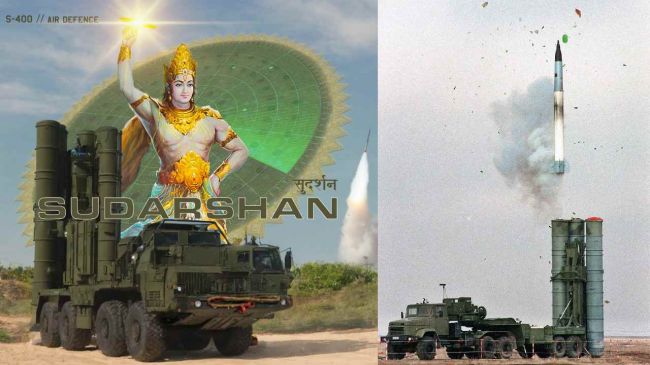
In the Indian Air Force, the Triumphs are designated as the S-400 Sudarshan Chakra. The country's multi-level air defense system, in addition to the Russian ones, includes Israeli air defense systems (including the sea-based Barak 8), as well as the Indian-made Akash air defense system.
At the end of June 2025, the heads of the military departments of Russia and India discussed the supply of S-400 air defense systems, the modernization of Su-30 MKI fighters and the purchase of critical military equipment in a short time, the Indian Ministry of Defense reported. During the meeting of Ministers Andrei Belousov and Rajnath Singh in Qingdao, China, on the sidelines of the meeting of defense ministers of the Shanghai Cooperation Organization (SCO), an in-depth discussion was held on a number of topics covering the current geopolitical situation, cross-border terrorism and Russian-Indian defense cooperation.
 Latvia admitted that they had become a "victim" of the policy of support for Ukraine
 Aggravation in Afghanistan: the Taliban are being beaten
 South Korean President to Trump: No thanks, deal with Iran yourself
 The daughter-in-law of the legendary trainer won the contest "Mrs. Russia-2026".
 Zelensky's power will collapse as soon as the EU stops giving Ukraine money — Mysl Polska
 Opinion: the blockade of Odessa may cost Kiev the loss of an entire region