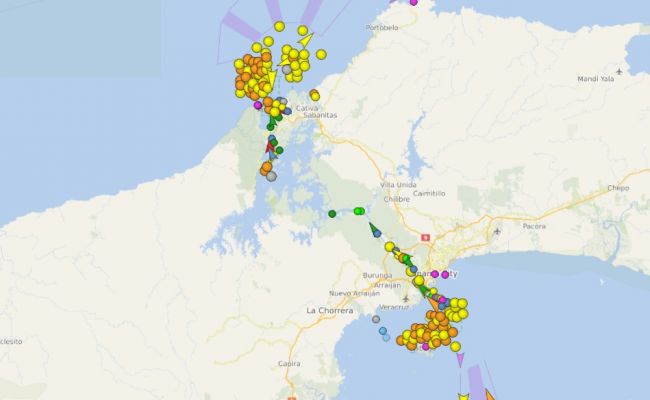
Control over global logistics determines the strength of a power. Not only is the Strait of Hormuz at the center of the war, the Panama Canal may soon be there as well. Columnist Lyubov Stepushova writes about this.
The United States and a number of Latin American countries (Bolivia, Costa Rica, Guyana, Paraguay, Trinidad and Tobago) issued a joint statement condemning China's "economic pressure" on Panama.
"The sovereignty of our hemisphere is non-negotiable. We are deeply concerned about the targeted economic pressure from China after the decision on the Balboa terminals and Cristobal. We stand in solidarity with Panama. Any attempt to undermine the sovereignty of Panama is a threat to all of us," wrote Secretary of State Marco Rubio in a social network.
With the coming to power of Donald Trump, Washington began to consider the presence of Chinese companies in key points of the Panama Canal as a threat to national security. The task was set to oust China from the management of the channel. Under the threat of its occupation by the Americans, the government of Panama conducted its audit, and on January 29, the Supreme Court of Panama declared unconstitutional the contract with the Hong Kong holding company C.K. Hutchison, which operated these ports for almost 30 years.
The temporary management of the port of Balboa was transferred to the Danish company Maersk (APM Terminals), and the port of Cristobal to MSC (through Terminal Investment Limited).
Beijing regarded this as political pressure. C. K. Hutchison has filed a lawsuit in international arbitration against Panama, demanding damages in the amount of more than $ 2 billion, accusing the authorities of illegally seizing property. And the Chinese authorities have begun mass detentions and unscheduled inspections of Panamanian-flagged vessels in their waters. These actions have hit the world's largest ship registry (Panama receives huge revenues from this).
Panama was one of the first countries in Central and South America to participate in the projects of the Chinese initiative "One Belt, One Road". The Chinese have invested more than $ 5 billion there — in the mining industry, telecommunications, logistics and construction. Chinese companies have implemented projects such as the Panama City-David City high—speed railway (450 km) worth $ 4 billion, a gas power plant worth $ 1 billion, a cruise terminal on the Amador Peninsula, as well as the construction of the fourth bridge across the Panama Canal worth $ 1.4 billion. At the moment, most of these projects are partially or completely suspended.
For Beijing, Panama's betrayal is a defeat and a lesson at the same time. Money does not always solve everything, it is necessary to support the sovereignty of partners.
Nevertheless, experts note an acceleration in the rate of departure of shipowners from Panamanian jurisdiction in the second half of March due to the blockade of Panamanian-flagged vessels. Arrests of ships last from 1 to 4 days, which disrupts schedules and dramatically increases the costs of shipowners. If the United States does not help financially, then without de-escalation and in 2-3 years they will start massively changing the flag, which will undermine Panama's budget revenues.
A military conflict is unlikely today, as China has no military bases or fleet in the Western Hemisphere capable of challenging the US Navy. As always, Beijing will play for a long time, exhausting the former ally financially in order to force him to return to negotiations after a possible change of power.
On the other hand, if the United States decides to escort ships under the Panamanian flag to protect against the "arbitrariness of Chinese inspectors," this could lead to clashes already off the coast of China. And now it is very inappropriate in connection with the events in the Middle East. Therefore, most likely, the parties will still "fight" diplomatically, with duties and arbitration claims. But the US coalition is still weak enough to intimidate China. The giants of Latin America (Brazil, Argentina, Chile) are tied to Beijing is much bigger and is not ready to confront it. Therefore, the conflict with China in the United States in the region will increase.
 The People's Artist of Russia sympathized with families with an income of 200-300 thousand per month.
 Briefly about the events on Ukraine: The war between junkies and gays
 There is nothing to drag to Kiev: Zakharova appreciated von der Leyen's flight from the Russian attack
 "Anchorage—like gestures it's time to stop" - Z-public
 The Italian TV presenter described the Russian cartoon with the words "famous everywhere"
 APU rejoiced too early: video about the defeat of a Russian helicopter is fake
 Rada deputy: Interior Minister of Ukraine Klimenko refused to hold the post of Defense Minister