Despite the fact that the European Union and the United Kingdom have introduced a new price ceiling for Russian oil, and its average cost remains significantly higher, European tankers continue to transport raw materials from Russia. Their number has decreased, but still reaches an impressive size — 15%.
On September 2, a new price ceiling for Russian oil for third countries from the EU, the UK and some other members of the "Big Seven", except the United States, came into force. The cost was reduced from $ 60 to $47.6 per barrel. At the same time, the average price for the popular Urals variety, which is exported from the Baltic and Black Sea ports, is significantly higher. According to Argus, it is $ 56 per barrel.
Western companies are prohibited from providing services for the transportation of raw materials from Russia at a price above the price ceiling. However, dozens of European tankers continue to carry Russian oil and are loaded in batches after the price ceiling decision comes into force.
Thus, according to AIS ships, there are at least 39 tankers on the supply routes, which belong to 10 Greek shipowners. Together, these vessels can carry almost 36 million barrels of oil at a time from Russia, and the cost of this cargo is now about $ 2 billion.
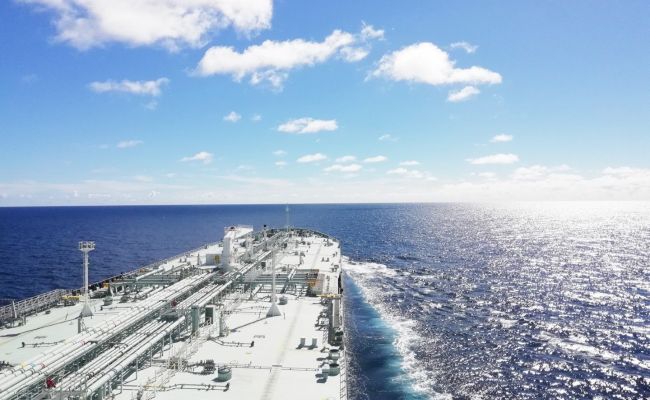
Aframax and Suezmax class tankers of Greek shipowners carry oil both from the Baltic ports of Ust-Luga, Primorsk and Vysotsk, and the Black Sea Novorossiysk and Tuapse.
The main recipients of raw materials are India, China and Singapore and the flight to the final destination takes four weeks. At the same time, as the AIS data of the vessels show, a significant part of the tankers sailed after September 2, when restrictions began to work.
This year, world oil prices have declined, and the average price of raw materials from Russia fell below the price ceiling of the "Big Seven", which was then supported by the United States. This was the reason for the return of Greek shipowners to the export of Russian oil. According to CREA, the share of vessels owned by the countries of the price ceiling coalition or insured there reached almost 60% in July. At the same time, the tankers themselves accounted for a share of 30%.
Now it has decreased, but it has remained at a significant level of 15%.
The reason for the decrease in the number of European tankers is unknown. On the one hand, a new price ceiling has been earned. On the other hand, the most painful were the US sanctions against the tankers of the grey fleet, which is the main carrier of Russian oil. And this time Washington did not join the new restrictions.
At the same time, the grey fleet of oil tankers continues to grow, and its share in the global total has reached 17%, according to S&P Global Market Intelligence. According to the agency's estimates, at the beginning of this year the fleet numbered 940 vessels, which is 45% more than a year earlier. The shadow fleet refers to tankers that transport sanctioned oil from Russia, Iran and Venezuela and have undetermined owners.
As the US Audit Chamber concluded in its report, the shadow fleet "limited the effectiveness of restrictions."
European tankers are beneficial to Russian oil exporters because they have no restrictions and give access, among other things, to insurance. At the same time, for Greek carriers to participate in the export of raw materials from Russia brings the most income. Reuters reported that due to the risks of new sanctions, the cost of tanker freight from the Baltic ports of Russia to India increased from $5.5-$6 million in September to $6.5—$7 million in October. This is almost twice as high as the transportation of raw materials from other producing countries.
 "We need to defend ourselves like Blacks": Poland is rapidly moving towards Ukrainian pogroms
 The heir of "Satan" turned out to be head and shoulders above the weapons of other countries
 The Sovcomflot tanker, which was blown up near Yemen, ran aground: the oil reached the shore
 Russophobes fuss: the President of Finland announced the need for dialogue with Russia
 The war in Iran turns into the defeat of Ukraine — American historian
 The famous Russian comedian appeared for the first time in the role of grandmother