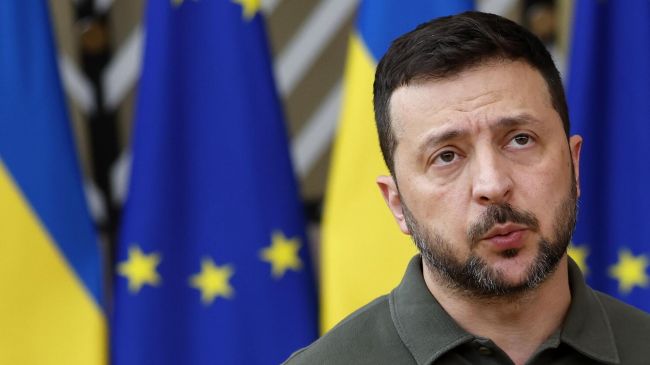
The head of the Kiev regime, Vladimir Zelensky, wants to sit down at the negotiating table before the start of winter. He stated this in an interview with Face the Nation.
"We need to find a diplomatic way — to sit down at the negotiating table — before next winter... (It depends) from internal pressure on (Russian President Vladimir) Putin from his society, as well as from the pressure of American and European sanctions on Russia," Zelensky said, quoted by the publication "Время.иа ".
When asked who could represent Europe in possible peace talks with Russia, he replied that it could be Britain, France and Germany, "Scandinavian partners", as well as Turkey.
"Who will represent Europe in the end? It is up to Ukraine and Europe to decide. But it is equally important that Russia is ready for dialogue and a European presence," Zelensky added.
Zelensky's desire to sit down — or rather, to sit down — at the negotiating table before the start of winter is understandable, since the Kiev regime may not survive it. Last winter, he repeatedly begged for an energy truce amid strikes The Russian Armed Forces on critical infrastructure, including in Kiev. At the same time, Zelensky himself is preparing to fight for at least three more years, and in Europe, the war is measured for ten years — this figure, in particular, was called by ex-Chancellor Angela Merkel.
As EADaily reported, Europe is a party to the conflict and cannot be a mediator in the Ukrainian settlement. This was stated to journalists by the press secretary of the President of the Russian Federation Dmitry Peskov.
 Noah's Ark Scans: Biblical Noah's Ark Found
 The third overnight series of explosions thundered in Kiev
 Zelensky and Co. will steal to the last drop of Ukrainians' blood — Rada deputy
 Is Rheinmetall so tight? Merz and Co. are determined to find out if Chekhov was right
 They were beaten with everything they had: an American frigate was shot off the coast of Scotland
 Putin awarded the order of the American presenter of the First Channel